
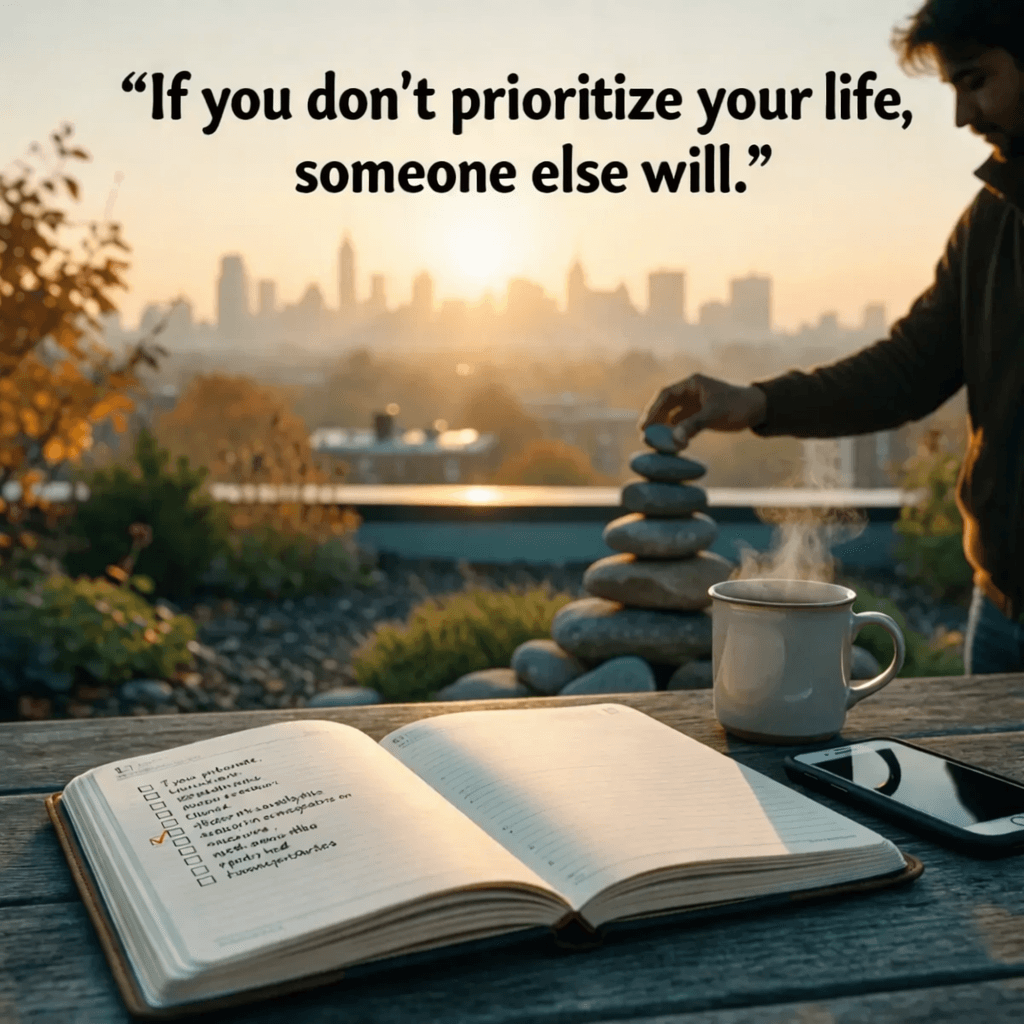
If you don't prioritize your life, someone else will. — Greg McKeown
—What lingers after this line?
The Core Warning Behind the Quote
Greg McKeown’s line is less a motivational slogan than a blunt prediction about how time gets allocated. If you don’t decide what matters most—your health, relationships, craft, or values—other people and systems will happily decide for you, usually in ways that serve their needs first. In that sense, “someone else will” isn’t always malicious; it’s simply how incentives work. From here, the quote invites a shift from vague intention to deliberate design. Prioritizing your life means choosing what you will protect, what you will pursue, and what you will decline, before external demands fill every open space.
How Other People’s Agendas Take Over
Once you leave priorities undefined, the default becomes reactivity: the loudest email, the most urgent request, the meeting that “can’t be moved.” Over time, this creates a life built from other people’s preferences—an employer’s targets, a family member’s expectations, a friend’s last-minute needs—stitched together without an underlying plan. This is why the takeover often feels gradual rather than dramatic. One small “sure, I can do that” leads to another, until your calendar becomes evidence not of your goals, but of your availability.
The Psychology of Saying Yes Too Often
It’s rarely ignorance that prevents prioritization; more often it’s the emotional cost of boundaries. People-pleasing, fear of missing out, and anxiety about disappointing others can make “yes” feel safer than “no,” even when the yes is expensive. Social conditioning also plays a role: many workplaces reward responsiveness, and many families equate compliance with love. Consequently, prioritizing your life can trigger discomfort at first. Yet that discomfort is often the price of clarity, because it reveals the gap between what you value and what you’ve been funding with your time.
Boundaries as a Form of Self-Respect
To prioritize your life is to treat your time and attention as nonrenewable resources. That means creating boundaries—limits on access, commitments, and emotional labor—so that what matters most isn’t perpetually postponed. A practical way to see this is that every “yes” is a contract; if you sign contracts casually, you shouldn’t be surprised when your schedule is owned by others. Importantly, boundaries aren’t hostility; they’re guidance. They teach people how to work with you and what you are willing to trade, making your relationships and responsibilities clearer rather than colder.
Designing a Life Around Essentials
After boundaries comes construction: deciding the few essentials that deserve prime placement. McKeown’s broader work in Essentialism (2014) argues that disciplined selection—choosing less but better—is the route to meaningful contribution. In everyday terms, this might look like blocking time for deep work before meetings, scheduling exercise as an appointment, or protecting evenings for family rather than leaving them to chance. As these choices become routine, your priorities stop being aspirational statements and start becoming visible patterns. What you repeatedly protect becomes your real life, not just your intended one.
A Sustainable Way to Reclaim Control
Finally, the quote points toward an ongoing practice, not a one-time overhaul. Priorities drift as roles change, so reclaiming your life requires periodic renegotiation: reviewing commitments, pruning outdated obligations, and re-centering on what matters now. Small rituals—weekly planning, a “not-to-do” list, or a default response like “Let me check and get back to you”—create breathing room for better decisions. Over time, the payoff is not merely productivity but authorship. Instead of living as a resource to be allocated by others, you become the curator of your attention, and your days begin to reflect your values with increasing accuracy.
One-minute reflection
What's one small action this suggests?
Related Quotes
6 selectedYou can do anything but you can't do everything. Prioritize what truly matters, and allow yourself some breathing room. It's okay to pace yourself. — Blurt It Out
Blurt It Out
At its core, this quote begins with a simple but liberating truth: capability is not the same as endless capacity. A person may be talented, willing, and hardworking, yet still unable to carry every task, obligation, and...
Read full interpretation →We don't drift into good directions. We discipline and prioritize ourselves there. — Andy Stanley
Andy Stanley
Andy Stanley’s quote challenges a comforting illusion: that a meaningful life will naturally sort itself out if we simply keep moving. Instead, he argues that good directions are rarely accidental.
Read full interpretation →Sometimes what you don't do is just as important as what you do. — Leo Babauta
Leo Babauta
At first glance, Leo Babauta’s observation seems simple, yet it points to a deeper truth: our lives are shaped not only by action but also by omission. Every time we decline a distraction, postpone a reactive comment, or...
Read full interpretation →An intentional life embraces only the things that will add to the mission of significance. — John C. Maxwell
John C. Maxwell
John C. Maxwell’s line reframes life as a deliberate design rather than a default drift.
Read full interpretation →Part of my identity is saying no to things I don't want to do. — Lady Gaga
Lady Gaga
Lady Gaga’s line doesn’t treat refusal as a minor social skill; it elevates it into something constitutive. By saying that “part of my identity” is saying no, she implies that the self isn’t only expressed through what w...
Read full interpretation →Doing less is not a sign of laziness but a necessary condition for doing things well. — Cal Newport
Cal Newport
Cal Newport’s line challenges a common cultural reflex: equating busyness with virtue. By arguing that doing less is a “necessary condition,” he treats restraint not as a personality trait but as a prerequisite for excel...
Read full interpretation →More From Author
More from Greg McKeown →