
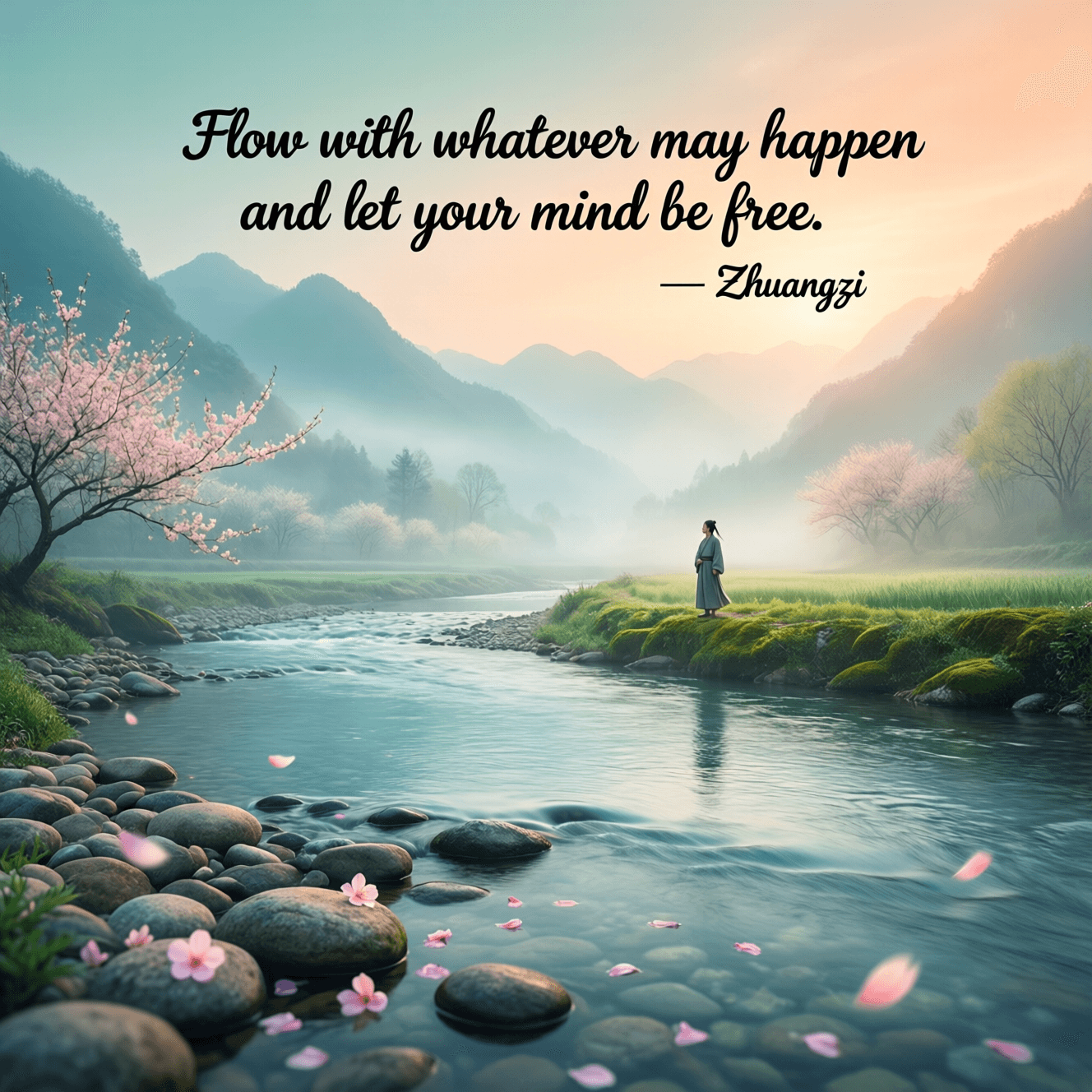
Flow with whatever may happen and let your mind be free. — Zhuangzi
—What lingers after this line?
A Daoist Invitation to Release Control
Zhuangzi’s line reads like a gentle instruction: stop tightening your grip on how things should go, and meet life as it actually arrives. In Daoist thought, insisting on control often creates the very tension we hope to avoid, because it pits the mind’s preferences against the world’s constant motion. From there, “flow with whatever may happen” doesn’t mean passivity so much as a willingness to cooperate with change. The moment you stop treating uncertainty as a personal threat, experience becomes less of a battle to win and more of a current to navigate.
What “Flow” Means in the Zhuangzi
In the Zhuangzi (c. 4th–3rd century BC), flowing aligns with following the Dao—the natural way things unfold—rather than forcing outcomes through rigid judgments. Zhuangzi often undermines fixed categories, showing how quickly certainty flips when circumstances shift, and how clinging to a single viewpoint narrows the soul. Consequently, to “flow” is to stay responsive: to adjust your stance, your timing, even your self-concept as conditions change. This responsiveness is not a lack of principles; it’s a refusal to confuse principles with inflexibility.
Letting the Mind Be Free From Rigid Labels
The second half—“let your mind be free”—points inward, to the habits that imprison attention: compulsive evaluation, comparison, and the urge to narrate every moment as success or failure. Zhuangzi’s writing repeatedly suggests that suffering intensifies when the mind hardens into a single story about what is good, bad, dignified, or shameful. As a result, freedom begins when we loosen our reliance on labels and allow experiences to be complex, mixed, and unfinished. The mind becomes more spacious—not because problems vanish, but because they no longer define the entire horizon.
Skillful Spontaneity in Everyday Life
Daoist freedom often looks like skillful spontaneity: acting with the situation instead of against it. A simple example is a conversation that turns unexpectedly serious; rather than forcing a planned tone, you follow what’s present—listening longer, speaking more carefully, letting the interaction become what it needs to be. In that way, “flow” becomes practical: you still bring effort, but you direct it toward attunement rather than domination. Over time, this cultivates an ease that others may mistake for luck, when it is really practiced adaptability.
Modern Parallels: Acceptance and Psychological Flexibility
Although Zhuangzi speaks in ancient metaphors, the core insight echoes modern ideas about psychological flexibility. Approaches like Acceptance and Commitment Therapy emphasize allowing thoughts and feelings to arise without being commandeered by them, then choosing actions aligned with values (Hayes, Strosahl, & Wilson, 1999). Seen through this lens, “let your mind be free” does not require emptying the mind; it requires disentangling from it. You can notice worry without obeying it, and notice desire without being driven blindly by it.
Freedom With Limits: Flow Is Not Indifference
Finally, Zhuangzi’s counsel is often misunderstood as a call to drift through life unconcerned. Yet flow does not erase responsibility; it reframes it. You still make choices, but you make them without the extra burden of insisting the world validate your expectations. Therefore, the deeper promise of the quote is a calmer kind of agency: you respond wholeheartedly while staying untrapped by outcomes. When change comes—as it will—you meet it with a mind that can move, rather than a mind that must break.
One-minute reflection
Where does this idea show up in your life right now?
Related Quotes
6 selectedFlow with whatever may happen and let your mind be free. Stay centered by accepting whatever you are doing. This is the ultimate. — Zhuangzi
Zhuangzi
This quote emphasizes the importance of accepting and adapting to life's circumstances. By flowing with whatever happens, one can maintain a sense of peace and equilibrium.
Read full interpretation →Go with the flow of life, because the best things come when you least expect them. - Anonymous
Unknown
This quote encourages an acceptance of life's unpredictability. By going with the flow, one stays open to unforeseen opportunities and positive experiences.
Read full interpretation →Impermanence is the only permanent thing in life. Embrace change with open arms. — Thich Nhat Hanh
Thich Nhat Hanh
Thich Nhat Hanh’s timeless message begins with an acknowledgment of life’s ever-shifting landscape. The idea that ‘impermanence is the only permanent thing’ underscores the Buddhist principle that everything is in a stat...
Read full interpretation →Before complaining that you are a slave to another, be sure that you are not a slave to self. — James Allen
James Allen
James Allen’s warning begins with a reversal: the most immediate master may not be another person, institution, or circumstance, but one’s own impulses. Before condemning external control, he asks us to examine whether a...
Read full interpretation →I wanted a perfect ending. Now I've learned, the hard way, that some poems don't rhyme, and some stories don't have a clear beginning, middle, and end. — Gilda Radner
Gilda Radner
Gilda Radner’s quote begins with a deeply human wish: the desire for a perfect ending. Most people instinctively want life to resemble a well-made story, with conflicts resolved, wounds explained, and every emotional thr...
Read full interpretation →The human soul doesn't want to be advised or fixed or saved. It simply wants to be witnessed. Exactly as it is. — Parker J. Palmer
Parker J. Palmer
At its core, Parker J. Palmer’s line shifts attention away from problem-solving and toward presence.
Read full interpretation →More From Author
More from Zhuangzi →To a mind that is still, the whole universe surrenders. — Zhuangzi
Zhuangzi’s line reframes power: instead of conquering the world through effort, it suggests that the world “surrenders” when the mind stops thrashing against it. The surrender here is not literal submission but a shift i...
Read full interpretation →Flow with whatever may happen and let your mind be free. Stay centered by accepting whatever you are doing. This is the ultimate. — Zhuangzi
This quote emphasizes the importance of accepting and adapting to life's circumstances. By flowing with whatever happens, one can maintain a sense of peace and equilibrium.
Read full interpretation →Well-being is realized by small steps, but is truly no small thing. — Zhuangzi
Zhuangzi’s saying reminds us that personal harmony and happiness aren’t the result of sudden transformation but rather a collection of small, mindful actions over time. This echoes the sentiment of Laozi in the *Tao Te C...
Read full interpretation →