
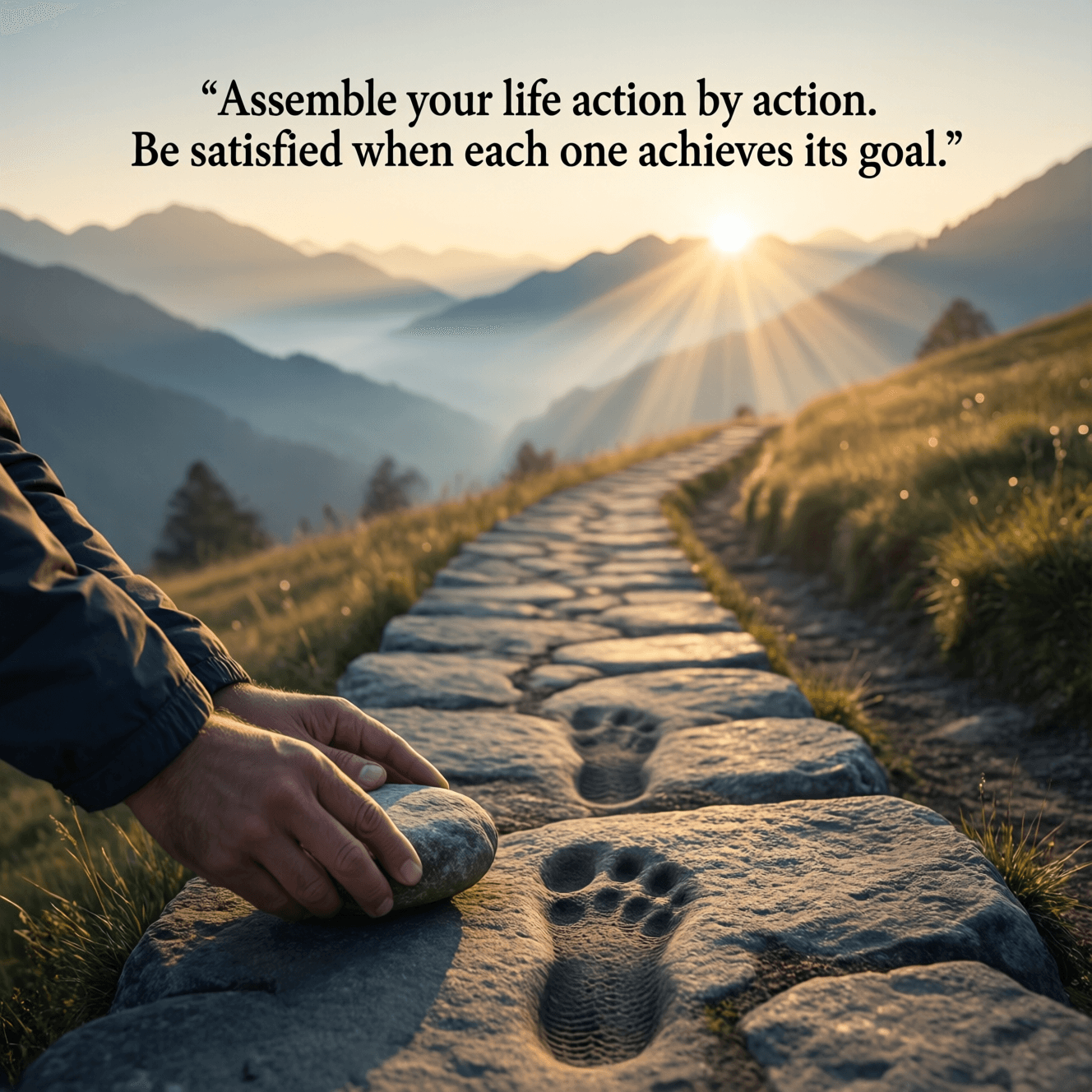
Assemble your life action by action. Be satisfied when each one achieves its goal. — Marcus Aurelius
—What lingers after this line?
Life as a Sequence of Chosen Acts
Marcus Aurelius reframes life not as a grand plan to be solved all at once, but as something constructed moment by moment through deliberate behavior. Rather than waiting for a perfect future version of yourself, you “assemble” your character and circumstances by what you do today, then tomorrow, then the day after. This viewpoint fits the spirit of Stoicism in Aurelius’ Meditations (c. 170–180 AD), where attention repeatedly returns to what is in your control: your judgments, intentions, and actions. Seen this way, a life well lived is not a single achievement but an accumulation of well-aimed choices.
Clarity of Purpose for Each Step
The line “action by action” implies more than staying busy; it suggests selecting actions with a clear purpose. Each task becomes a small moral and practical decision: What is the proper thing to do now? What serves duty, relationships, or health in this moment? From there, the quote quietly challenges drift. If actions are undertaken without a goal—whether that goal is learning, helping, earning, or healing—then the day becomes noise. By contrast, a goal gives even ordinary work a direction, letting daily life feel like progress rather than mere motion.
Satisfaction Through Completion, Not applause
Aurelius then adds a demanding standard: “Be satisfied when each one achieves its goal.” The satisfaction he describes is internal and specific, tied to doing the action well and finishing what it was meant to accomplish—not to praise, status, or dramatic outcomes. In this light, contentment becomes a practice of measuring success by fidelity to intention. If the goal of a conversation is honesty and kindness, you can judge your success immediately; if the goal of exercise is consistency, you can be satisfied by showing up. This shifts fulfillment from external validation to the integrity of execution.
Breaking Overwhelm Into the Next Right Move
Because the quote narrows attention to the present action, it also offers a method for dealing with overwhelm. Large worries—career uncertainty, family conflict, personal change—often feel unmanageable precisely because they appear as a single, intimidating mass. Yet when you translate the problem into a next step with a defined goal, it becomes workable. A student doesn’t “master the entire subject” today; they complete one set of problems correctly. A person rebuilding trust doesn’t “fix everything” in one talk; they follow through on one promise. The life is assembled in these manageable units.
Discipline, then Peace of Mind
Finally, the quote suggests a path from discipline to peace: act, complete, then release. Stoic calm is not passivity; it’s the result of applying effort where it matters and letting go where it doesn’t. Once an action has met its goal, rumination becomes optional rather than compulsory. Over time, this approach builds a steady identity: someone who chooses well, finishes well, and doesn’t require endless reassurance. The resulting life may not look perfect from the outside, but it becomes coherent from the inside—assembled carefully, one completed intention after another.
One-minute reflection
What does this quote ask you to notice today?
Related Quotes
6 selectedOrder your thoughts, then set your feet in motion; intention finds its path through action. — Marcus Aurelius
Marcus Aurelius
Marcus Aurelius’ line begins with a simple sequence: first arrange the mind, then move the body. In Stoic terms, this reflects the idea that a well-ordered inner life—clear judgments, realistic expectations, and measured...
Read full interpretation →Stand where your choices align with your highest purpose and act. — Marcus Aurelius
Marcus Aurelius
Marcus Aurelius’ call to “stand” before you act captures a Stoic sequence: orient, then move. In Meditations, he repeatedly ties human flourishing to virtue—living in accordance with reason and the common good (see Medit...
Read full interpretation →Meet each choice with steady purpose; virtue is forged in deliberate acts. — Marcus Aurelius
Marcus Aurelius
Marcus Aurelius frames ethics as a practice, not a proclamation. In Meditations, he returns repeatedly to a single discipline: meet what is before you with calm purpose, and do the next right thing well.
Read full interpretation →When doubt whispers, answer with the steady drum of deliberate action. — Marcus Aurelius
Marcus Aurelius
Doubt rarely arrives as a shout; more often it slips in as a whisper that slows our hands and clouds our will. The image of answering with a “steady drum” suggests not bravado but cadence—an even rhythm that keeps us mov...
Read full interpretation →Shift the ordinary by adding a deliberate, generous act each day. — Zadie Smith
Zadie Smith
Zadie Smith’s line treats the “ordinary” not as a problem to escape but as the most reliable starting point for change. Instead of waiting for a life overhaul, she points to the small terrain we actually inhabit—commutes...
Read full interpretation →Find the bridge between intent and action, and cross it deliberately. — Sun Tzu
Sun Tzu
The quote frames a familiar human problem: intention often feels like progress, yet it can remain safely abstract unless it becomes action. By naming a “bridge,” it implies there is a real gap—made of doubt, distraction,...
Read full interpretation →More From Author
More from Marcus Aurelius →Consistency is the sum that equals what we become. — Marcus Aurelius
Marcus Aurelius’ line frames becoming as a kind of moral mathematics: each repeated action adds to the total of a life. Rather than imagining identity as a single grand decision, the quote suggests that character is accu...
Read full interpretation →If anyone can refute me—show me I'm making a mistake or looking at things from the wrong perspective—I'll gladly change. — Marcus Aurelius
Marcus Aurelius begins from a position that appears modest but is actually deeply disciplined: he is willing to be corrected. Rather than treating disagreement as an insult, he frames it as an opportunity to see more cle...
Read full interpretation →The art of life is more like the wrestler's art than the dancer's; stand ready and firm to meet sudden and unexpected onsets. — Marcus Aurelius
Marcus Aurelius contrasts two arts to clarify what living well demands. A dancer suggests elegance, rhythm, and practiced beauty; a wrestler, by contrast, suggests balance under pressure, resistance, and constant readine...
Read full interpretation →How much time he gains who does not look to see what his neighbour says or does or thinks, but only at what he does himself, to make it just and holy. — Marcus Aurelius
Marcus Aurelius argues that a great deal of life is wasted in watching other people—what they say, what they do, and even what they might be thinking. Instead, he recommends a disciplined inward turn: focus on your own c...
Read full interpretation →