#Deliberate Action
Quotes tagged #Deliberate Action
Quotes: 34

Building a Life One Intentional Action at Time
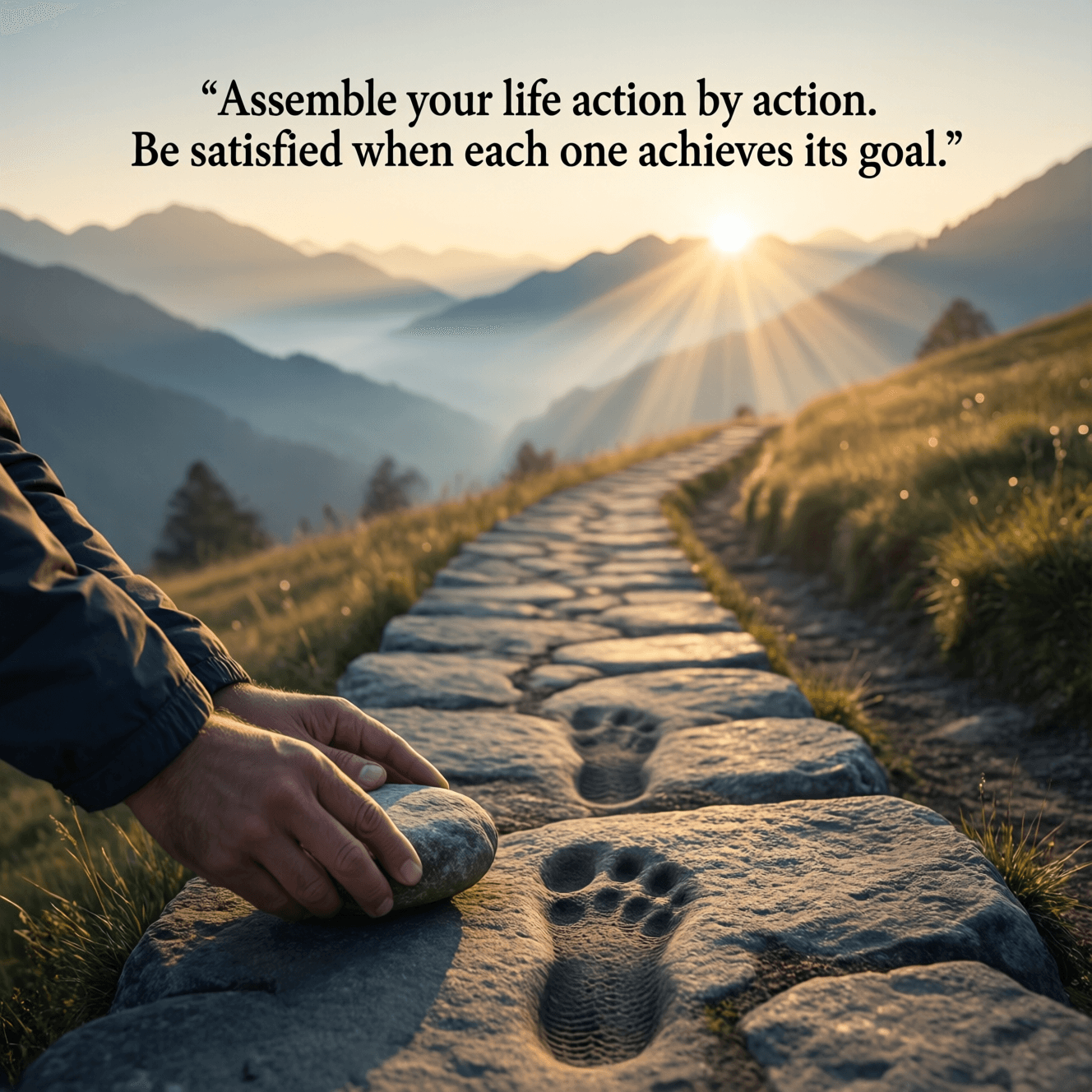
Marcus Aurelius reframes life not as a grand plan to be solved all at once, but as something constructed moment by moment through deliberate behavior. Rather than waiting for a perfect future version of yourself, you “assemble” your character and circumstances by what you do today, then tomorrow, then the day after. This viewpoint fits the spirit of Stoicism in Aurelius’ Meditations (c. 170–180 AD), where attention repeatedly returns to what is in your control: your judgments, intentions, and actions. Seen this way, a life well lived is not a single achievement but an accumulation of well-aimed choices. [...]
Created on: 2/1/2026

Transforming Everyday Life Through Generous Daily Acts
Finally, “generous” need not mean limitless. A daily act can be bounded—sending a thoughtful message, sharing credit, listening without interrupting, donating a small amount, mentoring for ten minutes. The key is the steadiness of the gesture and the sincerity behind it, not its size. In the end, Smith’s idea turns character into a daily craft project. By choosing one deliberate, generous act each day, you don’t merely decorate the ordinary—you gradually rebuild it into a life that feels more awake, more connected, and more worth inhabiting. [...]
Created on: 1/18/2026

How Intention Becomes Real Through Action
To apply the saying, start by ordering thoughts into one sentence: what do I value here, and what is the next right move? Then convert that into an action small enough to begin immediately, because starting is often the only part that requires courage. The path appears as you walk it—new steps become visible only after the first step is taken. Finally, the Stoic flavor of the line reminds you to measure success by fidelity to the process: clear intention, honest effort, and willingness to continue. Outcomes may vary, but the habit of turning thought into motion remains entirely yours. [...]
Created on: 1/11/2026

Crossing from Intent to Deliberate Action
Once deliberateness is established, the bridge often turns out to be surprisingly short: the smallest action that makes the intention real. A writer opens a document and writes a paragraph; a leader schedules the difficult conversation; a student attempts the first problem rather than rereading notes endlessly. Consider an everyday anecdote: someone intends to learn a language for years, but nothing changes until they book a weekly lesson and commit to speaking for ten minutes each day. The “bridge” was not motivation; it was a structure that made action unavoidable. The deliberate crossing was the repeated decision to begin, even when imperfect. [...]
Created on: 1/3/2026

Act With Intention, Leave Regret Behind
The line “regret lives in shadows” suggests that regret thrives where motives were muddled, where decisions were indirect, or where we avoided truth—especially our own. Regret often clings to the places we felt we weren’t fully present: saying yes to avoid conflict, staying silent to keep peace, or acting to impress rather than to serve what mattered. Consider the familiar anecdote of a friend who never told someone they cared, assuming there would be time later. The eventual regret isn’t only about the missed outcome; it’s about the unspoken intention and the failure to act on it. Shadows, in this sense, are the spaces where we let life happen while we remain uncommitted. [...]
Created on: 1/1/2026

Design Tomorrow by Acting Decisively Today
Virginia Woolf’s line reframes “tomorrow” as something we author rather than await. By urging us to write the outline of the future, she implies that what comes next is not a fixed destination but a draft—open to revision, shaped by intention. The phrase “pen of action” makes the metaphor practical: the instrument isn’t wishful thinking or perfect planning, but concrete behavior. From the start, the quote places agency at the center of time. Tomorrow becomes a document that begins forming the moment we choose, decide, and move, suggesting that the future is less discovered than constructed. [...]
Created on: 12/28/2025

Act From Purpose: A Stoic's Steadfast Choice
Marcus Aurelius’ call to “stand” before you act captures a Stoic sequence: orient, then move. In Meditations, he repeatedly ties human flourishing to virtue—living in accordance with reason and the common good (see Meditations 5.1 on doing “the work of a human being”). Thus, “highest purpose” is not a private whim but the alignment of will with what is rational, just, and beneficial to the whole. By beginning with orientation, the Stoic avoids aimless busyness. Purpose sets the vector; action supplies the force. When these converge, the ordinary becomes ethical practice rather than mere activity. [...]
Created on: 11/16/2025