
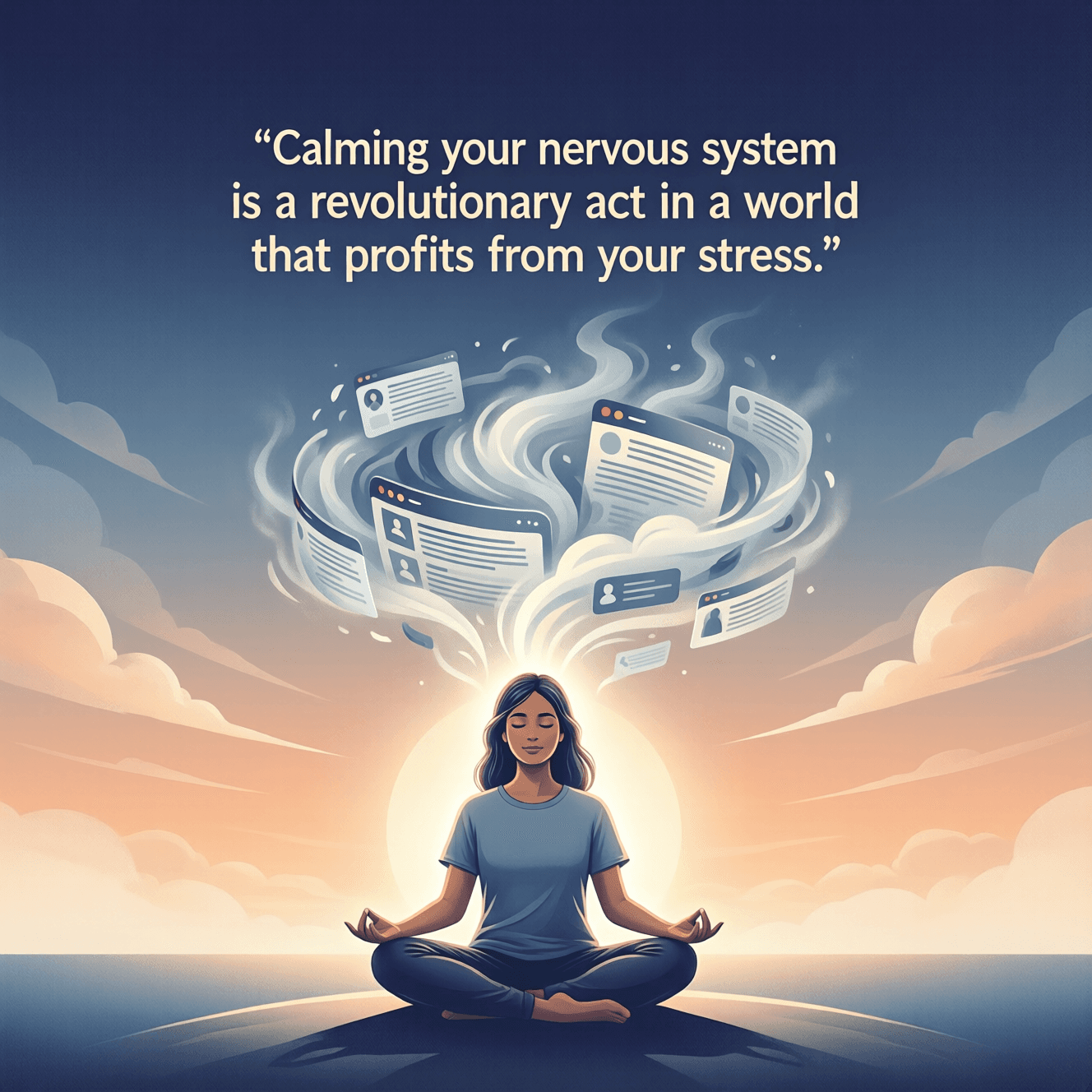
Calming your nervous system is a revolutionary act in a world that profits from your stress. — Unknown
—What lingers after this line?
Why Calm Can Be ‘Revolutionary’
The quote reframes self-regulation as something larger than personal wellness: it becomes a form of resistance. In a culture that normalizes urgency, calming your nervous system interrupts the default rhythm of constant reaction—alerts, deadlines, outrage cycles—and restores the ability to choose your response. That shift can feel revolutionary because it changes what you’re available for: not just more productivity, but more agency. From there, the statement also hints that stress is not merely an accident of modern life but a predictable outcome of systems designed around speed and scarcity. By lowering the body’s alarm signals, you reduce the leverage those systems have over your attention and behavior.
The Nervous System as a Targeted Resource
To understand the claim, it helps to view the nervous system as a kind of internal economy: where attention, energy, and emotional bandwidth are limited resources. Chronic stress biases the body toward threat detection—tight muscles, shallow breathing, quick judgments—making it easier to capture and steer attention. In that state, you may be more impulsive, more persuadable, and less able to sustain complex thinking. Consequently, calming practices—slow breathing, grounding, sleep, movement—do more than “relax” you. They restore higher-order capacities like perspective, patience, and discernment, which are precisely the traits that reduce external control.
How Stress Becomes Profitable
The phrase “profits from your stress” points to a broad ecosystem where anxiety and overload can be monetized. When people feel perpetually behind, they’re more likely to buy quick fixes, overconsume conveniences, and stay engaged with attention platforms that intensify emotion because it sustains clicks and watch time. Even workplace structures can inadvertently reward dysregulation by praising constant availability and conflating busyness with value. In that context, calm becomes disruptive. If you are not easily alarmed, you’re less likely to make fear-based purchases, join outrage-driven cycles, or accept unhealthy norms as inevitable.
From Personal Coping to Collective Power
Next, the quote subtly shifts the frame from individual self-care to social impact. A regulated nervous system supports clearer communication, steadier boundaries, and more consistent participation in community—all prerequisites for collective action. Movements and relationships alike tend to fracture when people operate from chronic activation, because small disagreements escalate and burnout spreads. Put differently, calm is not withdrawal; it can be preparation. By stabilizing your internal state, you become harder to polarize and easier to collaborate with, turning a private practice into a public advantage.
Calm as Boundary, Not Passivity
It’s important, though, that “calming” isn’t mistaken for suppressing anger or accepting injustice. Regulation doesn’t erase emotion; it helps you use emotion skillfully. When you can feel outrage without being hijacked by it, you can aim it—toward strategy, sustained effort, and principled refusal—rather than toward self-destruction or infighting. As a result, calm functions like a boundary: it keeps external pressures from dictating your pace and internal pressures from dictating your choices. That steadiness can look quiet, but it often enables bolder, more durable action.
Everyday Practices That Undermine the Stress Economy
Finally, the quote becomes practical when translated into small, repeatable acts: pausing before responding, taking a longer exhale, going for a walk without a podcast, eating without multitasking, sleeping as a nonnegotiable, or limiting doom-scrolling to a defined window. These are simple moves, yet they reduce the “supply” of your stress that the world can exploit. Over time, such habits create a different baseline—one where you can notice manipulation, resist urgency as a default, and invest your attention deliberately. In that sense, calming your nervous system isn’t escapism; it’s reclaiming the conditions needed for freedom.
Recommended Reading
As an Amazon Associate, we earn from qualifying purchases.
One-minute reflection
What feeling does this quote bring up for you?
Related Quotes
6 selectedRest is not a luxury; it is an act of resistance. — Tricia Hersey
Tricia Hersey
Tricia Hersey’s line overturns a familiar assumption: that rest is something we earn only after proving our productivity. Instead, she frames rest as a deliberate choice that asserts human worth beyond output.
Read full interpretation →The language is the substrate. The architecture is the contract.
Unknown
The line sets up a deliberate pairing: language lies beneath everything, while architecture governs everything above it. In other words, what you can express determines what you can build, and what you commit to structur...
Read full interpretation →A scroll is not a break; it is a trap disguised as rest. — Unknown
Unknown
The quote begins by challenging a familiar story we tell ourselves: that a brief scroll is a harmless pause between tasks. On the surface, it looks like recovery—no effort, no decision, no commitment.
Read full interpretation →Don't let your ice cream melt while you're counting someone else's sprinkles. — Unknown
Unknown
The quote uses ice cream as a simple stand-in for life’s fleeting pleasures: what you have is delicious, but it won’t last forever if you ignore it. Meanwhile, “counting someone else’s sprinkles” captures the habit of mo...
Read full interpretation →If your absence doesn't affect them, your presence never mattered. — Unknown
Unknown
The quote frames absence as a revealing experiment: remove yourself, and the reaction—concern, curiosity, indifference—becomes a kind of data. If nothing changes when you’re gone, it suggests your role was never integrat...
Read full interpretation →No one is coming to save you. This life is 100% your responsibility. Stop waiting for a hero and start being the adult you needed. — Unknown
Unknown
The quote begins with a jolt: “No one is coming to save you.” It isn’t meant to deny kindness or community, but to strip away the comforting fantasy that a single rescuer—an employer, partner, government, or perfectly ti...
Read full interpretation →More From Author
More from Unknown →The language is the substrate. The architecture is the contract.
The line sets up a deliberate pairing: language lies beneath everything, while architecture governs everything above it. In other words, what you can express determines what you can build, and what you commit to structur...
Read full interpretation →A scroll is not a break; it is a trap disguised as rest. — Unknown
The quote begins by challenging a familiar story we tell ourselves: that a brief scroll is a harmless pause between tasks. On the surface, it looks like recovery—no effort, no decision, no commitment.
Read full interpretation →Don't let your ice cream melt while you're counting someone else's sprinkles. — Unknown
The quote uses ice cream as a simple stand-in for life’s fleeting pleasures: what you have is delicious, but it won’t last forever if you ignore it. Meanwhile, “counting someone else’s sprinkles” captures the habit of mo...
Read full interpretation →If your absence doesn't affect them, your presence never mattered. — Unknown
The quote frames absence as a revealing experiment: remove yourself, and the reaction—concern, curiosity, indifference—becomes a kind of data. If nothing changes when you’re gone, it suggests your role was never integrat...
Read full interpretation →