
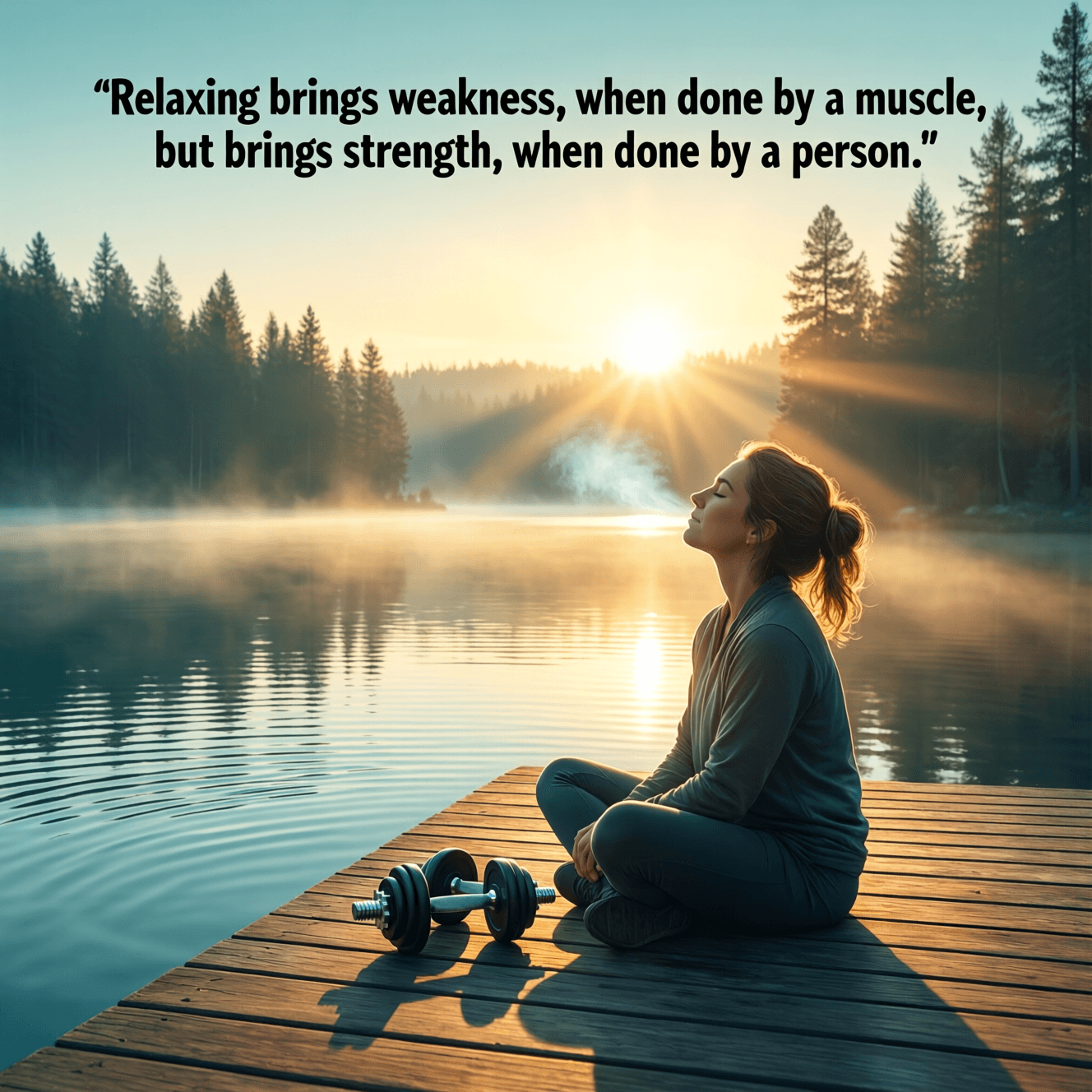
Relaxing brings weakness, when done by a muscle; but brings strength, when done by a person. — Mokokoma Mokhonoana
—What lingers after this line?
A Paradox That Separates Biology From Living
Mokokoma Mokhonoana frames relaxation as a paradox: the same act can degrade a muscle while renewing a person. The line works because it forces a distinction between a body part governed by simple use-and-adaptation rules and a whole human being who must manage attention, emotion, and meaning. From there, the quote invites a broader view of “strength.” Muscles tend to measure strength in immediate output—force, endurance, performance—whereas people measure it in capacities like patience, judgment, resilience, and creativity. Relaxation can reduce one kind of strength in the short term while building another that is harder to see but vital for a life well lived.
Why Muscles Weaken When They Rest Too Long
At the physiological level, muscle tissue follows a “use it or lose it” pattern. When a muscle isn’t challenged, the body has little reason to maintain its size and metabolic expense, so strength and mass can decline through detraining or atrophy. This is why prolonged immobilization after an injury often leads to noticeable weakness even when someone feels otherwise healthy. Yet this isn’t a moral failing of rest; it’s an efficiency strategy of biology. Muscles adapt specifically to the demands placed on them, and relaxing removes that demand. Seen this way, Mokhonoana’s first clause is simply the logic of adaptation: relaxation, for a muscle, is reduced stimulus—and reduced stimulus can mean reduced capacity.
Why People Grow Stronger Through Rest
Shifting from tissue to personhood, relaxation can restore the systems that enable effective action. Sleep and downtime support learning, emotional regulation, and the replenishment of attention—so the “strength” gained is often mental and behavioral: clearer thinking, steadier mood, and better impulse control. In other words, a relaxed person may become more capable precisely because their internal resources are no longer depleted. Moreover, rest creates space to metabolize experience. After stress, the mind needs quiet to integrate what happened, reassess priorities, and return to challenges with a wider perspective. That renewed perspective can look like strength: the ability to choose responses rather than react automatically.
Recovery Is Where Both Kinds of Strength Are Built
The apparent contradiction softens once we remember that muscles also become stronger because of rest—just not from rest alone. Training causes micro-damage and fatigue, and recovery is the period when repair and adaptation occur; however, if recovery is all we do, the stimulus disappears and strength fades. So for muscles, relaxation is helpful only when paired with deliberate effort. Likewise, people benefit most when relaxation alternates with meaningful exertion. Work without rest leads to burnout; rest without engagement can drift into stagnation. Mokhonoana’s insight points to the rhythm that sustains both: challenge followed by recovery, action followed by renewal.
Different Meanings of “Weakness” and “Strength”
Another way to read the quote is as a warning about category errors. Muscle weakness is measurable in performance—how much weight can be lifted or how long an effort can be sustained. Human weakness, however, often shows up as fragility: irritability, poor decisions, reduced empathy, or a shrinking tolerance for uncertainty. Relaxation can reduce that fragility by widening the gap between stimulus and response. Consequently, a person can become “stronger” while doing less in the gym sense, because the strength being built is self-command. That kind of strength doesn’t always look dramatic; it looks like calm follow-through, better boundaries, and the capacity to handle difficulty without breaking.
Putting the Insight Into Daily Practice
Practically, the quote suggests designing rest as a tool rather than treating it as a reward or a lapse. For the body, that means balancing relaxation with enough activity to keep muscles challenged—especially through consistent, progressive movement. For the person, it means protecting recovery that restores decision-making and emotional steadiness: sleep, quiet time, unstructured play, or a walk that lets the mind reset. Ultimately, Mokhonoana is pointing to a mature definition of strength. If strength includes durability, clarity, and the ability to meet life with presence, then relaxation is not indulgence but maintenance. Muscles may need stimulus to stay powerful, but people often need rest to stay whole.
One-minute reflection
What feeling does this quote bring up for you?
Related Quotes
6 selectedRelaxing brings weakness to a muscle, but strength to a person. — Mokokoma Mokhonoana
Mokokoma Mokhonoana
Mokokoma Mokhonoana frames relaxation as a paradox: what looks like decline in one domain can be growth in another. A resting muscle may lose a bit of conditioning, yet the person behind the muscle can gain clarity, pati...
Read full interpretation →Everything you do can be done better from a place of relaxation. — Stephen C. Paul
Stephen C. Paul
At its heart, Stephen C. Paul’s quote argues that relaxation is not laziness but a higher state of effectiveness.
Read full interpretation →Relaxing brings weakness to a muscle, but strength to a person. — Mokokoma Mokhonoana
Mokokoma Mokhonoana
Mokokoma Mokhonoana frames relaxation as a paradox: it can diminish a muscle’s capacity while improving a person’s resilience. At first glance, this sounds like a simple warning against inactivity, yet the quote is more...
Read full interpretation →It is nice when I have days off to go home and relax and literally take the weight off my shoulders and enjoy the simple things. — Michael B. Jordan
Michael B. Jordan
At its heart, Michael B. Jordan’s reflection presents rest not as laziness, but as a vital form of release.
Read full interpretation →It is a good idea always to do something relaxing prior to making an important decision in your life. — Paulo Coelho
Paulo Coelho
Paulo Coelho’s remark begins with a simple but powerful premise: important decisions are rarely improved by agitation. When the mind is tense, it tends to confuse urgency with clarity, pushing us toward choices made out...
Read full interpretation →The ultimate luxury is being able to relax and enjoy your home. — Billy Baldwin
Billy Baldwin
Billy Baldwin’s remark shifts the idea of luxury away from expensive objects and toward a deeply personal experience: ease. Rather than defining wealth by grand décor or rare materials, he suggests that true refinement a...
Read full interpretation →More From Author
More from Mokokoma Mokhonoana →People can't drive you crazy if you don't give them the keys. — Mokokoma Mokhonoana
At first glance, Mokokoma Mokhonoana’s line turns emotional distress into a vivid image: other people can only ‘drive’ you crazy if you hand over the keys. The metaphor suggests that influence is not always forced upon u...
Read full interpretation →Relaxing brings weakness to a muscle, but strength to a person. — Mokokoma Mokhonoana
Mokokoma Mokhonoana frames relaxation as a paradox: it can diminish a muscle’s capacity while improving a person’s resilience. At first glance, this sounds like a simple warning against inactivity, yet the quote is more...
Read full interpretation →The wise rest at least as hard as they work. — Mokokoma Mokhonoana
Mokokoma Mokhonoana’s line reframes wisdom as something more practical than intelligence or ambition: the wise treat rest with the same seriousness they give to effort. Rather than seeing downtime as a reward for finishi...
Read full interpretation →Relaxing brings weakness to a muscle, but strength to a person. — Mokokoma Mokhonoana
Mokokoma Mokhonoana frames relaxation as a paradox: what looks like decline in one domain can be growth in another. A resting muscle may lose a bit of conditioning, yet the person behind the muscle can gain clarity, pati...
Read full interpretation →