
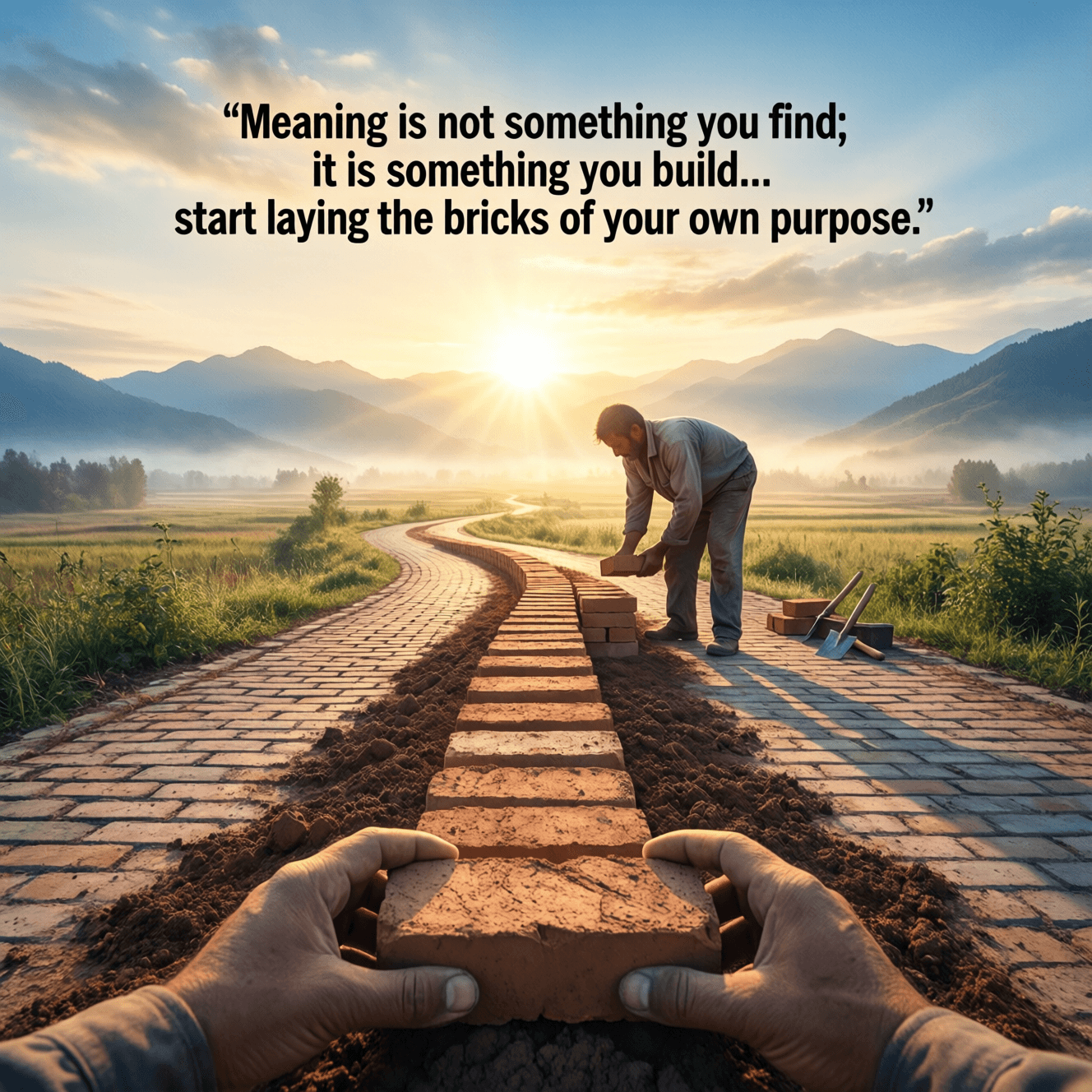
Meaning is not something you find; it is something you build. Stop waiting for a sign and start laying the bricks of your own purpose. — Viktor Frankl
—What lingers after this line?
Meaning as Construction, Not Discovery
Frankl’s line overturns a familiar hope—that life’s purpose is hidden somewhere, waiting to be uncovered like a buried artifact. Instead, he frames meaning as something made, assembled through choices and commitments over time. That shift matters because it moves responsibility from fate to the individual, suggesting that purpose is not a passive revelation but an active project. From there, the metaphor of “building” clarifies the process: meaning isn’t usually a single epiphany; it’s a structure erected in stages. Just as a house becomes real only through repeated, tangible work, a meaningful life becomes real through repeated, tangible actions.
The Trap of Waiting for a Sign
If meaning must be built, then waiting for a sign can become a subtle form of postponement. People often delay decisions until they feel perfectly inspired, perfectly certain, or perfectly chosen by circumstances. Yet that search for a confirming signal can quietly drain months or years, because ambiguity is a permanent feature of human life. Frankl’s challenge is therefore practical: stop outsourcing direction to luck, destiny, or mood. In this light, “a sign” is less a gift and more a temptation—to treat inaction as prudence. The quote nudges us to trade the comfort of waiting for the discomfort of beginning.
Laying Bricks: Small Acts With Cumulative Weight
The image of laying bricks emphasizes scale and patience. A single brick seems insignificant, but placed consistently, it becomes a wall; a wall becomes a room; rooms become a home. Likewise, meaning often emerges from ordinary repetitions—showing up for a friend, practicing a craft, caring for health, learning a difficult skill—until those actions add up to an identity you can stand inside. This also reframes motivation: you don’t need to feel “called” before you act. Instead, action can generate clarity. As many creators and caregivers discover, purpose frequently follows discipline, because commitment gives life its contours.
Frankl’s Logotherapy: Purpose Through Responsibility
The quote echoes the core of Viktor Frankl’s logotherapy, developed after his experiences recorded in Man’s Search for Meaning (1946). Frankl argued that humans are driven not primarily by pleasure or power but by a “will to meaning,” and that meaning is found through what we take responsibility for—work, love, and the stance we choose toward unavoidable suffering. In that framework, meaning isn’t a mood and purpose isn’t a prediction; they are responses. Life, Frankl suggests, questions us, and we answer not with theories but with lived commitments. Building meaning, then, is the practice of answering consistently.
Agency Under Constraints: Choosing One’s Attitude
A key tension in Frankl’s thought is that life may restrict our options, sometimes brutally, yet it rarely removes all choice. Even when circumstances narrow, the individual can still decide how to relate to what is happening—what to prioritize, what to refuse, what to protect, and what to hope for. This is where the quote becomes more than motivational language. It implies that purpose is not reserved for ideal conditions; it can be constructed inside imperfect ones. The “bricks” may be smaller during hardship—one honest conversation, one act of endurance, one refusal to become cruel—but they still count as building material.
From Idea to Practice: Designing a Livable Purpose
Once waiting is replaced with building, the next step is choosing what kind of structure you actually want. Purpose becomes more workable when translated into concrete commitments: a few values you will enact, a few people you will be accountable to, and a few activities you will keep returning to even when enthusiasm fades. Over time, these choices create feedback: you learn what energizes you, what serves others, and what you can sustain. In that sense, meaning is not “found” because it is not a single object; it is the lived coherence between what you say matters and what you repeatedly do.
One-minute reflection
What's one small action this suggests?
Related Quotes
6 selectedWrite tomorrow's answer with today's brave pen. — Viktor Frankl
Viktor Frankl
Viktor Frankl’s line—“Write tomorrow's answer with today's brave pen”—compresses two moments into one responsibility. The “answer” belongs to tomorrow, yet the tool that creates it is in our hand now.
Read full interpretation →Refuse to wait for permission to do what you can improve right now. — Viktor Frankl
Viktor Frankl
Viktor Frankl’s line is a direct challenge to passivity: if something is within your power to improve, delaying until you feel “allowed” is often just another form of avoidance. Rather than asking for a green light from...
Read full interpretation →When fear tightens its grip, stretch your hands toward what you want. — Viktor Frankl
Viktor Frankl
Fear tightens by narrowing our field of view, pulling attention toward threats and away from possibilities. In that constriction, our instincts often default to avoidance—delay, distraction, or retreat—which briefly soot...
Read full interpretation →You cannot command things, but you can command yourself. — Michael D. Pollock
Michael D. Pollock
At first glance, Michael D. Pollock’s line draws a sharp boundary between the outer world and the inner one.
Read full interpretation →A boundary is not a wall; it is a door with a lock that you control. — Annie Wright
Annie Wright
At first glance, Annie Wright’s quote corrects a common misunderstanding: people often treat boundaries as acts of distance or punishment, when in fact they are tools of intentional relationship. A wall shuts everyone ou...
Read full interpretation →When you feel like you are at a dead end, remember that you are at a place where you can choose a different path. — Haemin Sunim
Haemin Sunim
At first glance, a dead end feels like failure, as though movement itself has been denied. Yet Haemin Sunim’s insight gently reverses that impression: what seems like a wall may actually be a point of decision.
Read full interpretation →More From Author
More from Viktor Frankl →You are not responsible for your first thought, but you are responsible for your second thought. — Viktor Frankl
At its core, the quotation distinguishes between what arises automatically and what we deliberately endorse. A first thought may be reflexive, inherited, fearful, angry, or conditioned by habit; it appears before moral j...
Read full interpretation →The meaning of life differs from man to man, from day to day and from hour to hour. — Viktor Frankl
Frankl’s sentence immediately resists the idea that life has one universal, static answer. Instead, he frames meaning as something that changes with the individual and even with the passing of time—so what matters most t...
Read full interpretation →Each man is questioned by life; and he can only answer to life by answering for his own life. — Viktor Frankl
Frankl reverses a common assumption: instead of treating life like a puzzle we interrogate for meaning, he frames life as the one doing the asking. In this view, daily events—work demands, relationship conflicts, illness...
Read full interpretation →Act with care, move with purpose, and leave behind a trail people want to follow. — Viktor Frankl
The opening directive—“Act with care”—frames life as something shaped by attention rather than impulse. Care here is not mere gentleness; it is the discipline of considering consequences, especially when other people’s d...
Read full interpretation →