
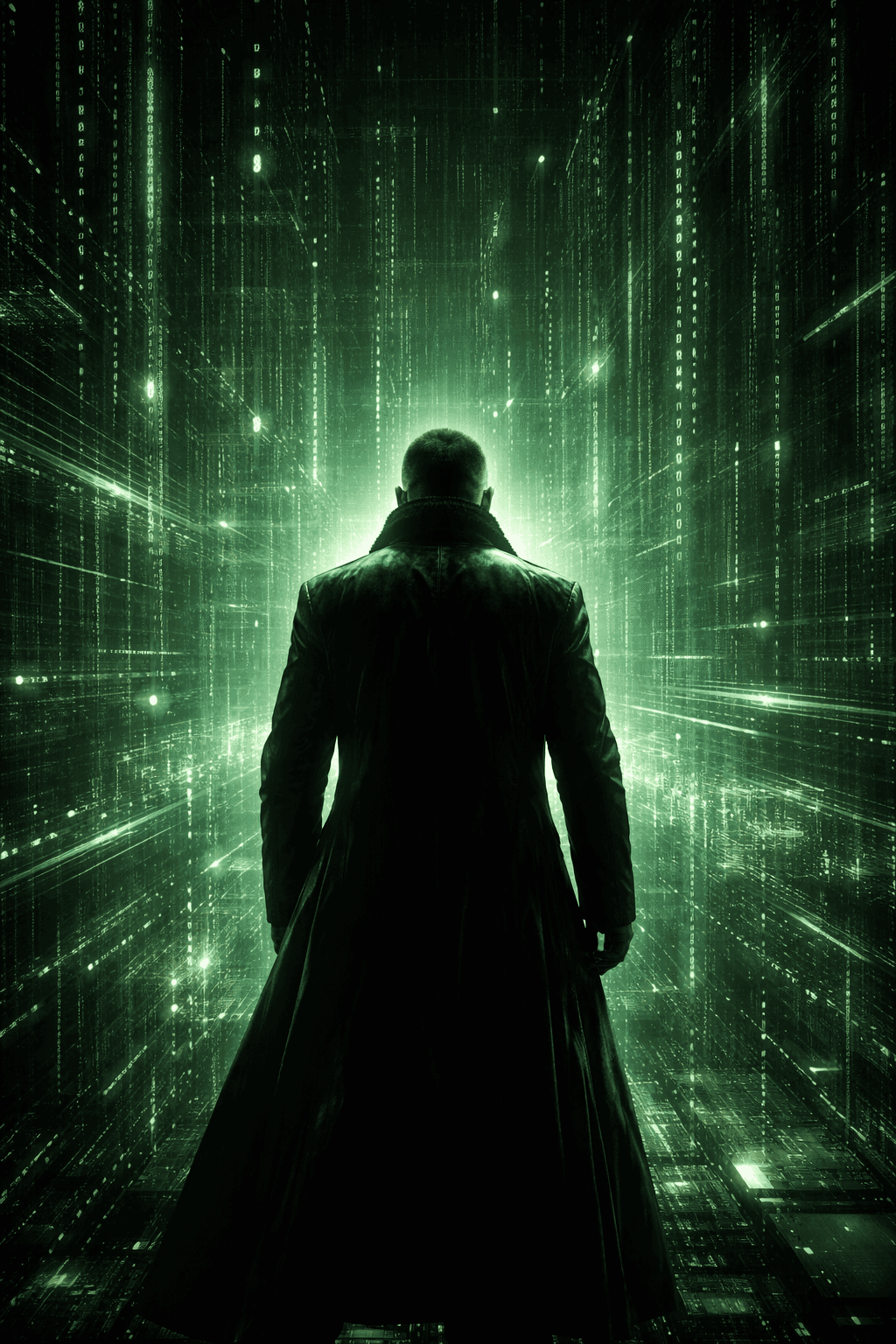
Unfortunately, no one can be told what the Matrix is. You have to see it for yourself. — Morpheus (The Matrix)
—What lingers after this line?
Why Some Truths Resist Explanation
Morpheus’s line hinges on a simple frustration: certain realities can’t be adequately transferred through description alone. However clear the words, the listener still lacks the lived reference point that gives them meaning. In that sense, “what the Matrix is” isn’t just a fact to memorize; it’s an experiential shift in perception. This is also why the quote sounds like a warning. If you accept only what you’re told, you remain dependent on someone else’s framing. Morpheus implies that real understanding begins when explanation ends—when the mind is forced to confront something directly, without the cushioning of secondhand narration.
Experience as a Kind of Initiation
From there, the quote reads like an initiation formula: you can be invited, prepared, even guided, but you cannot be carried across the threshold. The Matrix dramatizes this with Neo’s choice, yet the underlying logic is older than the film. Plato’s “Allegory of the Cave” in the Republic (c. 375 BC) similarly suggests that enlightenment is not a simple lecture but an awakening that reorders what the senses and mind take to be real. Even with a teacher, the turning-point is internal. Morpheus can point, but he cannot “tell,” because the transformation depends on the viewer’s own encounter with the evidence—and the discomfort that comes with it.
The Limits of Language and Metaphor
Next comes the problem of language itself. Words are excellent for labeling familiar things, but they struggle when the subject breaks the listener’s existing categories. Ludwig Wittgenstein’s Tractatus Logico-Philosophicus (1921) famously concludes, “Whereof one cannot speak, thereof one must be silent,” capturing the idea that some domains exceed what propositions can neatly contain. Morpheus isn’t claiming the Matrix is mystical in a vague way; he’s saying that any explanation would be misread through the audience’s old assumptions. Until you “see it,” you’ll treat it as another story, another metaphor—rather than a reconfiguration of the frame through which all stories are interpreted.
How Systems Stay Invisible
The line also points to a practical social insight: the most powerful systems are the ones you barely notice. Ideologies, incentives, and norms feel like “reality” precisely because they are ambient and unquestioned. In that way, the Matrix functions as an extreme image of something ordinary—how a world can be constructed around you while you mistake it for nature. Once you grasp that, the insistence on direct seeing makes more sense. A person can recite critiques of propaganda or consumerism and still live as if nothing has changed. The “Matrix,” whatever form it takes, is recognized less by slogans and more by the moment you notice the hidden rules shaping your choices.
The Psychology of the Break in Perception
After noticing the system, the next challenge is emotional and cognitive. Learning that your assumptions were engineered can produce denial, anger, or grief, because it threatens identity and stability. Cognitive dissonance theory, introduced by Leon Festinger (1957), describes the mental strain that occurs when evidence clashes with deeply held beliefs—often leading people to rationalize rather than revise their worldview. That’s why “you have to see it for yourself” is not merely about access to information; it’s about readiness to endure the psychological cost of updating your model of reality. Without that personal confrontation, the safest route is to treat the revelation as entertainment.
What ‘Seeing for Yourself’ Demands
Finally, Morpheus’s statement hints at responsibility. Once you see, you can’t fully return to innocence, because your actions are now informed by what you know. The film frames this as liberation, but it is also burden: you must choose how to live with the insight rather than simply talk about it. In everyday terms, “seeing the Matrix” can mean testing claims against evidence, watching your own biases, and noticing who benefits from a given “reality.” The quote lands because it insists that clarity is not transmitted like a message; it is earned through an encounter that changes the one who encounters it.
One-minute reflection
What's one small action this suggests?
Related Quotes
6 selectedWhat is behind your eyes holds more power than what is in front of them. — Gary Zukav
Gary Zukav
At its core, Gary Zukav’s quote argues that the mind’s inner landscape—beliefs, memories, expectations, and values—has greater influence than external appearances. What we carry ‘behind our eyes’ determines how we interp...
Read full interpretation →There are things known and there are things unknown, and in between are the doors of perception. — Aldous Huxley
Aldous Huxley
Aldous Huxley’s line divides reality into three striking regions: what we know, what we do not know, and the mysterious passage between them. Rather than treating knowledge and ignorance as fixed opposites, he imagines p...
Read full interpretation →We are not here to copy the reality that is already sold to us, but to use our own lenses to reshape the world we see. — Georgia O'Keeffe
Georgia O'Keeffe
Georgia O’Keeffe’s statement begins with a refusal: we are not here merely to reproduce a ready-made version of reality. In that sense, she challenges the passive habit of accepting what culture, commerce, and convention...
Read full interpretation →It is not activity that disturbs people, but false conceptions of things that drive them mad. — Marcus Aurelius
Marcus Aurelius
At the heart of this saying lies a classic Stoic insight: external events do not automatically shatter our peace; rather, our interpretations give them emotional force. Although the quote is often attributed to Marcus Au...
Read full interpretation →It isn't the things themselves that disturb people, but the judgments that they form about them. — Epictetus
Epictetus
Epictetus distills a central Stoic principle into a single striking claim: external events do not wound us as deeply as our interpretations of them. In the Enchiridion (c.
Read full interpretation →It is not things, but our verdicts that are painful. — Seneca
Seneca
At first glance, Seneca’s line seems to deny the reality of suffering, yet its real force is more precise: events happen, but the mind adds a second layer through interpretation. In works such as Seneca’s Letters to Luci...
Read full interpretation →More From Author
More from Morpheus (The Matrix →