
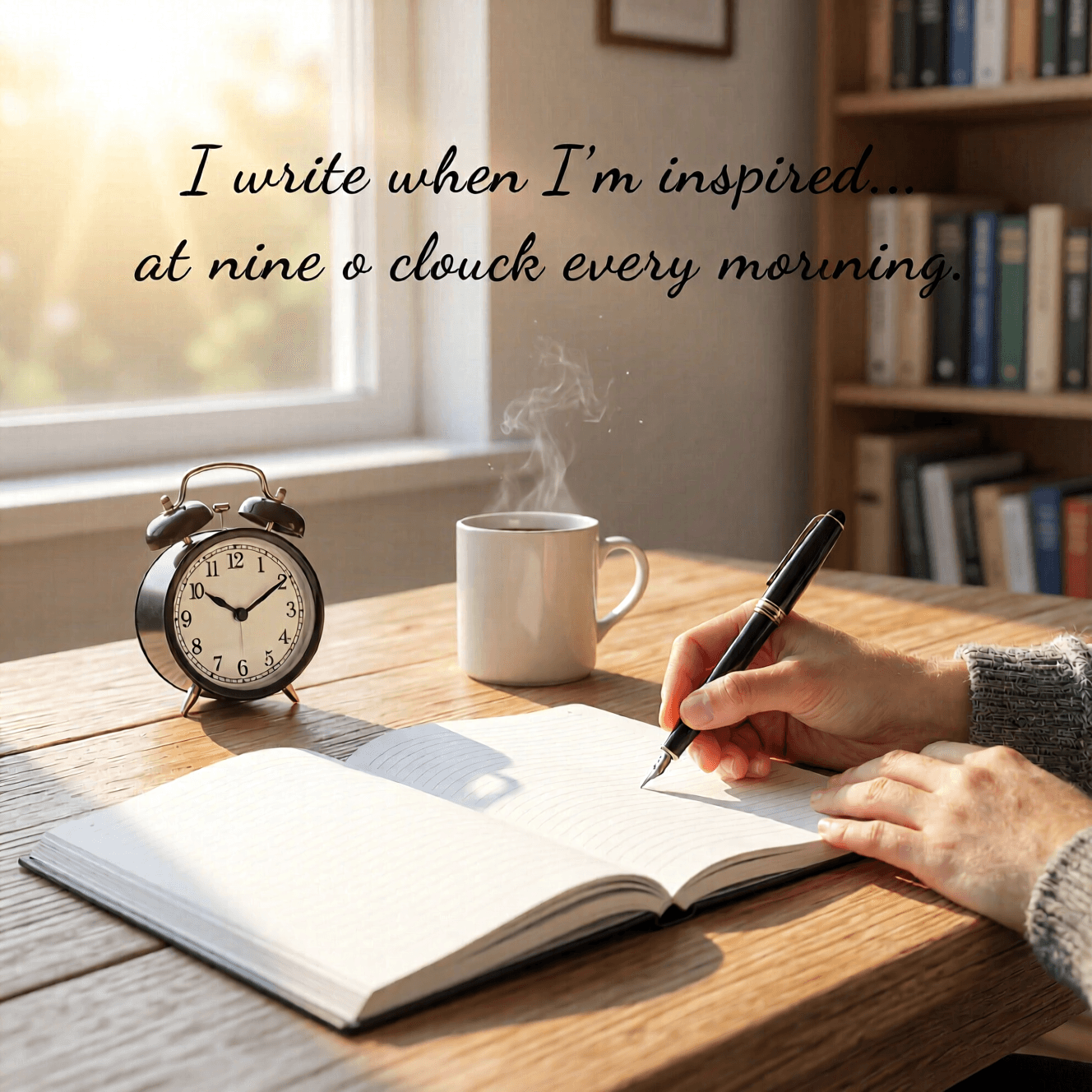
I write when I'm inspired, and I see to it that I'm inspired at nine o'clock every morning. — Peter De Vries
—What lingers after this line?
The Joke That Reveals a Method
Peter De Vries frames his line as a wry paradox: he writes “when” inspiration strikes, yet he also schedules it for nine every morning. The humor lands because it punctures the romantic myth that good work depends on unpredictable lightning bolts of feeling. Instead, he implies that inspiration can be coaxed—or at least reliably encountered—through routine. This sets the theme for everything that follows: artistry isn’t only an emotional event but also a practical discipline, and the two can cooperate rather than compete.
Routine as a Doorway to Creativity
Once the punchline settles, the deeper claim emerges: the mind learns to show up when you show up. A regular time and place reduces decision fatigue and lowers the threshold to begin, which matters because beginning is often the hardest part. By nine o’clock, De Vries has already decided that writing is what happens now, not later. In that sense, routine becomes a doorway through which inspiration can enter—less a muse descending at random and more a guest who knows when the door will be unlocked.
Inspiration as a Behavior, Not a Mood
From there, De Vries nudges us to treat inspiration less like a feeling and more like a byproduct of behavior. When you draft, revise, and wrestle with sentences, ideas start to appear that weren’t available before the work began. The act itself generates momentum: one clear paragraph suggests the next, and even a flawed page creates something tangible to respond to. Consequently, “being inspired” can be reframed as entering a productive state—one that is easier to reach when it’s practiced at the same hour each day.
The Nine O’Clock Contract With Yourself
Setting a specific time—nine o’clock—functions like a personal contract. It separates intention from execution: instead of vaguely hoping to write, you commit to a recurring appointment where the only requirement is to sit down and attempt the work. This structure also protects writing from being crowded out by errands, messages, and the convenient promise of “later.” Over time, that contract builds trust with yourself, and that trust is quietly powerful: it makes creativity feel less fragile because it rests on something sturdier than mood.
Discipline That Still Leaves Room for Surprise
Yet De Vries doesn’t eliminate inspiration; he relocates it. The schedule doesn’t guarantee brilliance, but it increases the odds of encountering it, like walking the same trail daily until you start noticing new birds. In practice, the surprises often arise mid-process: an unexpected metaphor, a sharper argument, a more honest confession. Thus, discipline and spontaneity stop being opposites. The habit supplies the stage, and inspiration—when it arrives—has somewhere ready to perform.
A Practical Lesson for Any Creative Life
Finally, the quote offers a portable lesson: if you want more inspiration, make it easier for inspiration to find you. That might mean a daily hour, a consistent workspace, or a modest minimum—two pages, one scene, one sketch—so that progress is inevitable even on uninspired days. De Vries’ nine o’clock is less about the clock and more about the principle of regularity. In the end, his humor points to a serious creative ethic: talent may start the journey, but a dependable practice is what keeps it moving.
One-minute reflection
Why might this line matter today, not tomorrow?
Related Quotes
4 selectedThe discipline of creation, be it to paint, compose, write, is an effort towards wholeness. — Madeleine L'Engle
Madeleine L’Engle
Madeleine L'Engle’s insight frames creation not as mere self-expression but as a disciplined movement toward inner completeness. To paint, compose, or write is to gather scattered thoughts, emotions, and experiences into...
Read full interpretation →Begin each day by matching imagination with disciplined action. — Sun Tzu
Sun Tzu
To begin, the maxim urges a morning pact between vision and execution. Imagination sets direction—what could be—while discipline choreographs the first steps—what must be done now.
Read full interpretation →If you wish to be a writer, write. — Epictetus
Epictetus
This quote emphasizes that wanting to be a writer is not enough. To achieve the goal of becoming a writer, one must take action and actually engage in writing.
Read full interpretation →Take a simple idea and take it seriously. — W. H. Auden
W. H. Auden
At first glance, simplicity looks easy; in practice, it is an act of discipline. Auden’s injunction reads less like a quip and more like a work order: identify the essential idea, then spare it from dilution.
Read full interpretation →More From Author
More from Peter De Vries →