
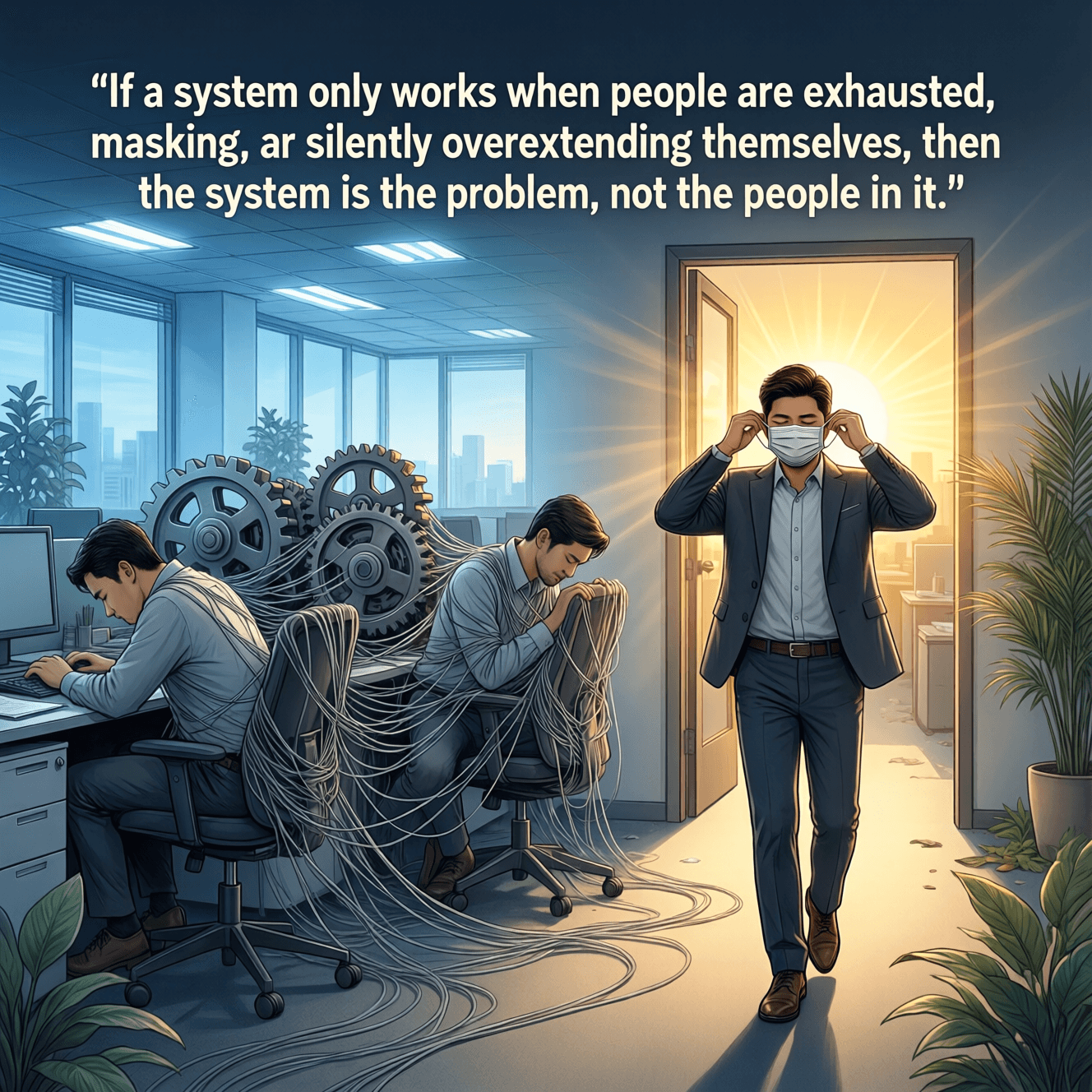
If a system only works when people are exhausted, masking, or silently overextending themselves, then the system is the problem, not the people in it. — Nicola Knobel
—What lingers after this line?
Reframing Blame from People to Structures
Nicola Knobel’s line opens by flipping a common script: instead of asking why individuals can’t “cope,” it asks why coping requires self-erasure. If an organization, community, or workplace remains functional only when people suppress their needs and stretch beyond capacity, then the apparent success is built on hidden damage. In that sense, the system is not neutral—it is designed, implicitly or explicitly, to externalize its costs onto human bodies and minds. From here, the quote invites a structural diagnosis. Rather than treating burnout as a personal weakness, it treats chronic depletion as evidence of a faulty operating model. The central claim is straightforward: when breakdown is routine, the environment—not the individual—is what needs repair.
Exhaustion as an Unspoken Business Model
Building on that reframing, exhaustion becomes a kind of fuel source: unpaid overtime, constant vigilance, and emotional labor keep outputs high while resources stay constrained. A telling pattern appears in many settings—deadlines are always urgent, staffing is always “lean,” and any quiet moment is treated as inefficiency rather than recovery. Over time, people learn that the system rewards endurance, not sustainability. This dynamic is especially visible during crunch periods that never end. What was meant to be occasional surge capacity becomes permanent expectation, and the organization quietly normalizes crisis as culture. At that point, the system isn’t merely failing to prevent burnout; it is effectively calibrated around it.
Masking and the Cost of Performing ‘Okay’
The quote also highlights masking—presenting as fine while struggling—as a key ingredient of systemic dysfunction. When people hide stress, disability needs, mental health challenges, or even basic fatigue to avoid stigma or retaliation, the system receives false feedback: it appears to be working. This performance of wellness can look like professionalism, but it is often self-protective silence. Because masking reduces visible friction, leaders may assume capacity is higher than it is, and expectations rise accordingly. The result is a loop: the more people conceal strain, the less the system adapts, and the more individuals must conceal. In this way, “being fine” becomes part of the job, and authenticity becomes a liability.
Silent Overextension and Invisible Labor
Next comes silently overextending—doing what is necessary to prevent collapse without naming what it costs. This includes staying late to fix avoidable problems, smoothing interpersonal conflicts, training new hires without time allocated, or absorbing extra work when positions remain unfilled. Much of this labor is invisible precisely because it succeeds; crises don’t happen, so the intervention is never counted. Yet invisible work is still work, and unpaid work is still a debt—only it is paid in energy, sleep, and long-term health. Over time, the person who “always manages” becomes the system’s safety net, and the organization quietly offloads responsibility onto their goodwill.
Why the System Prefers Individual Fixes
From this vantage, it becomes clear why organizations often default to personal solutions: resilience trainings, mindfulness apps, time-management tips. These tools can help, but they can also function as a convenient narrative that leaves root causes untouched. If the main problem is workload, unclear priorities, understaffing, or punitive culture, then the “fix” cannot be solely internal to the individual. Moreover, individualizing the problem keeps accountability diffuse. It turns structural issues into private struggles and makes people feel responsible for failing to thrive in conditions that are, by design, unlivable. Knobel’s statement resists that pattern by insisting the locus of change belongs to the system.
Designing for Human Sustainability
Finally, the quote implies a practical standard: a healthy system should function when people are well, honest, and adequately resourced—not when they are depleted and silent. That means building in slack, normalizing boundaries, staffing for reality, and rewarding early problem-reporting rather than punishing it. It also means treating rest and accommodation not as perks, but as infrastructure. In the end, Knobel offers a diagnostic test and a moral stance at once. If an environment requires exhaustion to operate, then it is not a high-performing culture—it is a fragile one. Fixing it starts by making hidden costs visible and redesigning the work so people don’t have to disappear for the system to succeed.
One-minute reflection
What's one small action this suggests?
Related Quotes
6 selectedBurnout is not a badge of honor; it is a sign that you have forgotten how to be a person instead of a productivity machine. — Arianna Huffington
Arianna Huffington
Arianna Huffington’s line begins by confronting a familiar cultural script: if you’re depleted, you must be important. By calling burnout “not a badge of honor,” she reframes exhaustion from a status symbol into a warnin...
Read full interpretation →Burnout is too much emotional responsibility. — K. Arbidane
K. Arbidane
K. Arbidane’s line narrows burnout to something more intimate than long hours: the slow overload of carrying other people’s feelings, outcomes, and needs.
Read full interpretation →Constant tiredness isn't commitment, it's imbalance, and the body keeps receipts. — Nel-Olivia Waga
Olivia Waga
Nel-Olivia Waga’s line opens by challenging a common cultural script: that being perpetually drained is proof of dedication. Instead, she reframes constant tiredness as evidence that something in life’s system is miscali...
Read full interpretation →Burnout isn't a moral failing. It's your brain doing exactly what it was designed to do under pressure: shut things down and protect you. — Kimber Nelson
Kimber Nelson
Kimber Nelson’s line begins by overturning a familiar cultural story: that exhaustion signals weakness, laziness, or poor character. By saying burnout “isn’t a moral failing,” she separates human worth from performance,...
Read full interpretation →Burnout is what happens when you try to avoid being human for too long. — Michael Gungor
Michael Gungor
Michael Gungor’s line reframes burnout from a mere workload problem into an identity problem: it’s what happens when we live as though we are not human. In that sense, exhaustion is not just the cost of effort; it’s the...
Read full interpretation →Burnout is nature's way of telling you, you've been going through the motions your soul has departed. — Sam Keen
Sam Keen
Sam Keen frames burnout less as a personal failure and more as an intelligent warning system. In his view, the exhaustion isn’t merely about too many tasks; it’s about a deeper mismatch between what you do and what you a...
Read full interpretation →More From Author
More from Nicola Knobel →