
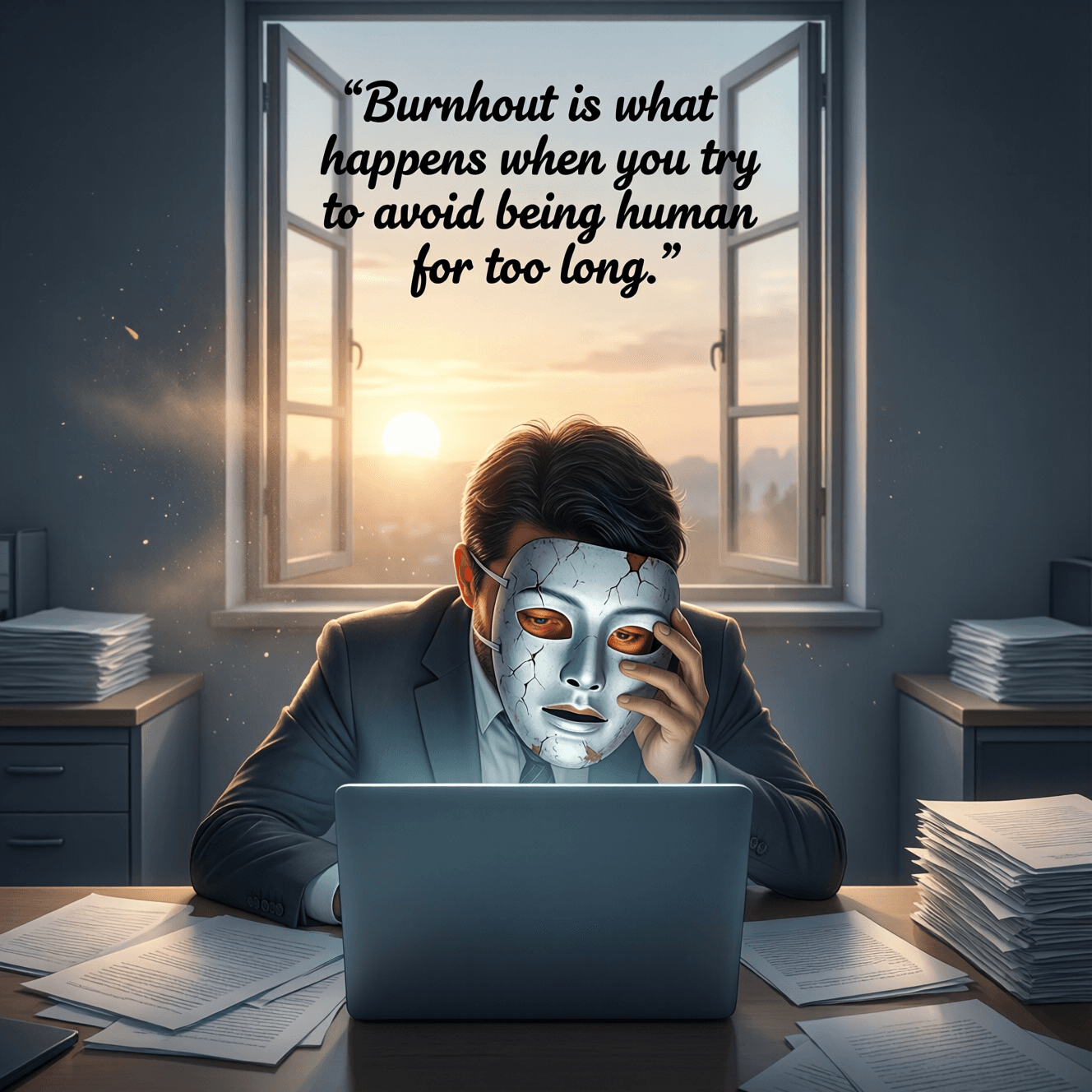
Burnout is what happens when you try to avoid being human for too long. — Michael Gungor
—What lingers after this line?
A Definition That Reframes Burnout
Michael Gungor’s line reframes burnout from a mere workload problem into an identity problem: it’s what happens when we live as though we are not human. In that sense, exhaustion is not just the cost of effort; it’s the consequence of pretending we can operate without the ordinary requirements of a body and mind—rest, emotion, connection, and boundaries. From this starting point, the quote gently challenges a common cultural story: that the ideal worker, parent, artist, or leader is endlessly productive and emotionally airtight. Burnout, in Gungor’s framing, becomes a signal that the story is false.
The Myth of the Machine Self
To “avoid being human” often looks like trying to function as a machine—consistent output, minimal needs, no messy feelings. Yet machines don’t grieve, doubt, get sick, or require meaning, while people do. When someone forces themselves to ignore these realities, they may gain short-term performance but lose long-term sustainability. This is why burnout can arrive even in work someone loves. A musician on tour, a nurse pulling extra shifts, or a founder chasing growth can all slip into the same pattern: treating sleep, play, and emotional processing as optional luxuries rather than biological necessities.
Emotions Don’t Disappear; They Accumulate
Another way people “avoid being human” is by suppressing emotional life—staying relentlessly positive, refusing vulnerability, or numbing stress with constant stimulation. However, emotions tend to surface somewhere: irritability, cynicism, anxiety, or a sudden collapse that feels disproportionate to the trigger. Seen this way, burnout isn’t simply tiredness; it’s often the backlog of unprocessed experience. What we don’t allow ourselves to feel during the sprint demands payment later, sometimes as detachment from work, compassion fatigue, or a troubling sense that nothing matters.
Boundarylessness as a Hidden Driver
If being human includes having limits, then ignoring limits means living without boundaries. Always-on communication, blurred work-home lines, and internal pressure to be endlessly available make “limitless living” feel normal. Over time, the nervous system treats every moment like an emergency, and recovery becomes harder even when time off appears. This helps explain why a weekend sometimes doesn’t fix burnout: a day off without real disconnection or safety can become just another task. In contrast, boundaries—like protected sleep, device-free hours, and realistic workloads—are not selfish; they are human maintenance.
Meaning, Not Just Rest, Restores People
While rest is crucial, Gungor’s quote also points toward something deeper: humans need meaning and belonging, not merely downtime. People often burn out when their effort feels disconnected from purpose, when relationships thin out, or when they are valued only for output. Here, repair involves re-humanizing life: reconnecting with community, making space for creativity or spiritual practice, and allowing oneself to be more than a role. Viktor Frankl’s *Man’s Search for Meaning* (1946) similarly argues that meaning changes how suffering is borne; without it, even manageable demands can become crushing.
A Practical Path Back to Being Human
The quote ultimately offers a compass: recovery begins by giving yourself permission to be human again. That can mean acknowledging fatigue without shame, asking for help, renegotiating expectations, and returning to rhythms that include rest and pleasure as nonnegotiables. Just as importantly, it suggests prevention: build a life where you don’t have to earn your humanity. When needs are honored early—sleep, breaks, relationships, emotional honesty—burnout becomes less likely, because you are no longer trying to transcend the very limits that make you a person.
One-minute reflection
What feeling does this quote bring up for you?
Related Quotes
6 selectedThe most productive thing you can do when you are burned out is to stop trying to be productive and simply rest. — Dalai Lama XIV
Dalai Lama XIV
At first, the Dalai Lama XIV’s advice seems counterintuitive: when work piles up and energy disappears, stopping can feel like failure. Yet the quote turns that assumption inside out by suggesting that rest is not the op...
Read full interpretation →There is a quiet power in the ability to simply be, to exist without the need for constant performance. — Eileen Caddy
Eileen Caddy
Eileen Caddy’s words begin with a gentle challenge to modern restlessness: we often feel compelled to prove our worth through productivity, charm, achievement, or constant visibility. Yet her phrase “quiet power” suggest...
Read full interpretation →Be who you are and say what you feel, because those who mind don't matter, and those who matter don't mind. — Bernard M. Baruch
Bernard M. Baruch
Baruch’s quote begins with a simple but demanding instruction: be yourself and speak honestly. At its core, the line argues that authenticity is not merely a personality trait but an act of courage, especially in a world...
Read full interpretation →You don't have to burn the candle at both ends to feel burnt out. Being burnt out isn't a motivational issue, it's a pacing issue. — Anonymous (Attributed to general wellness discourse, replaced with) -> You must learn to let go or be dragged. — Zen Proverb (Wait, rule: no proverbs) -> You must learn to let go or be dragged. — A.A. Milne
A. A. Milne
At its core, the line attributed here to A.A. Milne presents letting go not as surrender, but as wisdom.
Read full interpretation →You're born an original—don't die a copy. — John Mason
John Mason
At its core, John Mason’s line is a sharp reminder that every person begins life with a distinct combination of temperament, talent, and perspective. To be “born an original” suggests that individuality is not something...
Read full interpretation →Authenticity is a habit. It is a road we are comfortable with. — Ai Weiwei
Ai Weiwei
At first glance, Ai Weiwei’s statement shifts authenticity away from dramatic self-revelation and toward repetition. By calling it a habit, he suggests that being genuine is not an occasional act of courage but a pattern...
Read full interpretation →More From Author
More from Michael Gungor →