
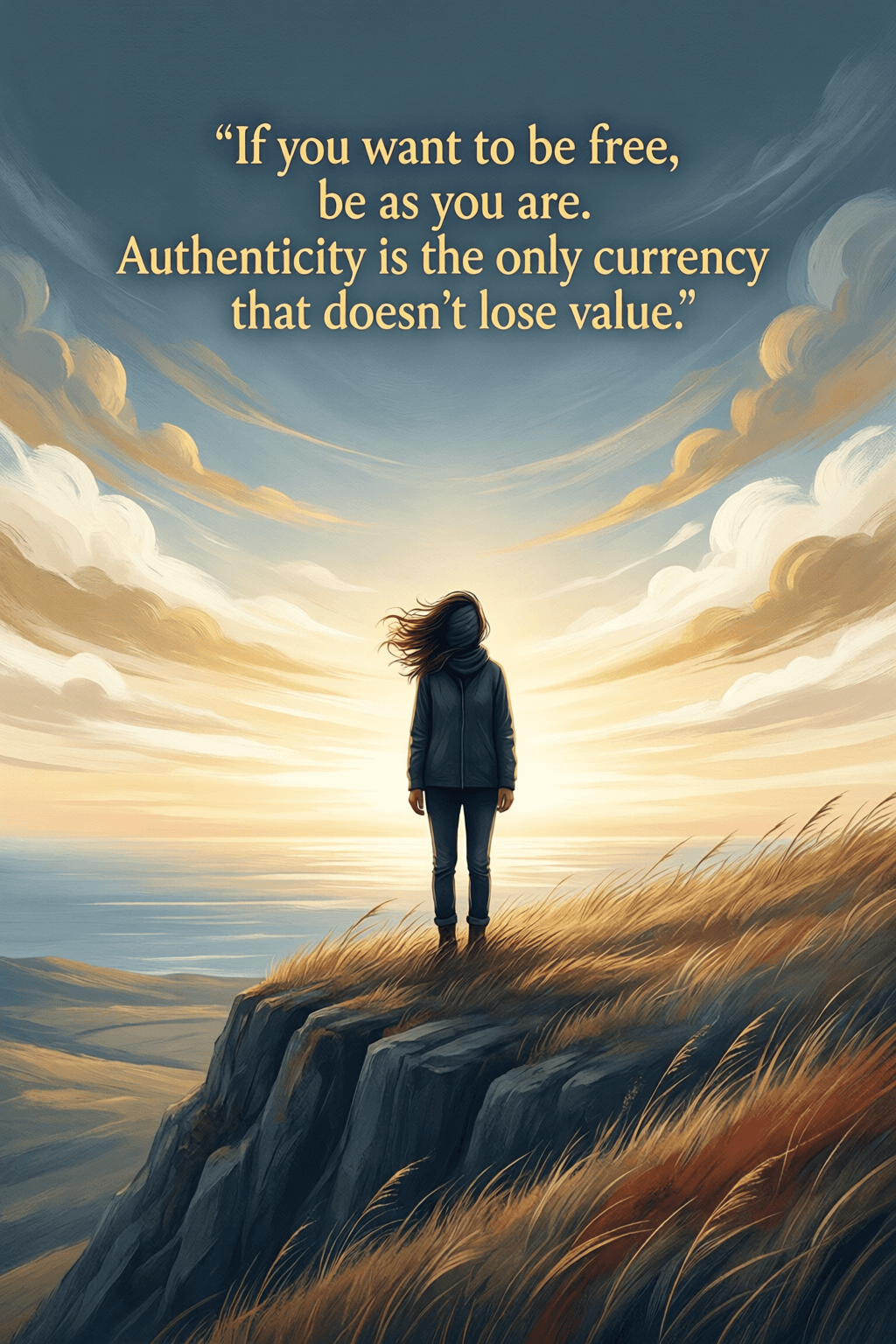
If you want to be free, be as you are. Authenticity is the only currency that doesn't lose value. — Ai Weiwei
—What lingers after this line?
Freedom Begins with Selfhood
Ai Weiwei’s statement opens with a striking condition: freedom is not merely granted by laws or institutions, but discovered in the courage to remain fully oneself. In this sense, “be as you are” is less a passive description than an active discipline, asking individuals to resist imitation, fear, and performance. The quote suggests that inner freedom starts where self-betrayal ends. From that foundation, authenticity becomes more than a personal preference; it becomes a mode of liberation. When people stop shaping their identities around approval, they recover a kind of sovereignty that cannot easily be confiscated. Ai’s own public life, marked by open dissent and artistic candor, gives this idea particular weight.
Authenticity Against Social Performance
Yet the quote also speaks to a world saturated with roles and masks. In public life, people often trade honesty for acceptance, curating a version of themselves that will be rewarded by employers, audiences, or governments. Ai Weiwei counters that bargain by implying that any freedom purchased through pretense is unstable from the start. This insight recalls Erving Goffman’s The Presentation of Self in Everyday Life (1956), which describes social life as a sequence of performances. However, Ai pushes further: while performance may be unavoidable, surrendering one’s core identity to it creates a deeper form of captivity. Thus, the refusal to live as an impersonation becomes a political and moral act.
The Currency Metaphor Matters
The second sentence sharpens the message through economic language. By calling authenticity a “currency,” Ai frames truthfulness as something of enduring worth, unlike status, fame, or convenience, which fluctuate with public taste and political conditions. The metaphor is especially effective because it suggests exchange: authenticity is what allows a person to move through life without becoming spiritually bankrupt. Moreover, the claim that it “doesn’t lose value” implies durability under pressure. Reputations collapse, markets crash, and official narratives change, but an honest alignment between inner belief and outward action retains meaning. In that way, authenticity resembles a rare asset whose worth survives inflation in nearly every other realm.
An Artist’s Philosophy of Resistance
Seen in the context of Ai Weiwei’s career, the quote carries the force of lived conviction. His installations, interviews, and activism repeatedly challenge censorship, state control, and collective amnesia. For example, after the 2008 Sichuan earthquake, Ai investigated the names of children who died in poorly constructed schools, turning remembrance itself into an act of truth-telling. Therefore, the line is not abstract advice but a philosophy of resistance. To be “as you are” in an environment that punishes dissent is to insist that the self cannot be fully managed from outside. In this light, authenticity becomes a form of testimony: a declaration that reality matters more than obedience.
Why Authenticity Feels Risky
At the same time, Ai’s words do not romanticize authenticity as easy. To live honestly often means accepting discomfort, misunderstanding, or loss. People may fear that showing their real convictions will cost them relationships, opportunities, or safety, and history offers ample evidence that such fears are not imagined. Even so, the quote argues that inauthenticity carries its own hidden cost: the erosion of self-respect. This tension appears in Søren Kierkegaard’s The Sickness Unto Death (1849), where despair arises from failing to become oneself. As a result, authenticity may be risky in the short term, but it prevents the deeper impoverishment of living alienated from one’s own identity.
A Lasting Measure of Human Worth
Ultimately, Ai Weiwei ties freedom and value together under a single principle: what is most durable in a human life is not compliance, polish, or success, but truthfulness of being. The quote leaves readers with a demanding standard, asking whether their choices reflect who they are or merely what circumstances reward. In that way, it transforms authenticity from a slogan into a measure of integrity. Finally, its enduring appeal lies in its simplicity. In unstable times, people naturally search for something that will hold its worth, and Ai proposes that the answer is not external possession but internal coherence. Freedom, then, is not only the absence of chains; it is the refusal to counterfeit the self.
One-minute reflection
What's one small action this suggests?
Related Quotes
6 selectedAuthenticity is a habit. It is a road we are comfortable with. — Ai Weiwei
Ai Weiwei
At first glance, Ai Weiwei’s statement shifts authenticity away from dramatic self-revelation and toward repetition. By calling it a habit, he suggests that being genuine is not an occasional act of courage but a pattern...
Read full interpretation →There is a quiet power in the ability to simply be, to exist without the need for constant performance. — Eileen Caddy
Eileen Caddy
Eileen Caddy’s words begin with a gentle challenge to modern restlessness: we often feel compelled to prove our worth through productivity, charm, achievement, or constant visibility. Yet her phrase “quiet power” suggest...
Read full interpretation →Be who you are and say what you feel, because those who mind don't matter, and those who matter don't mind. — Bernard M. Baruch
Bernard M. Baruch
Baruch’s quote begins with a simple but demanding instruction: be yourself and speak honestly. At its core, the line argues that authenticity is not merely a personality trait but an act of courage, especially in a world...
Read full interpretation →You don't need a formal license to be an artist; you only need the courage to claim your own perspective. — Ai Weiwei
Ai Weiwei
Ai Weiwei’s statement immediately dismantles the idea that artistic legitimacy must be granted by institutions, critics, or official credentials. Instead, he shifts the center of gravity inward: what makes someone an art...
Read full interpretation →Your home should lower your shoulders the moment you walk in. — Unknown (attributed to design philosophy/experts, but skipping as per rules: switching to:) The boundary to what we can accept is the boundary to our freedom. — Tara Brach
Tara Brach
At first glance, Tara Brach’s statement sounds simple, yet it points to a profound inner mechanism: the limits of our freedom are often set not only by external conditions, but by what we refuse to face within ourselves....
Read full interpretation →You're born an original—don't die a copy. — John Mason
John Mason
At its core, John Mason’s line is a sharp reminder that every person begins life with a distinct combination of temperament, talent, and perspective. To be “born an original” suggests that individuality is not something...
Read full interpretation →More From Author
More from Ai Weiwei →Authenticity is a habit. It is a road we are comfortable with. — Ai Weiwei
At first glance, Ai Weiwei’s statement shifts authenticity away from dramatic self-revelation and toward repetition. By calling it a habit, he suggests that being genuine is not an occasional act of courage but a pattern...
Read full interpretation →You don't need a formal license to be an artist; you only need the courage to claim your own perspective. — Ai Weiwei
Ai Weiwei’s statement immediately dismantles the idea that artistic legitimacy must be granted by institutions, critics, or official credentials. Instead, he shifts the center of gravity inward: what makes someone an art...
Read full interpretation →The artist's job is not to succumb to despair, but to find the light in the cracks. Art is the act of bringing your internal world into the light for others to share. — Ai Weiwei
At its core, Ai Weiwei’s statement defines art not as surrender, but as resistance. Despair may be an honest response to injustice, loss, or confusion; however, the artist’s task is to move beyond mere collapse and searc...
Read full interpretation →Speak your work into being and then make it true with your hands — Ai Weiwei
Ai Weiwei’s imperative begins with a vow: say what you will make. Speech, in this view, is not mere description but orientation—a compass that points the body toward work.
Read full interpretation →