
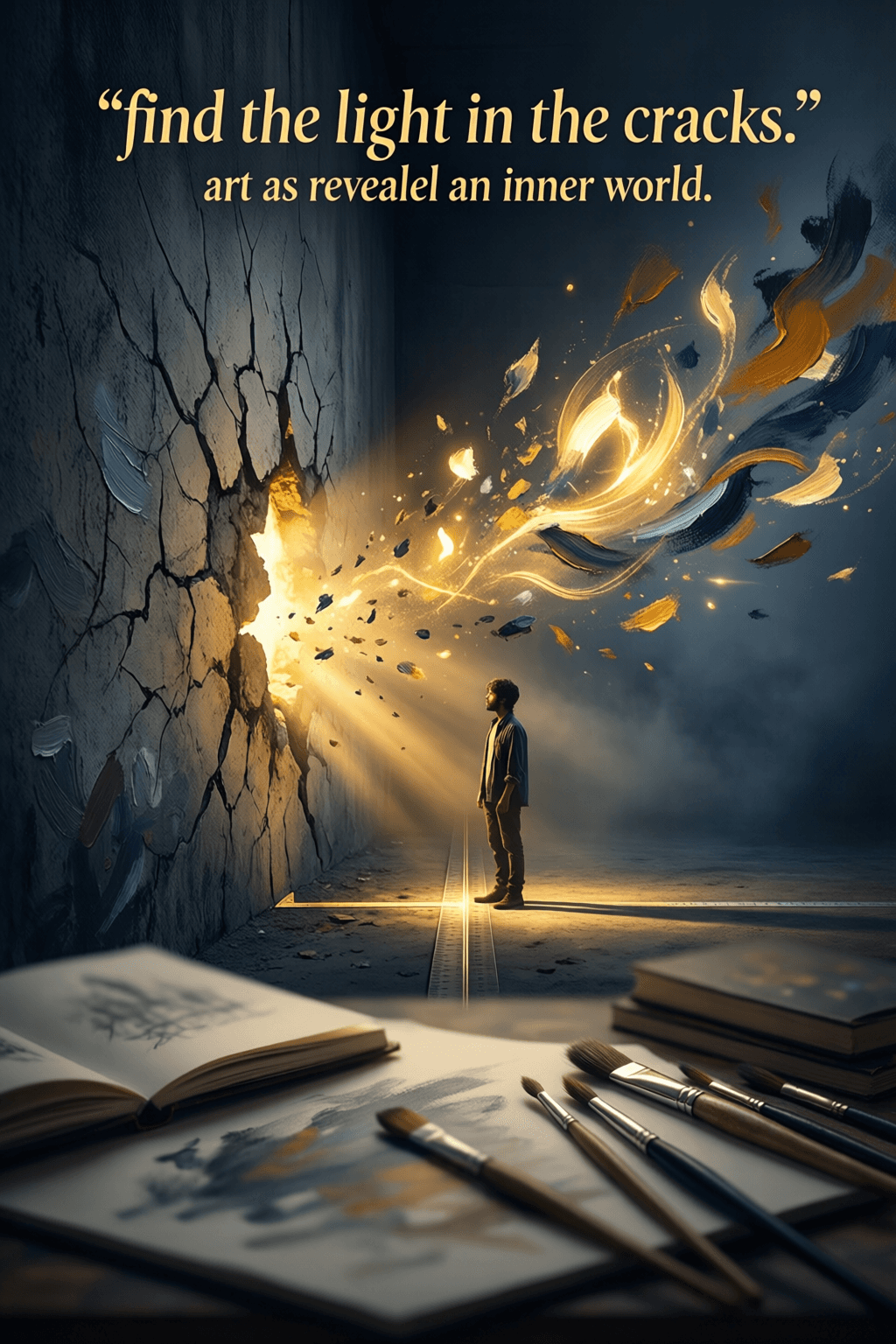
The artist's job is not to succumb to despair, but to find the light in the cracks. Art is the act of bringing your internal world into the light for others to share. — Ai Weiwei
—What lingers after this line?
Art as Defiance Against Despair
At its core, Ai Weiwei’s statement defines art not as surrender, but as resistance. Despair may be an honest response to injustice, loss, or confusion; however, the artist’s task is to move beyond mere collapse and search for illumination within damaged places. The image of “light in the cracks” suggests that brokenness is not only an end state, but also an opening through which truth can enter. In this way, art becomes an act of moral and emotional defiance. Rather than denying pain, the artist acknowledges it and then transforms it into something sharable. Ai’s own work, from his politically charged installations to his documentaries on displacement, repeatedly demonstrates this principle: fracture is real, yet meaning can still emerge from it.
The Meaning of the Internal World
From there, Ai Weiwei expands the artist’s role inward, describing art as the bringing of one’s internal world into the light. This phrase includes memory, fear, conviction, grief, humor, and private perception—the invisible material that usually remains hidden beneath ordinary speech. Art gives form to what is difficult to explain directly, allowing inner life to become visible, audible, or tangible. Consequently, creation is not simply self-expression in a casual sense; it is a disciplined act of translation. Vincent van Gogh’s letters, especially those collected in *The Letters of Vincent van Gogh* (1914), show this struggle vividly, as he tried to render emotional intensity through color and line. Ai’s quotation belongs to that same tradition, where the unseen life within the artist becomes a shared human encounter.
Cracks as Openings, Not Failures
Importantly, the metaphor of cracks changes how we think about damage. A crack usually implies weakness, rupture, or imperfection, yet Ai recasts it as the very place where light appears. This idea echoes Leonard Cohen’s lyric from “Anthem” (1992), “There is a crack in everything, that’s how the light gets in,” but Ai gives the thought a civic and artistic urgency: broken realities demand witness, and artists help us see what suffering alone might obscure. Therefore, imperfection is not an obstacle to art’s meaning; it is often its source. Consider the Japanese practice of kintsugi, in which broken pottery is repaired with lacquer mixed with gold, making the fracture more visible rather than less. The repaired object does not hide its history. Similarly, art can illuminate wounds without pretending they never existed.
Sharing Private Vision With Others
Yet Ai Weiwei does not stop at personal revelation; he insists on sharing. Art matters because it moves from isolation into relation, carrying an inner world outward so that others may enter it. This shift is crucial: private feeling becomes communal experience, and individual perception acquires social meaning. What begins in solitude can become recognition for someone else who had no words for the same feeling. For that reason, art often creates fellowship across distance, language, and circumstance. Frida Kahlo’s paintings, for example, turned bodily pain and emotional turmoil into images that continue to resonate globally; her *The Broken Column* (1944) remains intensely personal and unmistakably collective in its effect. Ai’s words capture this movement beautifully: art is not only revelation, but invitation.
Witness, Courage, and Public Truth
Moreover, Ai Weiwei’s statement carries a political charge. To bring one’s internal world “into the light” is also to oppose systems that depend on silence, fear, or concealment. In such contexts, the artist is not merely a maker of beautiful objects, but a witness who risks visibility in order to make hidden realities harder to ignore. The search for light, then, becomes inseparable from courage. This is especially fitting given Ai’s own career, shaped by surveillance, detention, and outspoken criticism of state power. His installation *Remembering* (2009), created in response to the Sichuan earthquake and the suppression of public grief, exemplifies how art can expose what authority would rather leave in darkness. Thus, the quotation speaks not only to creativity, but to ethical responsibility.
A Human Purpose for Artistic Creation
Finally, the quotation offers a hopeful philosophy of why art exists at all. Art is not escapism in the shallow sense, nor is it mere decoration layered over suffering. Instead, it is a human method for converting inward complexity into shared clarity, and for discovering brightness where life appears fractured. The artist’s role is therefore both intimate and universal: to make something honest enough that others can see themselves in it. Seen this way, Ai Weiwei’s vision joins a long lineage of thinkers who treat art as revelation. Aristotle’s *Poetics* (c. 335 BC) suggested that artistic representation can produce recognition and emotional understanding; Ai updates that ancient insight for a wounded modern world. Even amid despair, art remains a means of contact, witness, and light.
Recommended Reading
As an Amazon Associate, we earn from qualifying purchases.
One-minute reflection
What feeling does this quote bring up for you?
Related Quotes
6 selectedIn the darkness, there is always a ray of light; that is hope.
Unknown
This quote highlights the idea that no matter how challenging or dire a situation may seem, there is always a glimmer of hope. Hope acts as a guiding light during dark times.
Read full interpretation →The deep roots never doubt spring will come. — Marty Rubin
Marty Rubin
At first glance, Marty Rubin’s line turns a simple natural image into a meditation on trust. Deep roots, hidden from view and buried in cold earth, symbolize the part of life that endures when nothing visible seems alive...
Read full interpretation →I am fascinated by tiny, incremental changes, almost imperceptible shifts in how people orient themselves in the world, because those are in some ways the most hopeful. — Rebecca Solnit
Rebecca Solnit
Rebecca Solnit’s reflection begins with a striking claim: the smallest changes may carry the greatest promise. Rather than celebrating dramatic revolutions, she turns our attention to subtle adjustments in how people see...
Read full interpretation →The main thing is to be moved, to love, to hope, to tremble, to live. — Auguste Rodin
Auguste Rodin
Rodin’s statement begins with a striking priority: “the main thing” is not to possess, achieve, or control, but to feel deeply. To be moved suggests openness to beauty, sorrow, wonder, and human connection.
Read full interpretation →Home isn't where you're from, it's where you find light when all grows dark. — Pierce Brown
Pierce Brown
At first glance, Pierce Brown’s line separates home from birthplace, inheritance, or mere address. In doing so, it reframes home as an experience rather than a location: the place, person, or community that restores mean...
Read full interpretation →If I could say it in words there would be no reason to paint. — Edward Hopper
Edward Hopper
At its core, Edward Hopper’s remark suggests that some experiences resist verbal capture. If words were sufficient, painting would be unnecessary; art emerges precisely because feeling, atmosphere, and perception often e...
Read full interpretation →More From Author
More from Ai Weiwei →You don't need a formal license to be an artist; you only need the courage to claim your own perspective. — Ai Weiwei
Ai Weiwei’s statement immediately dismantles the idea that artistic legitimacy must be granted by institutions, critics, or official credentials. Instead, he shifts the center of gravity inward: what makes someone an art...
Read full interpretation →If you want to be free, be as you are. Authenticity is the only currency that doesn't lose value. — Ai Weiwei
Ai Weiwei’s statement opens with a striking condition: freedom is not merely granted by laws or institutions, but discovered in the courage to remain fully oneself. In this sense, “be as you are” is less a passive descri...
Read full interpretation →Speak your work into being and then make it true with your hands — Ai Weiwei
Ai Weiwei’s imperative begins with a vow: say what you will make. Speech, in this view, is not mere description but orientation—a compass that points the body toward work.
Read full interpretation →Life is a continuous exercise in creative resilience. — Ai Weiwei
The quote highlights that life is full of obstacles and difficulties, requiring us to persist and adapt constantly.
Read full interpretation →