
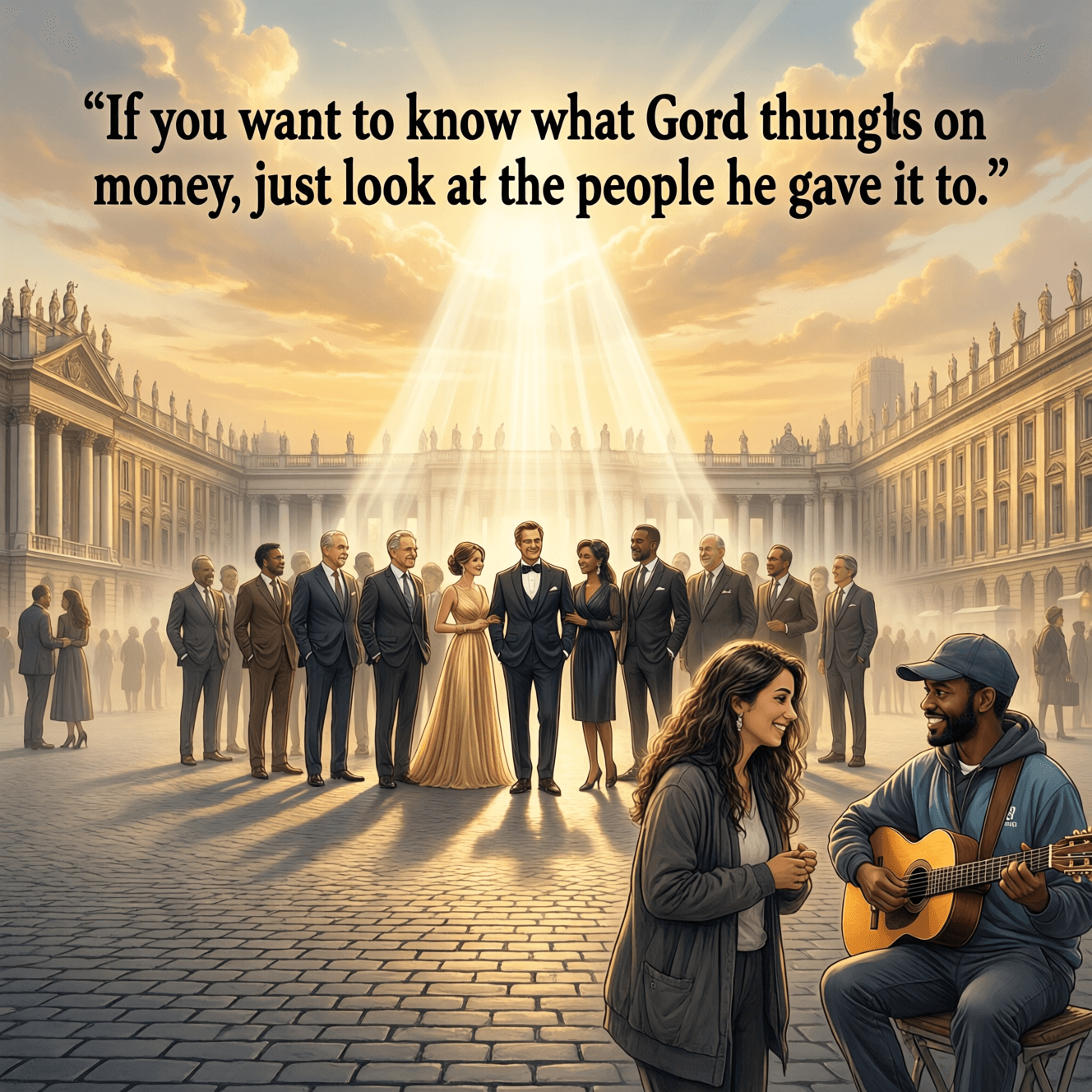
If you want to know what God thinks of money, just look at the people he gave it to. — Dorothy Parker
—What lingers after this line?
A Witty Theological Provocation
Dorothy Parker’s line lands as a joke, but it quickly turns into a dare: if money were a reliable sign of virtue, then the moral quality of the wealthy should inspire confidence. Instead, her punchline implies the opposite—wealth often sits with people whose behavior makes the idea of “divine endorsement” feel absurd. By framing the question as “what God thinks,” Parker borrows religious language to expose a human habit: treating financial success as a kind of moral certificate. From there, the quip nudges the reader to notice the gap between what we say we value—generosity, humility, justice—and what society frequently rewards. The laughter is a doorway into critique.
Satire as a Mirror of Social Values
Satire works by exaggeration, yet Parker’s exaggeration is calibrated: she doesn’t claim to know God’s mind, she points to observable outcomes. In that sense, the remark becomes less about theology and more about public hypocrisy—how easily people equate “rich” with “deserving.” The implication is not merely that some rich people are flawed (as anyone is), but that the pattern of who ends up with money can feel morally random or even perverse. This is why the line carries bite. It suggests that if we infer meaning from wealth, we may be forced into uncomfortable conclusions about our institutions, our admiration, and the stories we tell about merit.
Echoes of Older Religious Warnings
Although Parker is irreverent, her skepticism harmonizes with long-standing religious cautions about riches. The New Testament, for instance, warns about wealth’s spiritual hazards—“You cannot serve God and mammon” (Matthew 6:24) and the famous image of the camel and the needle’s eye (Mark 10:25). Those passages don’t argue that money itself is evil, but that it easily becomes a rival loyalty. Parker’s twist is to reverse a common assumption. Rather than reading wealth as divine favor, she treats it as evidence that money is not distributed according to holiness—and that, if anything, it may accumulate where other motives dominate.
The Moral Luck Behind Fortunes
Moving from scripture to lived experience, Parker’s quip also points toward what philosophers call “moral luck”: outcomes shaped by birth, timing, connections, health, and historical circumstance. A person can be diligent and still remain poor; another can be reckless and still end up rich. The more one looks at inheritances, monopolies, bubbles, and political access, the harder it becomes to claim that wealth cleanly tracks virtue. In this light, “the people he gave it to” reads like a sardonic inventory of accidents and advantages. Parker’s humor compresses a complex argument: if money were a moral scoreboard, the scoring system would look deeply unreliable.
What the Quote Accuses Us Of
Just as pointedly, the line isn’t only aimed at the rich—it targets the rest of us and our willingness to sanctify success. People often defer to wealth as if it confers wisdom, trustworthiness, or superior character. Parker’s sentence punctures that reflex by suggesting that wealth can coexist with pettiness, cruelty, or emptiness, and therefore should not command automatic reverence. Once that spell breaks, new questions follow naturally: Who benefits from the myth that money equals merit? Who is blamed when they lack it? Parker’s joke becomes a small act of resistance against the moralization of inequality.
A Practical Takeaway: Humility and Responsibility
If Parker is right that money doesn’t reliably indicate goodness, then the ethical task shifts. For those with wealth, the point is humility: fortunes are not proof of superiority, and they carry obligations—fair pay, honest dealing, and generosity—rather than entitlement. For those without wealth, the point is liberation from false shame: financial status is a poor proxy for human worth. Ultimately, Parker’s line endures because it turns a common cultural instinct inside out. It asks readers to judge money by its effects on people—and to judge people by something other than money.
One-minute reflection
Where does this idea show up in your life right now?
Related Quotes
2 selectedAnd if you do not like me so, to hell, my love, with you. — Dorothy Parker
Dorothy Parker
Dorothy Parker’s line lands like a door slamming: if affection must come on terms she can’t accept, then she’d rather burn the whole bargain down. The phrasing is blunt, but the emotion underneath is more complicated tha...
Read full interpretation →The cure for boredom is curiosity. There is no cure for curiosity. — Dorothy Parker
Dorothy Parker
This quote suggests that curiosity is a powerful remedy for boredom. When one is curious, they are engaged and eager to explore or learn, which naturally eliminates the feeling of being bored.
Read full interpretation →More From Author
More from Dorothy Parker →And if you do not like me so, to hell, my love, with you. — Dorothy Parker
Dorothy Parker’s line lands like a door slamming: if affection must come on terms she can’t accept, then she’d rather burn the whole bargain down. The phrasing is blunt, but the emotion underneath is more complicated tha...
Read full interpretation →The cure for boredom is curiosity. There is no cure for curiosity. — Dorothy Parker
This quote suggests that curiosity is a powerful remedy for boredom. When one is curious, they are engaged and eager to explore or learn, which naturally eliminates the feeling of being bored.
Read full interpretation →