
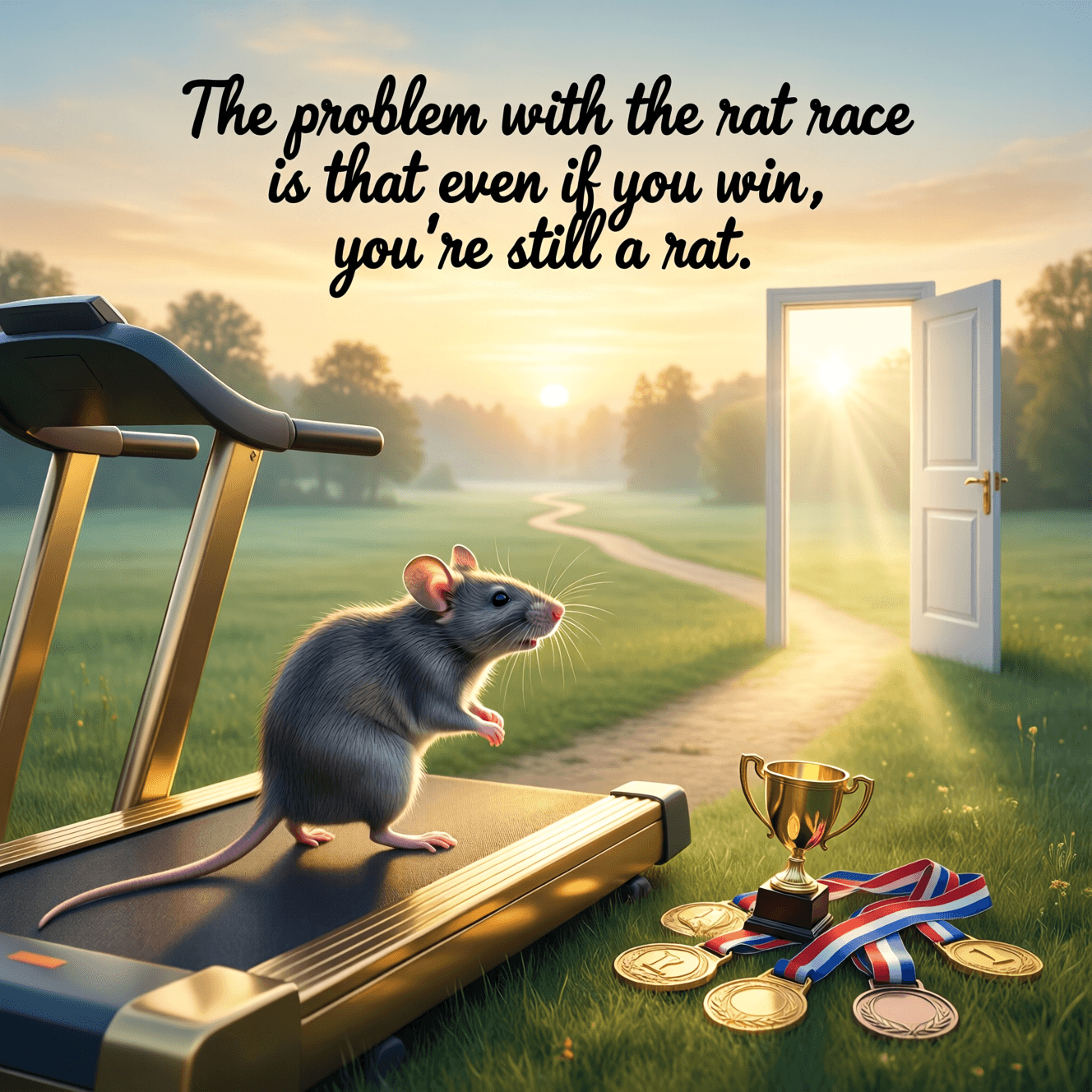
The problem with the rat race is that even if you win, you're still a rat. — Lily Tomlin
—What lingers after this line?
A Razor-Sharp Reframe of Success
Lily Tomlin’s quip works because it flips a familiar promise: compete hard, win big, and you’ll be fulfilled. Instead, she suggests that the victory itself is hollow if the whole contest is demeaning or misaligned with your values. The phrase “still a rat” isn’t just an insult—it’s a metaphor for staying inside a system that reduces people to frantic strivers. From the outset, the quote asks a disquieting question: if the game demands you become smaller, harsher, or more anxious to succeed, what exactly have you gained when you reach the top?
The System That Shapes the Competitor
The “rat race” implies a maze built for endless running—motion without meaning. Even the “winner” remains defined by the same rules: constant comparison, fear of falling behind, and rewards that never quite settle into satisfaction. In that sense, Tomlin is less interested in personal failure than in the structure of the competition. This connects to a long tradition of doubting status-driven striving: Thorstein Veblen’s concept of “conspicuous consumption” in *The Theory of the Leisure Class* (1899) describes how people chase signals of rank that require continual upkeep, ensuring the race never really ends.
Achievement Without Autonomy
Once you accept the race’s rules, your choices can quietly narrow. Promotions, prestige, and pay rises may arrive, yet the cost is often diminished control over your time and attention—longer hours, constant availability, and a sense that stepping off the track equals failure. Tomlin’s punchline lands because it exposes this trap: winning doesn’t necessarily restore freedom. A useful lens appears in Deci and Ryan’s Self-Determination Theory (1985), which argues that well-being depends on autonomy, competence, and relatedness. When success erodes autonomy, even “winning” can feel like a loss.
Identity as a Byproduct of Competition
Moreover, the quote warns about identity drift: over time, a person can start equating their worth with their position in the race. The winner becomes someone who wins—rather than someone who lives, creates, loves, or contributes on their own terms. Tomlin’s “still a rat” points to how the environment can imprint its values onto the self. This concern echoes Erich Fromm’s *To Have or To Be?* (1976), where he contrasts a life built around possessing and outperforming with one grounded in being—presence, meaning, and authentic connection.
The Moving Finish Line of Social Comparison
Even if you “win,” the victory is unstable because it depends on others’ positions. Someone else will outrank you, earn more, or achieve a newer badge of prestige, and the race restarts. Tomlin compresses that cycle into one sentence: you can’t solve a comparison problem by winning a comparison contest. Here, social psychology offers a bridge: Leon Festinger’s Social Comparison Theory (1954) explains how people evaluate themselves relative to others, often fueling dissatisfaction even amid objective success. The race is powered by the mind’s habit of measuring.
Stepping Off the Track Without Giving Up
Finally, the quote isn’t anti-ambition so much as pro-clarity. It invites a different kind of winning: defining the game yourself. That may mean pursuing work that fits your values, setting boundaries that protect your time, or measuring success by craft, service, or relationships rather than rank. In practical terms, Tomlin’s line encourages a simple audit: if your “win” requires chronic stress, self-betrayal, or constant performance, it may be time to redesign the goal. The real alternative to the rat race isn’t laziness—it’s a life organized around meaning rather than rivalry.
One-minute reflection
Why might this line matter today, not tomorrow?
Related Quotes
6 selectedWhere all think alike there is little danger of innovation. — Edward Abbey
Edward Abbey
Edward Abbey’s line turns a common assumption on its head. At first glance, a group that thinks alike may seem stable, efficient, and harmonious.
Read full interpretation →The chief enemy of creativity is good sense. — Pablo Picasso
Pablo Picasso
At first glance, Picasso’s claim sounds like a provocation against reason itself. Yet his point is subtler: ‘good sense’ often means the habits, rules, and social expectations that keep people from taking imaginative ris...
Read full interpretation →The reward for conformity is that everyone likes you but yourself. — Rita Mae Brown
Rita Mae Brown
Rita Mae Brown’s line points to a cruel bargain: if you constantly shape yourself to fit what others want, you may gain approval, but it won’t feel like a real victory. Because the version of you being liked is partly a...
Read full interpretation →It is no measure of health to be well adjusted to a profoundly sick society. — Jiddu Krishnamurti
Jiddu Krishnamurti
Krishnamurti’s line begins by unsettling a common assumption: that if you fit smoothly into your environment, you must be doing well. Yet he argues that “health” cannot be defined by adaptation alone, because adaptation...
Read full interpretation →To be ourselves causes us to be exiled by many others, and yet to comply with others' wishes causes us to be exiled from ourselves. — Clarissa Pinkola Estés
Clarissa Pinkola Estés
Clarissa Pinkola Estés frames a painful dilemma: authenticity can invite social rejection, while conformity can produce an inner estrangement. In other words, we often choose between being “exiled” by others or exiling o...
Read full interpretation →Whenever you find yourself on the side of the majority, it is time to pause and reflect. - Mark Twain
Mark Twain
This quote encourages individuals to engage in critical thinking. Whenever you find yourself agreeing with the majority, it is a cue to step back and examine your beliefs and decisions to ensure they are well-founded and...
Read full interpretation →More From Author
More from Lily Tomlin →For fast-acting relief, try slowing down. — Lily Tomlin
Lily Tomlin’s line turns a common instinct on its head: when discomfort hits—stress, irritation, panic—the reflex is to speed up and push through. Yet she suggests that the most immediate relief often comes from the oppo...
Read full interpretation →I have always wanted to be somebody, but I see now I should have been more specific. — Lily Tomlin
Lily Tomlin’s line works as a punchline, yet it carries the sting of recognition: many people hunger to “be somebody” without ever defining what “somebody” means. The humor comes from the sudden self-correction—wanting s...
Read full interpretation →