
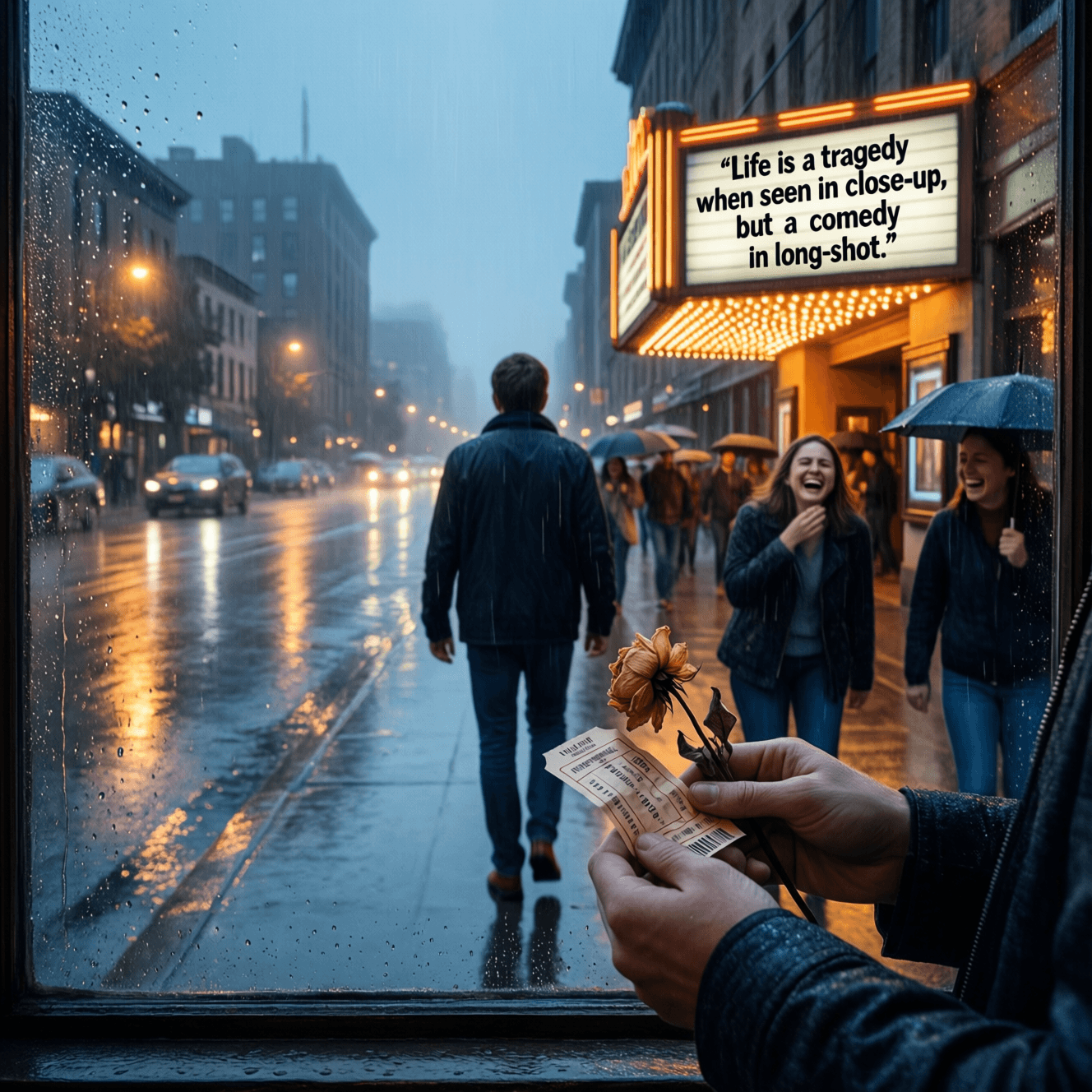
Life is a tragedy when seen in close-up, but a comedy in long-shot. — Charlie Chaplin
—What lingers after this line?
Chaplin’s Lens on Human Experience
Charlie Chaplin’s line hinges on a filmmaker’s metaphor: change the camera distance, and you change the genre. In close-up, a life contains tears, misunderstandings, and private anguish that feel heavy and singular. Yet when the view widens into a long-shot, the same events can look patterned, even absurd, as though time itself has edited them into something lighter. This shift isn’t about denying pain; rather, it suggests that meaning is partly a matter of perspective. Chaplin, who built comedy from hardship, implies that the story of a life can be reframed without falsifying it—only by moving the frame.
Why Proximity Makes Everything Hurt More
Seen up close, life’s details crowd in: the exact words said in anger, the bill you can’t pay, the moment you realize you’ve disappointed someone. Because we experience events minute by minute, our nervous system treats them as immediate threats or losses, and so tragedy feels like the most honest label. In that sense, “close-up” resembles being trapped inside a scene with no cutaway. From there, Chaplin’s contrast becomes clearer: the closer we are to the raw sensation of an event, the harder it is to locate irony, context, or resolution. The immediate present offers intensity, but it withholds perspective.
Distance Turns Chaos Into Pattern
Once time passes, the same sequence of mishaps can look strangely coherent, even comedic. A missed train that ruined your day might later become a story whose punchline is your own overconfidence; an awkward social blunder can soften into a tale you retell because it now has an ending. By stepping into a “long-shot,” you see the arc rather than the sting. In other words, distance doesn’t erase what happened—it reorganizes it. Memory, retelling, and hindsight function like editing: they compress, highlight, and create contrast, which is precisely how comedy often works.
Comedy as Survival, Not Dismissal
Chaplin’s remark also hints at comedy’s moral function: it helps people endure what would otherwise feel unendurable. His own work, including The Kid (1921) and Modern Times (1936), repeatedly turns poverty, hunger, and humiliation into scenes that make audiences laugh without pretending those realities are harmless. The laughter becomes a way to breathe inside the pressure. Therefore, the “long-shot” isn’t cynicism; it’s a coping strategy. By making room for humor, we regain agency over events that once seemed to dominate us, converting helplessness into narrative control.
The Ethics of Laughing at Pain
Still, Chaplin’s framing raises a delicate question: when does long-shot comedy become cruelty? If distance belongs only to observers, humor can slide into ridicule, because the person still living the close-up doesn’t experience the safety of perspective. This is why the same incident can be funny when told by the person who suffered it, but harsh when told by someone else. Consequently, the quote invites a balanced approach: humor works best when it acknowledges the tragedy beneath it. The comedy is earned when it grows out of empathy and shared fragility rather than detachment.
Practicing the Long-Shot Without Denial
A practical reading is that we can learn to zoom out while still respecting what hurts. Journaling, therapy, or simply retelling an event after emotions settle can reveal the wider context—what you learned, what you survived, what was never fully under your control. Over time, you may notice that some “tragic” scenes were also misunderstandings, timing errors, or human clumsiness that, in hindsight, carry a wry humor. Ultimately, Chaplin suggests that life contains both genres at once. The art is knowing when to honor the close-up with compassion—and when to step back far enough to let the long-shot restore lightness and proportion.
One-minute reflection
What does this quote ask you to notice today?
Related Quotes
6 selectedYou'll never find a rainbow if you're looking down. — Charlie Chaplin
Charlie Chaplin
This quote emphasizes the importance of maintaining a positive outlook. By looking down or focusing on negatives, one may miss the beauty and opportunities that life has to offer.
Read full interpretation →When I hear somebody sigh, 'Life is hard,' I am always tempted to ask, 'Compared to what?' — Sydney J. Harris
Sydney J. Harris
Sydney J. Harris’s remark begins with an ordinary expression of fatigue: “Life is hard.” Yet his response, “Compared to what?” quietly turns complaint into inquiry.
Read full interpretation →Where you stand determines what you see and what you do not see; a change in where you stand changes everything. — Søren Kierkegaard
Søren Kierkegaard
Kierkegaard’s insight begins with a simple but unsettling claim: vision is never neutral. Where we stand—socially, emotionally, spiritually, or intellectually—determines not only what comes into view but also what remain...
Read full interpretation →The point is to have a long-term perspective. — Dalai Lama XIV
Dalai Lama XIV
At its core, the Dalai Lama XIV’s remark urges us to lift our eyes from the pressures of the present moment and consider the wider arc of life. A long-term perspective does not deny today’s difficulties; rather, it place...
Read full interpretation →Sometimes all it takes is a tiny shift of perspective to see something familiar in a totally new light. — Dan Brown
Dan Brown
At first glance, Dan Brown’s quote seems simple, yet its force lies in how little it asks of us: not a total reinvention, but a slight adjustment in viewpoint. He suggests that familiarity can dull perception, making peo...
Read full interpretation →Everything is a season, and this is just a chapter, not your whole story. — Glennon Doyle
Glennon Doyle
At its core, Glennon Doyle’s quote reframes hardship and change by comparing life to the natural cycle of seasons. Just as winter does not cancel spring, a painful or uncertain period does not define a person forever.
Read full interpretation →More From Author
More from Charlie Chaplin →You'll never find a rainbow if you're looking down. — Charlie Chaplin
This quote emphasizes the importance of maintaining a positive outlook. By looking down or focusing on negatives, one may miss the beauty and opportunities that life has to offer.
Read full interpretation →We think too much and feel too little. — Charlie Chaplin
Charlie Chaplin’s famous words, 'We think too much and feel too little,' capture a lingering human dilemma—that intellect, while invaluable, can overshadow our emotional selves. Spoken by a comedic genius who observed th...
Read full interpretation →Nothing is permanent in this wicked world — not even our troubles. — Charlie Chaplin
At the outset, Chaplin’s line turns a grim recognition into solace: the world may be wicked, yet its wickedness is temporary—and so are our sorrows. Comedy thrives on that time-lag between pain and relief; Carol Burnett’...
Read full interpretation →