
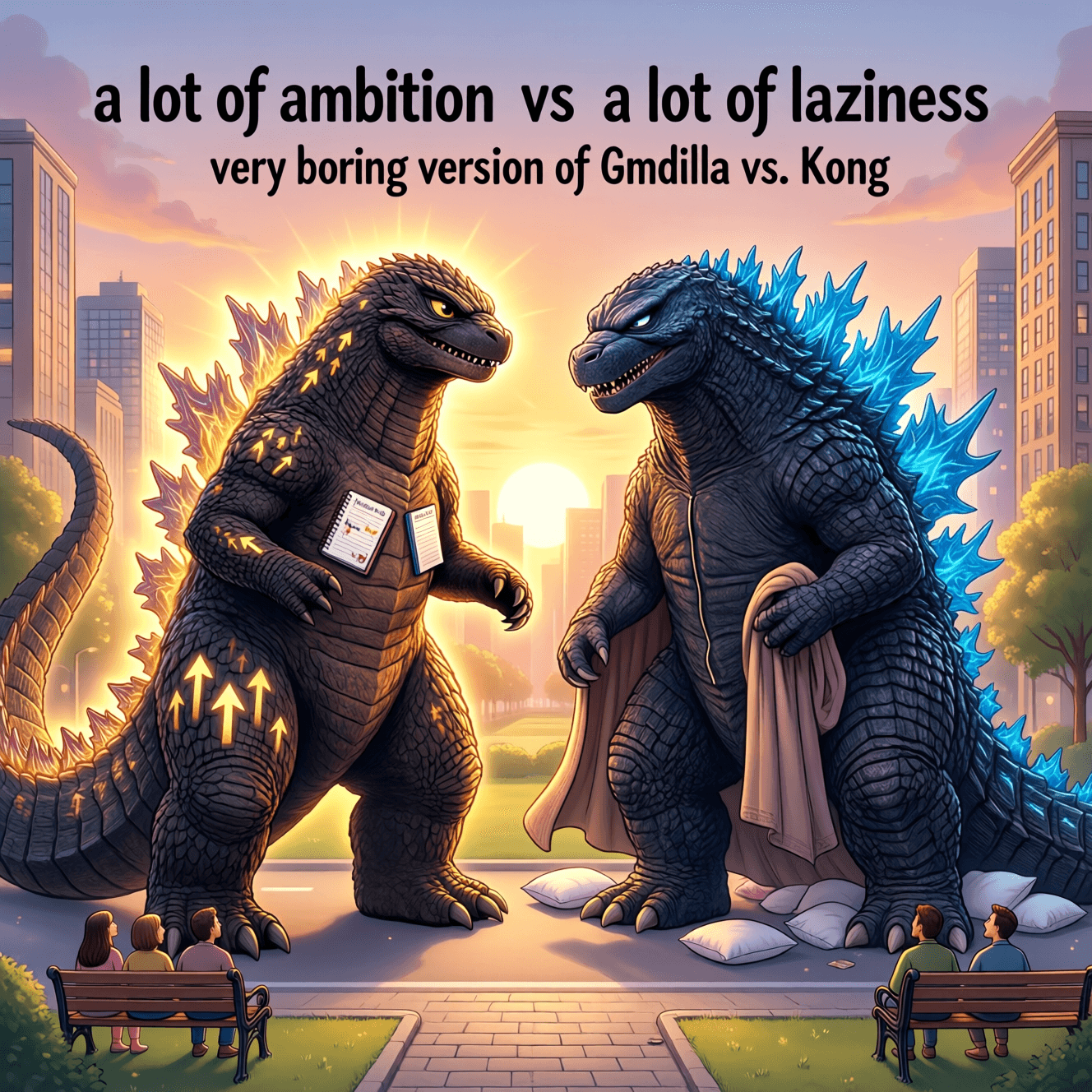
I have a lot of ambition, but I also have a lot of laziness. They're constantly fighting. It's a very boring version of Godzilla vs. Kong. — Ali Wong
—What lingers after this line?
A Comic Metaphor for a Real Conflict
Ali Wong turns an intimate struggle into a vivid pop-culture image: ambition and laziness as two giant forces wrestling in the same small city of the self. By calling it a “boring version of Godzilla vs. Kong,” she highlights how dramatic the stakes can feel internally, even when the outward result is simply another day of procrastination or half-finished plans. The joke lands because it captures the mismatch between how epic our intentions sound in our heads and how mundane our follow-through can look in practice. That contrast sets the tone for the deeper point: many people aren’t short on desire or potential—they’re caught in a repetitive stalemate that drains energy without producing much change.
Why the Battle Feels So Constant
Underneath the humor is a familiar pattern of competing motivations: one part of us wants progress, recognition, or creative fulfillment, while another part wants comfort, ease, and protection from effort. This tug-of-war is especially persistent because both sides offer something immediately valuable—ambition promises a better future, while laziness provides instant relief. As a result, the conflict doesn’t resolve like a movie climax; it loops. One day ambition roars, making plans and buying notebooks. The next day laziness wins with a quiet, practical argument: rest first, start tomorrow, you’ve earned a break.
The “Boring” Part: Stalemate and Drift
Calling it “boring” is a sharp observation about how self-conflict often plays out. The inner narrative may be intense—self-talk, guilt, pep speeches, bargaining—but externally it can look like stasis: the same goals re-announced, the same tasks postponed. Instead of a spectacular crash, it’s a slow leak of momentum. This is where the line resonates as more than a punchline. A stalemate can be more frustrating than failure because it preserves the feeling that you should be moving while offering endless reasons not to.
Ambition’s Fuel and Laziness’s Logic
Wong’s framing also suggests that laziness isn’t merely a character flaw; it has persuasive logic. Laziness can be a way to conserve energy, avoid discomfort, or sidestep the risk of discovering you’re not as good as your ambition imagines. In that sense, it’s often less about idleness and more about emotional protection. Meanwhile, ambition can be both inspiring and punishing. It supplies drive, but it can also raise the bar so high that starting feels like stepping into judgment. When those two forces meet, the “fight” is really a negotiation over safety versus growth.
Identity, Shame, and the Comedy of Contradiction
The joke works because it acknowledges a contradiction many people hide: “I want a lot” coexisting with “I don’t want to do much.” That mismatch can trigger shame, especially in cultures that treat productivity as virtue. Wong defuses that shame by making it laughable, which is itself a small form of freedom. From there, the humor invites a gentler self-understanding: you can be ambitious without being consistently industrious, and you can be tired without being unmotivated. The contradiction doesn’t make you fake—it makes you human.
From Monster Fight to Manageable Truce
If the inner battle is endless, a useful shift is moving from “who wins?” to “what arrangement works?” Rather than waiting for ambition to permanently defeat laziness, many people do better by reducing the arena: smaller tasks, clearer starts, and expectations that allow imperfect progress. In practice, this can look like committing to a tiny first step that is too easy to refuse, then letting momentum carry what motivation cannot. Seen this way, Wong’s “boring” monster movie becomes a relatable strategy tale: the goal isn’t a final knockout, but a workable truce that lets ambition advance without treating rest as the enemy.
One-minute reflection
What feeling does this quote bring up for you?
Related Quotes
6 selectedIf you are not failing from time to time, you are not aiming high enough. — Soichiro Honda
Soichiro Honda
At its core, Soichiro Honda’s remark reframes failure from a mark of inadequacy into proof of aspiration. If every attempt succeeds smoothly, the goal may be too safe, too familiar, or too small to stretch one’s abilitie...
Read full interpretation →The world belongs to the energetic. — Ralph Waldo Emerson
Ralph Waldo Emerson
Emerson’s line condenses an entire philosophy into a few words: the world tends to yield itself to those who move with vigor, initiative, and persistence. At first glance, “the energetic” may sound like people blessed wi...
Read full interpretation →Whatever you want to do, do it now. — Michael Landon
Michael Landon
Michael Landon’s line turns a private wish into a public command: if something matters, do it now. At first glance, the statement sounds simple, yet its force lies in how it strips away excuses, postponements, and the fa...
Read full interpretation →Someday is a disease that will take your dreams to the grave with you. — Tim Ferriss
Tim Ferriss
At first glance, “someday” sounds innocent, even hopeful. Yet Tim Ferriss turns it into a warning, arguing that the word often disguises delay rather than possibility.
Read full interpretation →Between every ambition, plant a seed of stillness. — The Balanced Edit
The Balanced Edit
At first glance, “Between every ambition, plant a seed of stillness” suggests that striving should not be continuous motion. The image of planting is important: stillness is not idleness, but something quietly cultivated...
Read full interpretation →We do today what they won't, so tomorrow we can accomplish what they can't. — Dwayne Johnson
Dwayne Johnson
At its core, Dwayne Johnson’s line frames success as a delayed reward earned through present sacrifice. The contrast between “won’t” and “can’t” is crucial: many people avoid difficult habits not because they are impossi...
Read full interpretation →More From Author
More from Ali Wong →