
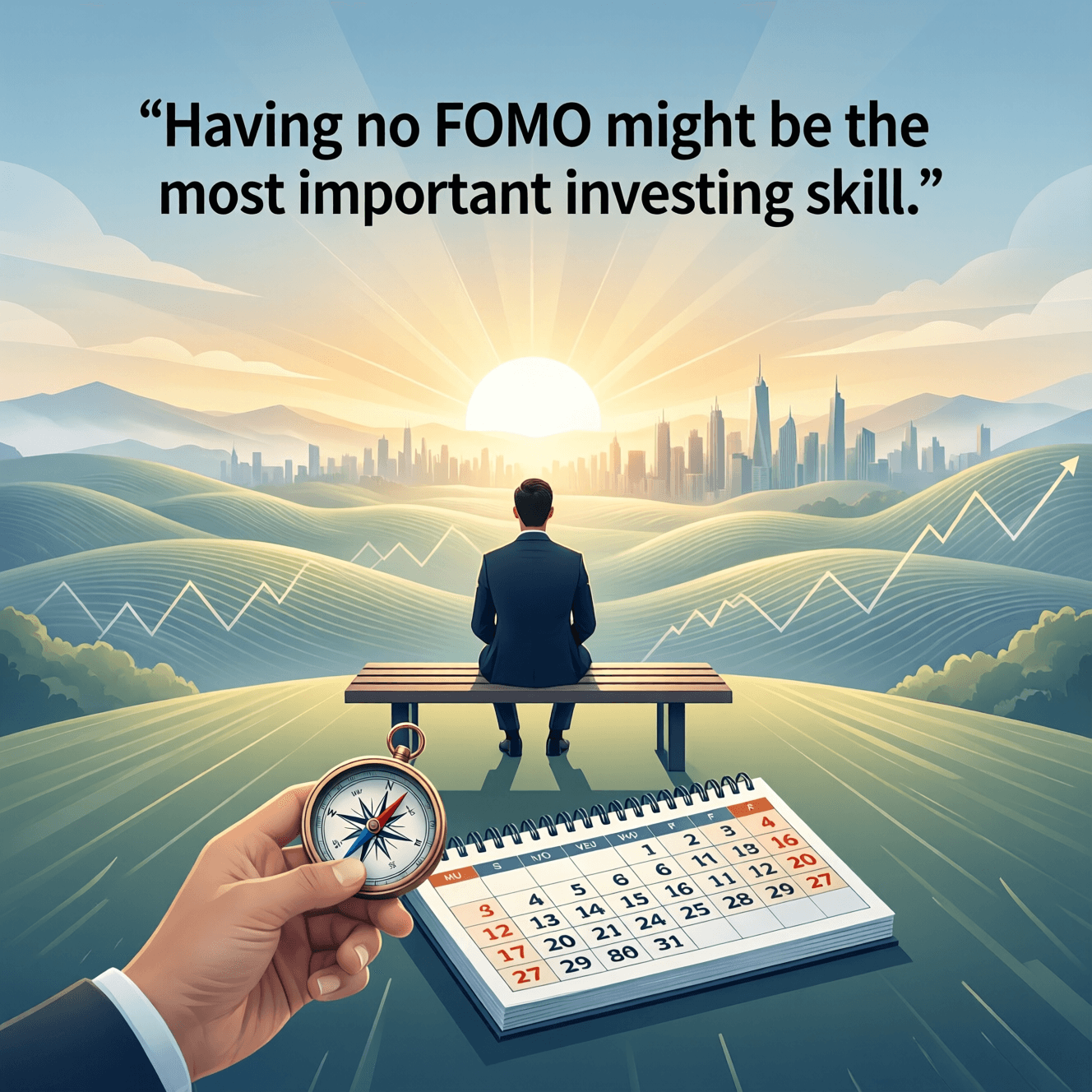
Having no FOMO might be the most important investing skill. — Morgan Housel
—What lingers after this line?
Why FOMO Becomes an Investing Enemy
Morgan Housel’s line points to a deceptively simple truth: the market punishes urgency more often than it rewards it. FOMO—fear of missing out—turns investing from a plan into a reflex, where decisions are driven by what just went up rather than what makes sense. From there, a subtle shift happens: you stop measuring progress against your goals and start measuring it against other people’s screenshots, headlines, and overnight winners. In that environment, “being right” feels less important than “not being left behind,” which is exactly how disciplined investors get pulled into undisciplined risks.
The Social Comparison Trap
Because investing is publicly narrated—through news tickers, social media posts, and cocktail-party stories—it’s uniquely vulnerable to comparison. Even if you’re doing fine, someone else’s exceptional year can make your steady returns feel like failure. That’s why Housel’s point is less about emotion management and more about identity: are you the kind of person who follows a strategy, or the kind of person who follows a crowd? Once comparison becomes your compass, you’re likely to buy what has already become popular, which often means paying the highest prices precisely when future returns are lowest.
Chasing Performance and Buying High
FOMO most often expresses itself as performance-chasing: piling into assets after they’ve already delivered eye-catching gains. The painful irony is that the very visibility of past success attracts late money, and late money tends to experience mean reversion. In other words, the emotion of “I can’t miss this” frequently arrives at the moment when the opportunity is most crowded. As Jason Zweig has repeatedly noted in his Wall Street Journal columns on investor behavior, ordinary investors commonly underperform the funds they invest in because they buy after good runs and sell after bad ones—FOMO at the top, fear at the bottom.
Patience as a Competitive Advantage
If FOMO is the impulse to act, then its opposite is the willingness to wait. That doesn’t sound like a skill, but in markets it functions like one, because patience is scarce. Resisting the urge to trade gives compounding time to do the work that frantic decision-making interrupts. This is why “doing nothing” can be an active choice rather than a passive one. Warren Buffett’s annual letters to Berkshire Hathaway shareholders have long emphasized that the big money is often made by sitting on good businesses, not by constantly searching for the next one. Avoiding FOMO protects that sitting still.
Having a Plan That Beats a Feeling
A practical way to neutralize FOMO is to replace mood-based decisions with rule-based actions. Clear asset allocation targets, rebalancing bands, and automatic contributions create a system where you participate in markets without needing to interpret every surge as a personal emergency. Then, when a speculative boom appears, your plan gives you a script: if the asset exceeds your target weight, you trim; if it collapses and your long-term thesis remains intact, you add—slowly and proportionally. The plan doesn’t eliminate uncertainty, but it prevents excitement from rewriting your standards in real time.
Redefining “Missing Out” as a Feature
Ultimately, investing well requires accepting that you will miss out—on many things, including some legitimate winners. But missing out is not always a mistake; often it’s the cost of avoiding the blow-ups that come from chasing every story. Housel’s insight lands because it reframes success: the goal isn’t to capture every upside spike; it’s to reach your destination with survivable risk. Once you treat “not owning the hottest thing” as normal rather than shameful, you free yourself to focus on what actually matters: a strategy you can stick with when the crowd is celebrating, and when the crowd is panicking.
One-minute reflection
What's one small action this suggests?
Related Quotes
6 selectedThe most important investment you can make is in your own education. — Morgan Housel
Morgan Housel
Morgan Housel’s statement reframes investment away from stocks, property, or savings accounts and toward something far more durable: personal knowledge. At first glance, education may seem less tangible than financial as...
Read full interpretation →It is only shallow people who require years to get rid of an emotion. A man who is master of himself can end a sorrow as easily as he can invent a pleasure. — Oscar Wilde
Oscar Wilde
Oscar Wilde’s remark is deliberately provocative, drawing a sharp line between those ruled by feeling and those who govern it. At first glance, he seems almost cruel in dismissing prolonged sorrow as a mark of shallownes...
Read full interpretation →Money's greatest intrinsic value is its ability to give you control over your time. — Morgan Housel
Morgan Housel
Morgan Housel’s line shifts the conversation away from money as a scoreboard and toward money as an instrument. Instead of asking how much wealth proves success, it asks what wealth lets you do with your days.
Read full interpretation →Doing well with money has a little to do with how smart you are and a lot to do with how you behave. — Morgan Housel
Morgan Housel
Morgan Housel’s line reframes “being good with money” away from spreadsheets and toward psychology. The point isn’t that knowledge is useless, but that intelligence alone rarely determines outcomes when money is involved...
Read full interpretation →Spending money to show people how much money you have is the fastest way to have less money. — Morgan Housel
Morgan Housel
Morgan Housel’s line hinges on a simple contradiction: the more you spend trying to look wealthy, the less wealth you keep. Status purchases feel like proof of success, but they often function as withdrawals from the ver...
Read full interpretation →The hardest financial skill is getting the goalpost to stop moving. — Morgan Housel
Morgan Housel
Morgan Housel’s line points to a counterintuitive truth: personal finance is rarely defeated by a lack of calculators or knowledge of index funds; it’s defeated by shifting desires. You can hit a savings target, pay off...
Read full interpretation →More From Author
More from Morgan Housel →The most important investment you can make is in your own education. — Morgan Housel
Morgan Housel’s statement reframes investment away from stocks, property, or savings accounts and toward something far more durable: personal knowledge. At first glance, education may seem less tangible than financial as...
Read full interpretation →Money's greatest intrinsic value is its ability to give you control over your time. — Morgan Housel
Morgan Housel’s line shifts the conversation away from money as a scoreboard and toward money as an instrument. Instead of asking how much wealth proves success, it asks what wealth lets you do with your days.
Read full interpretation →Doing well with money has a little to do with how smart you are and a lot to do with how you behave. — Morgan Housel
Morgan Housel’s line reframes “being good with money” away from spreadsheets and toward psychology. The point isn’t that knowledge is useless, but that intelligence alone rarely determines outcomes when money is involved...
Read full interpretation →Spending money to show people how much money you have is the fastest way to have less money. — Morgan Housel
Morgan Housel’s line hinges on a simple contradiction: the more you spend trying to look wealthy, the less wealth you keep. Status purchases feel like proof of success, but they often function as withdrawals from the ver...
Read full interpretation →