
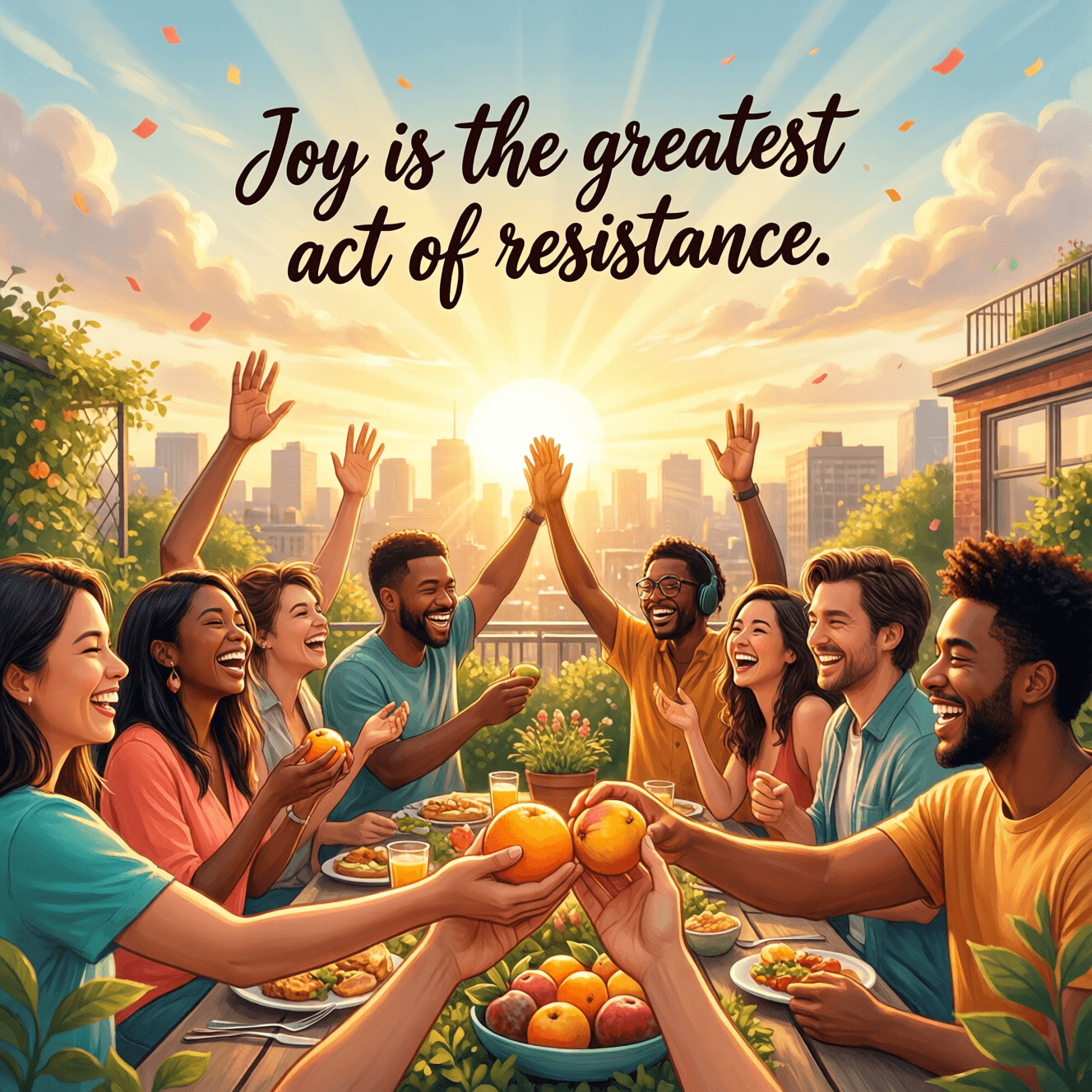
Joy is the greatest act of resistance. — Valarie Kaur
—What lingers after this line?
Reframing Joy as Defiance
Valarie Kaur’s line turns a feeling into a stance: joy is not merely a private mood but a public refusal to be reduced by injustice. Rather than treating happiness as naïve, she suggests joy can be chosen with clear eyes—an insistence that oppression does not get the final word. This reframing matters because resistance is often imagined only as protest, critique, or sacrifice. Yet by naming joy as “the greatest act,” Kaur elevates the inner life—our capacity for wonder, laughter, and connection—into a battleground where power also tries to dominate.
What Joy Protects in the Human Spirit
If oppressive systems aim to produce fear, numbness, and isolation, then joy protects exactly what those systems threaten: dignity, belonging, and imagination. In that sense, joy functions like a shield for the psyche, preserving the belief that life can be otherwise. From here, the quote implies that despair is not only an emotion but a tactic that spreads when people feel alone and hopeless. Joy interrupts that spread. It keeps communities emotionally breathable, making it possible to keep caring—and therefore to keep acting—when exhaustion would otherwise win.
Joy as a Renewable Source of Energy
Resistance requires endurance, and endurance requires replenishment. Joy supplies a kind of renewable fuel: it restores the nervous system and helps people return to struggle without losing themselves. This is why movements often include music, dance, humor, and shared meals alongside strategy meetings. A simple anecdote captures the logic: after a long day of organizing, volunteers who sing together on the walk home may not have changed policy yet, but they have strengthened the bonds that make tomorrow’s work possible. In that way, joy is not a detour from resistance—it is the maintenance that keeps resistance alive.
Collective Joy and the Creation of Solidarity
Joy becomes especially potent when it is collective. Shared celebration signals, “We are still here,” transforming individuals into a we. That communal dimension makes joy legible as resistance, because it publicly contests narratives that certain people should be quiet, ashamed, or invisible. Historically, spirituals sung by enslaved African Americans functioned as both consolation and coded communication, showing how song can hold grief and defiance at once. Moving from that example to the present, marches that incorporate chant and rhythm demonstrate the same principle: collective joy is a social glue that turns vulnerability into solidarity.
Joy That Doesn’t Deny Grief
Kaur’s statement doesn’t require pretending everything is fine. In fact, the most credible joy is often the kind that coexists with mourning, because it acknowledges reality while refusing to be flattened by it. Joy here is closer to courage than to cheerfulness. This is why the quote resonates after loss: people may gather for a memorial, cry together, and still tell stories that spark laughter. The laughter doesn’t erase the harm; it asserts that love, memory, and meaning survive. In that continuity, joy becomes a moral declaration: we will not be hollowed out.
Practicing Joy as Daily Resistance
Seen this way, joy can be practiced—through mutual care, creativity, rest, and the deliberate noticing of beauty. These actions may look small, but they challenge the logic of systems that profit from burnout and disconnection. Choosing joy becomes a way of reclaiming time, attention, and agency. Finally, Kaur’s claim invites a disciplined question: what kind of joy strengthens commitment rather than escaping responsibility? The answer is a joy that expands empathy and keeps people in relationship. When joy deepens our capacity to show up—again and again—it becomes not only resistance, but a strategy for lasting change.
One-minute reflection
What feeling does this quote bring up for you?
Related Quotes
6 selectedWe need joy as we need air. We need love as we need water. We need each other as we need the earth we share. — Maya Angelou
Maya Angelou
Maya Angelou’s words turn emotional needs into elemental ones, placing joy beside air, love beside water, and human connection beside the earth itself. By doing so, she refuses to treat happiness, affection, and communit...
Read full interpretation →Joy is a net of love by which you can catch souls. — Mother Teresa
Mother Teresa
Mother Teresa’s saying begins with a striking metaphor: joy is not merely a private feeling, but an instrument that reaches outward. By calling it a “net of love,” she suggests that joy gathers people in without force, p...
Read full interpretation →Adults can benefit from play as much as children. Go ahead and dance with your dog or build something just for fun. — Dr. Elinore McCance-Katz
Katz
At first glance, Dr. Elinore McCance-Katz’s quote sounds almost disarmingly simple, yet it challenges a common adult assumption: that play belongs mainly to childhood.
Read full interpretation →Art begins with resistance—at the point where resistance is overcome. No human masterpiece has ever been created without great labor. — André Gide
André Gide
At its core, André Gide’s statement defines art not as effortless inspiration but as a struggle that starts where friction appears. Resistance may take many forms—technical difficulty, self-doubt, material limits, or the...
Read full interpretation →There is no true joy in a life lived closed up in the little shell of the self. — The Dalai Lama
The Dalai Lama
At its core, the Dalai Lama’s statement argues that a life centered only on personal comfort, status, or protection becomes emotionally cramped. The image of a ‘little shell’ suggests not strength but confinement: when p...
Read full interpretation →Whenever you recover or discover something that nourishes your soul and brings joy, care enough about yourself to make room for it in your life. — Jean Shinoda Bolen
Jean Shinoda Bolen
Jean Shinoda Bolen’s words begin with a gentle but radical premise: joy is not a luxury to be postponed, but something worthy of deliberate space in our lives. Rather than treating soul-nourishing experiences as accident...
Read full interpretation →More From Author
More from Valarie Kaur →