
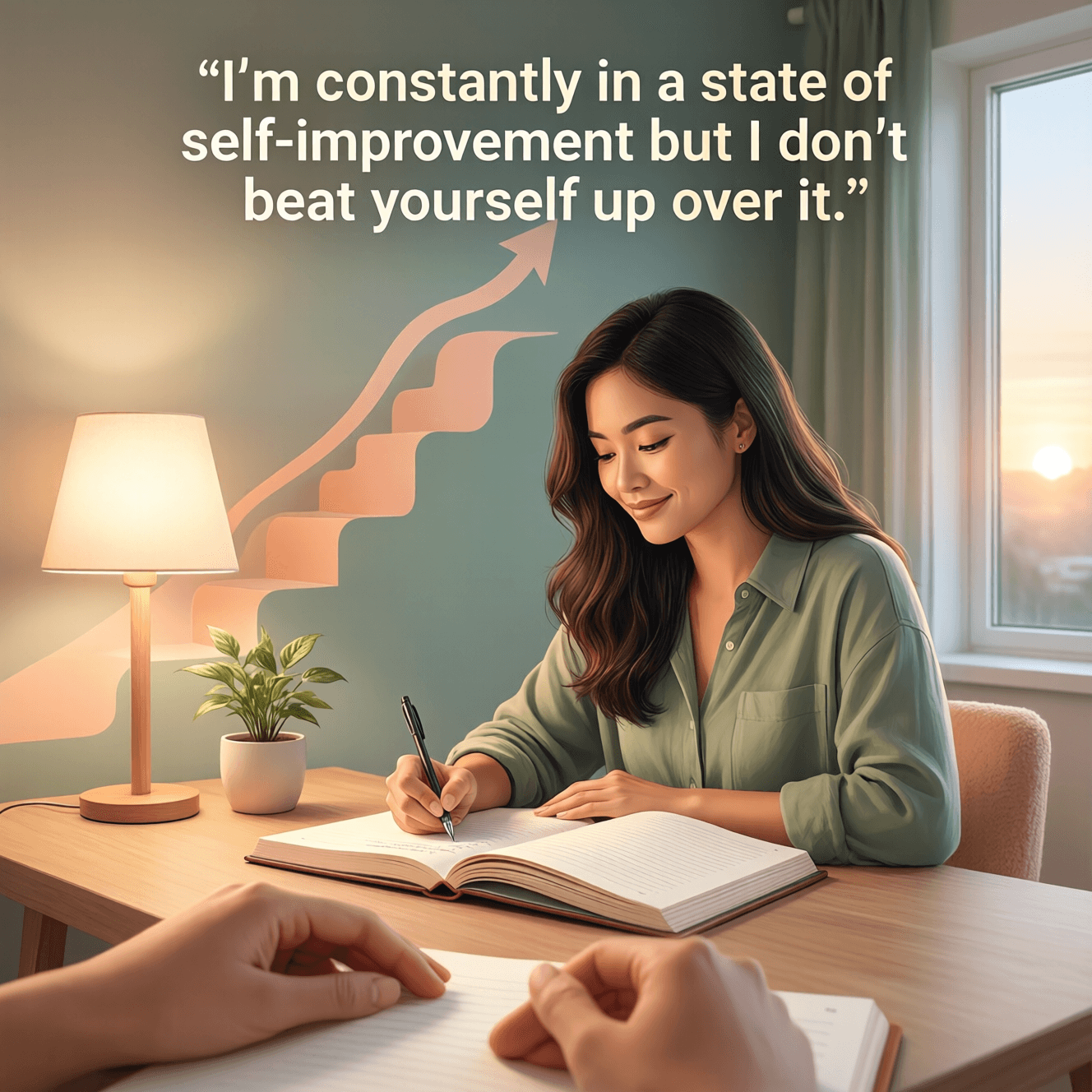
I'm constantly in a state of self-improvement but I don't beat myself up over it. — Mindy Kaling
—What lingers after this line?
A Growth Mindset, Minus the Guilt
Mindy Kaling’s line captures a modern ideal: keep evolving, but refuse to turn the process into a courtroom where you are both defendant and judge. Self-improvement here is not an emergency response to being “not enough,” but an ongoing practice—more like daily hygiene than moral failure. This framing matters because many people confuse ambition with self-criticism. By separating the desire to get better from the impulse to self-attack, Kaling suggests you can be motivated by curiosity and possibility rather than fear and inadequacy.
The Difference Between Discipline and Self-Flagellation
Building on that, the quote distinguishes constructive discipline from self-punishment. Discipline asks, “What’s the next helpful step?” whereas self-flagellation asks, “What’s wrong with me?” The first produces plans; the second produces spirals. In practice, this can look like reviewing a mistake the way a coach would—specific, actionable, forward-facing—rather than replaying it for emotional penance. Kaling’s tone implies that improvement is compatible with kindness, and that harshness is not a prerequisite for high standards.
Self-Compassion as a Performance Strategy
From there, the quote aligns with research on self-compassion as a tool for resilience rather than indulgence. Kristin Neff’s work on self-compassion (e.g., *Self-Compassion*, 2011) argues that treating yourself with warmth during setbacks can reduce shame and support healthier persistence. Seen this way, not “beating yourself up” is pragmatic: shame tends to narrow attention and encourage avoidance, while compassion makes it easier to face feedback honestly. Kaling’s approach implies that the most sustainable self-improvement runs on encouragement, not intimidation.
Progress Through Iteration, Not Reinvention
Next, “constantly” suggests small, continuous upgrades rather than dramatic overhauls. This echoes the logic of incremental improvement often associated with Kaizen practices in business culture, where tiny changes compound over time. Instead of reinventing your identity every January, the quote favors iterative refinement: adjust a habit, strengthen a skill, revise a boundary, repeat. The emotional benefit is that your current self is not discarded; it becomes the foundation for the next version.
Keeping Standards While Staying on Your Side
Finally, Kaling’s statement models a balanced inner relationship: you can hold yourself accountable while still being your ally. Accountability sets direction—deadlines, feedback, practice—while self-respect keeps the journey livable. In a culture that often romanticizes burnout and harsh self-talk as proof of seriousness, this quote offers a quieter credibility: you’re allowed to want more and still like yourself now. The endpoint isn’t perfection; it’s forward motion with dignity intact.
One-minute reflection
What feeling does this quote bring up for you?
Related Quotes
6 selectedConfidence is silent. Insecurities are loud. — Unknown (Wait—skip/replace with: True nobility is being superior to your former self. — Ernest Hemingway)
Ernest Hemingway
At its core, Hemingway’s line redefines nobility as an inward achievement rather than a social rank. Instead of measuring worth by wealth, pedigree, or dominance over others, it points to a quieter standard: becoming bet...
Read full interpretation →Mindfulness is a way of befriending ourselves and our experience. — Jon Kabat-Zinn
Zinn
At its core, Jon Kabat-Zinn’s statement reframes mindfulness as an act of friendship rather than self-improvement. To be mindful is not merely to pay attention, but to meet our thoughts, feelings, and bodily sensations w...
Read full interpretation →You are under no obligation to be consistent with the person you were yesterday. — James McCrae
James McCrae
At its core, James McCrae’s line challenges the quiet pressure to remain legible to others. Many people feel bound to opinions, habits, or identities simply because they once claimed them, as though consistency were a mo...
Read full interpretation →Rest for you could look like moving slower as you clean the house or being mindful while you make a meal. It probably means being nicer to yourself. — Jeff Brown
Jeff Brown
At first glance, Jeff Brown’s reflection challenges the common idea that rest only happens when all activity stops. Instead, he suggests that rest can exist inside ordinary moments: in the pace we choose, the attention w...
Read full interpretation →Growth often looks like slowing down, reassessing, and rebuilding with intention. — Erin Gregory
Erin Gregory
At first glance, growth is often imagined as constant acceleration—more output, faster decisions, visible momentum. Erin Gregory’s quote gently overturns that assumption by suggesting that real development may appear qui...
Read full interpretation →Beyond a wholesome discipline, be gentle with yourself. — Jim Rohn
Jim Rohn
At first glance, Jim Rohn’s line places two values side by side that are often treated as opposites: discipline and gentleness. Yet the force of the quote lies in its quiet correction.
Read full interpretation →More From Author
More from Mindy Kaling →Gratitude is the closest thing to beauty manifested in an emotion. — Mindy Kaling
At first glance, Mindy Kaling’s line suggests that beauty is not only something we see but something we feel. Gratitude becomes a kind of inward radiance, transforming an ordinary emotional response into something almost...
Read full interpretation →Write your own part. It's the only way to get exactly what you want. — Mindy Kaling
Mindy Kaling’s advice reads like a simple directive, but it carries a larger philosophy: if you want a role that truly fits you, you may have to create it. Rather than waiting for permission or perfect circumstances, she...
Read full interpretation →If you don't see a clear path for a career, sometimes you have to make it yourself. — Mindy Kaling
Mindy Kaling’s line begins with a candid observation: not everyone is handed a clear career roadmap. In many fields, the “path” is more myth than method—job titles are ambiguous, internships are scarce, and the steps fro...
Read full interpretation →Confidence is just entitlement. Entitlement has a bad rap, but it's just the belief that you should be there. — Mindy Kaling
Mindy Kaling’s line starts by deliberately colliding two concepts that usually live on opposite sides of a moral judgment: confidence and entitlement. Because “entitlement” often evokes arrogance or unearned demands, the...
Read full interpretation →