
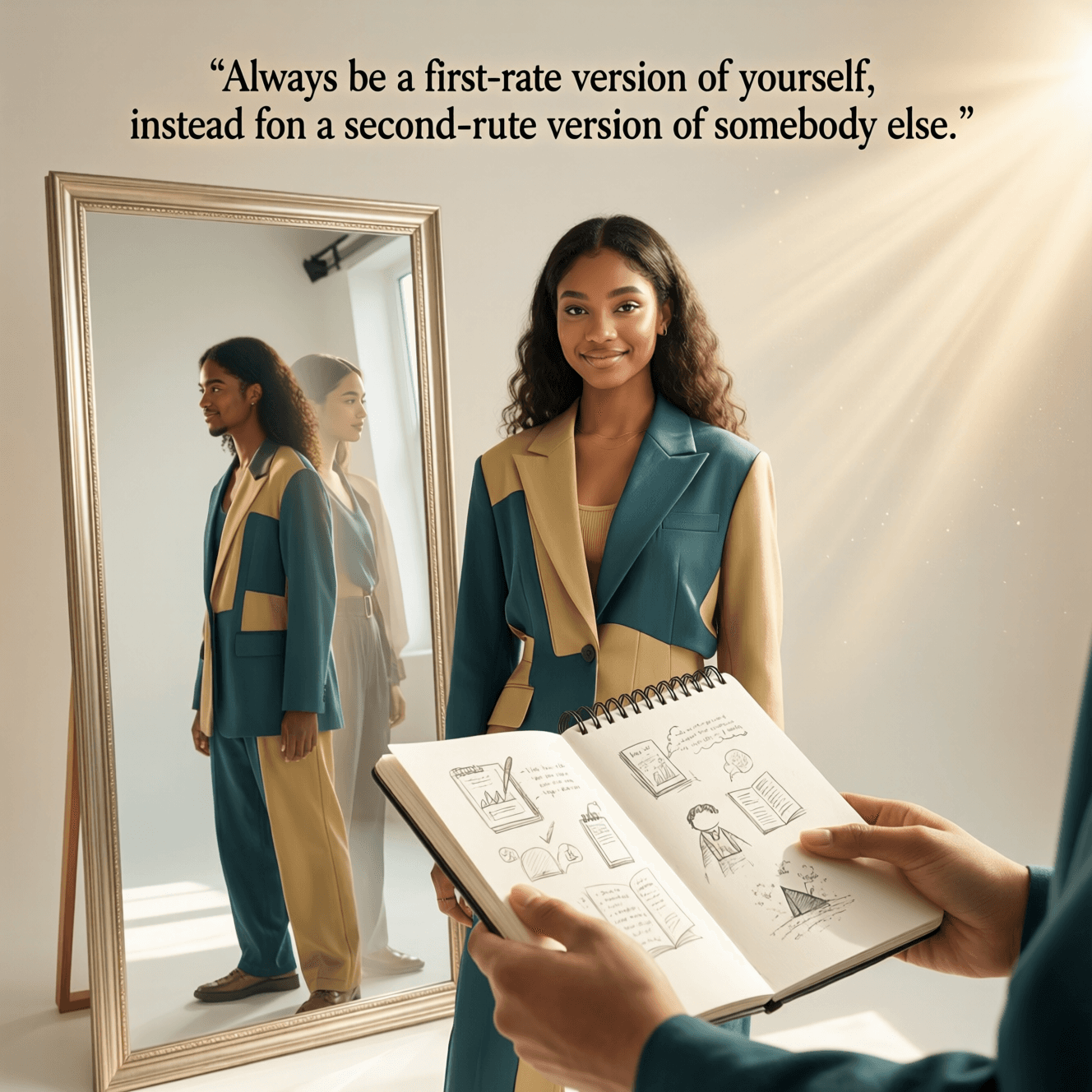
Always be a first-rate version of yourself, instead of a second-rate version of somebody else. — Judy Garland
—What lingers after this line?
The Core Claim: Be Fully Yourself
Judy Garland’s line argues that excellence is most sustainable when it grows from authenticity rather than imitation. A “first-rate” self isn’t a perfected persona; it’s a life shaped by your genuine temperament, values, and talents, refined through practice and honesty. By contrast, being a “second-rate” version of someone else implies living by borrowed standards—always slightly behind, because the original has the home-field advantage. This framing immediately shifts success from comparison to alignment. Instead of asking, “How do I match them?” the quote nudges a better question: “How do I develop what’s distinctively mine?” That reorientation matters, because it replaces anxious mimicry with purposeful self-cultivation.
Why Imitation Keeps You Behind
Imitation can teach technique, but it becomes limiting when it turns into identity. The moment you model your whole self after another person—style, opinions, ambitions—you inherit their goals without inheriting their history, constraints, or motivations. As a result, the performance can feel strained, like wearing someone else’s fitted jacket: close enough to pass, never comfortable enough to thrive. From there, the social cost compounds. When you’re busy tracking a template, you stop noticing your own strengths and the specific contexts where they would shine. Garland’s “second-rate” is not an insult so much as an outcome: copying makes you derivative by design, because your choices are tethered to someone else’s lead.
The Craft of Becoming “First-Rate”
Authenticity isn’t a single revelation; it’s a craft. It often begins with small acts of selection: choosing projects that fit your curiosity, adopting habits that match your energy, and expressing preferences even when they’re unfashionable. Over time, these choices create coherence—others start to recognize your voice because you stop switching dialects to please different crowds. This process also involves refinement rather than raw self-indulgence. Being “first-rate” means developing your natural inclinations with discipline—much like an artist who has a recognizable style yet still studies anatomy, light, or structure. In that sense, Garland’s advice points toward growth that is personal but rigorous.
Identity Versus Performance Under Pressure
The temptation to become a “second-rate somebody” usually peaks under evaluation: interviews, auditions, social media, competitive workplaces. In those moments, it can seem safer to mimic whatever appears rewarded. Yet the more pressure rises, the more valuable authenticity becomes, because it creates internal steadiness when external signals are noisy. A simple real-world pattern illustrates this: two candidates may present equally polished résumés, but the one who can clearly articulate what they uniquely do well—and why it matters to them—often comes across as more trustworthy. The transition from performance to identity is subtle, but audiences tend to feel it. Garland’s line is a reminder that credibility is often the byproduct of being unforced.
Learning From Others Without Losing Yourself
Garland’s quote doesn’t require rejecting influence; it warns against surrendering authorship. You can study mentors the way writers study prose or athletes study film: extract methods, then adapt them to your own build and aims. This is imitation as apprenticeship, not imitation as disappearance. A helpful distinction follows: copy strategies, not selves. If you admire someone’s confidence, learn the behaviors that build it—preparation, boundaries, rehearsal—while letting the outward expression remain yours. In that way, influence becomes a toolkit rather than a costume, and you remain “first-rate” because the final composition is still unmistakably you.
The Long-Term Payoff: A Life You Can Maintain
Finally, authenticity is pragmatic. Maintaining an adopted identity is expensive: it requires constant monitoring, constant comparison, and constant fear of being “found out” as less than the original. In contrast, being yourself—while continually improving—creates a life you can actually sustain, because it aligns with your real capacities and desires. Over years, this alignment compounds into reputation and peace of mind. People may not always agree with you, but they can predict you, trust your consistency, and understand your direction. Garland’s counsel therefore reads as both encouragement and strategy: choose the path where your best efforts produce a unique excellence, not a lifelong echo.
One-minute reflection
What's one small action this suggests?
Related Quotes
6 selectedTo be part of society is to lose a part of yourself; do what you would do if you were the only person on Earth. — Derek Sivers
Derek Sivers
Derek Sivers’ line begins with a sober observation: joining society often means trimming away parts of the self to fit shared expectations. Manners, careers, tastes, and even ambitions can become performances shaped by a...
Read full interpretation →The world accommodates you for fitting in, but only rewards you for standing out. — Matshona Dhliwayo
Matshona Dhliwayo
Matshona Dhliwayo’s quote begins with a social truth: the world often makes room for people who adapt to its expectations. Fitting in can bring acceptance, safety, and access, because groups tend to welcome those who und...
Read full interpretation →There is a quiet power in the ability to simply be, to exist without the need for constant performance. — Eileen Caddy
Eileen Caddy
Eileen Caddy’s words begin with a gentle challenge to modern restlessness: we often feel compelled to prove our worth through productivity, charm, achievement, or constant visibility. Yet her phrase “quiet power” suggest...
Read full interpretation →Be who you are and say what you feel, because those who mind don't matter, and those who matter don't mind. — Bernard M. Baruch
Bernard M. Baruch
Baruch’s quote begins with a simple but demanding instruction: be yourself and speak honestly. At its core, the line argues that authenticity is not merely a personality trait but an act of courage, especially in a world...
Read full interpretation →Children do not need us to shape them. They need us to respond to who they are. — Naomi Aldort
Naomi Aldort
Naomi Aldort’s statement begins by rejecting a familiar adult impulse: the desire to mold children into predetermined forms. Instead, she proposes a quieter and more demanding task—paying attention to the person already...
Read full interpretation →If the family were a fruit, it would be an orange, a circle of sections, held together but separable—each segment distinct. — Letty Cottin Pogrebin
Letty Cottin Pogrebin
At first glance, Letty Cottin Pogrebin’s image feels simple, yet it captures family structure with unusual precision. By comparing a family to an orange, she evokes something whole, rounded, and naturally unified.
Read full interpretation →More From Author
More from Judy Garland →