
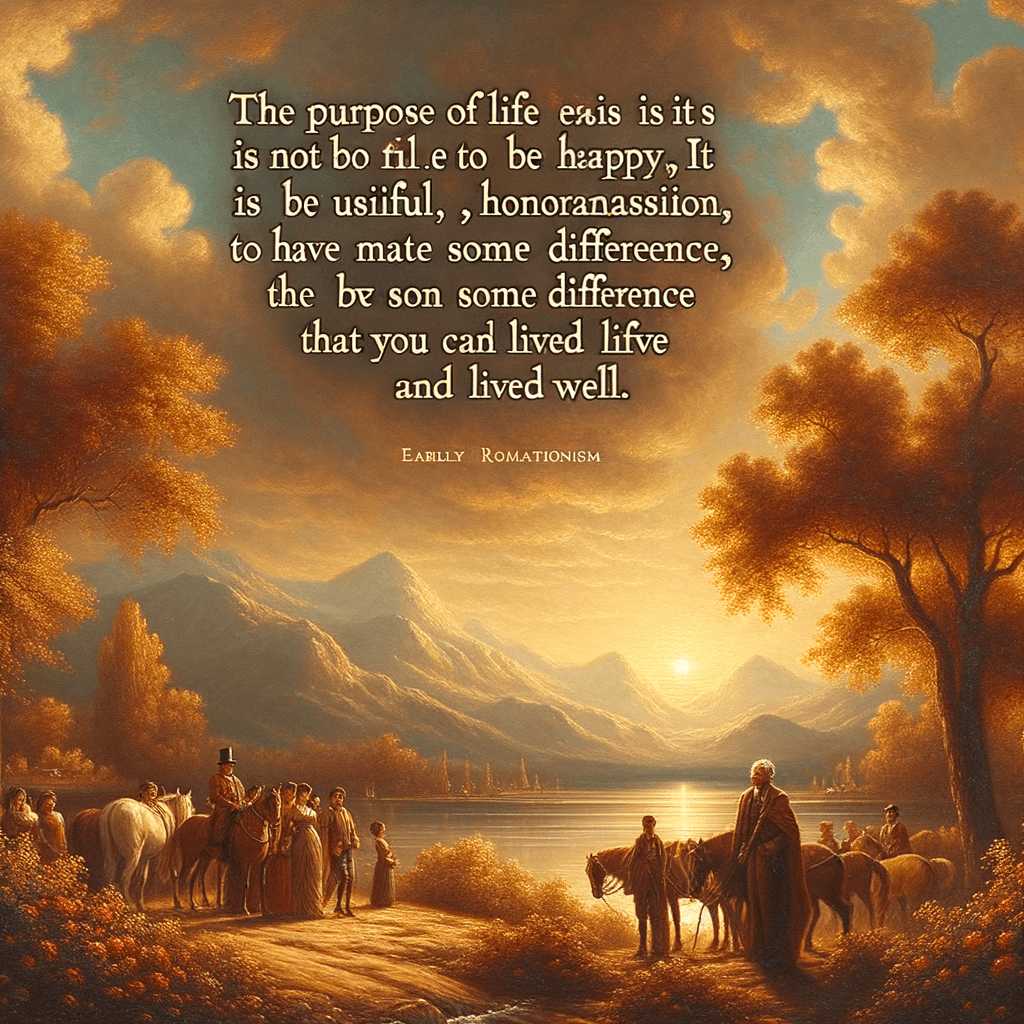
The purpose of life is not to be happy. It is to be useful, to be honorable, to be compassionate, to have it make some difference that you have lived and lived well. — Ralph Waldo Emerson
—What lingers after this line?
Utility and Contribution
This quote highlights that the ultimate goal of life is to be useful and contribute positively to the world around you. It's about creating a meaningful impact rather than just seeking personal happiness.
Honor and Integrity
Emerson emphasizes living with honor and integrity. Leading an honorable life involves being true to one's values and principles, and acting in a way that earns respect and credibility.
Compassion and Empathy
Being compassionate means understanding and helping others. Emerson suggests that part of a fulfilling life is showing kindness and empathy toward fellow human beings.
Making a Difference
The quote stresses leaving a positive mark on the world. Emerson believes that a well-lived life is one where your actions and presence have made a significant, beneficial difference.
Philosophical Insight
Ralph Waldo Emerson, a 19th-century American philosopher and essayist, often explored themes related to individual purpose and the human condition. This quote reflects his transcendentalist beliefs in the importance of making a meaningful impact beyond personal gratifications.
Recommended Reading
As an Amazon Associate, we earn from qualifying purchases.
One-minute reflection
What feeling does this quote bring up for you?
Related Quotes
6 selectedYou shouldn't have to crash to deserve compassion. — Tessa Frazer
Tessa Frazer
At first glance, Tessa Frazer’s line exposes a painful social habit: people are often taken seriously only after they visibly break down. The quote rejects the idea that suffering must become dramatic before it is consid...
Read full interpretation →In dealing with those who are undergoing great suffering, if you feel burnout setting in, it is best, for the sake of everyone, to withdraw and restore yourself. — Dalai Lama XIV
Dalai Lama XIV
At its core, the Dalai Lama’s remark reframes withdrawal not as abandonment but as responsibility. When we accompany people through intense pain, we often imagine that constant presence is the highest form of care.
Read full interpretation →Don't throw your suffering away. Use it. It is the compost that gives you the understanding to nourish your happiness. — Thich Nhat Hanh
Thich Nhat Hanh
At first glance, Thich Nhat Hanh’s words reject the common impulse to discard pain as quickly as possible. Instead, he reframes suffering as something that can be transformed, much like compost becomes fertile soil.
Read full interpretation →Check in on yourself the way you check in on your loved ones. We cannot pour into others without pausing to top up our own reserves. — Blurt It Out
Blurt It Out
At its heart, this quote asks for a simple but radical shift: to offer ourselves the same attentive concern we so readily extend to others. Many people instinctively ask friends and family, “How are you really doing?” ye...
Read full interpretation →To understand one's world, one must sometimes turn away from it; to serve better, one must briefly hold it at a distance. — Jeanette Winterson
Jeanette Winterson
Jeanette Winterson frames understanding as a paradox: to truly know one’s world, one must occasionally step away from its immediate noise. At first, this sounds like withdrawal, yet her point is subtler.
Read full interpretation →Healing yourself is connected with healing others. — Yoko Ono
Yoko Ono
Yoko Ono’s statement begins with a simple but far-reaching insight: healing is rarely a private event. When a person becomes more whole, less reactive, and more compassionate, that inner change naturally affects the peop...
Read full interpretation →More From Author
More from Ralph Waldo Emerson →In art, the hand can never execute anything higher than the heart can imagine. — Ralph Waldo Emerson
Emerson’s line shifts attention from technique to inner vision. At first glance, he seems to be speaking about painting or sculpture, yet his deeper claim is that craftsmanship cannot surpass the emotional and imaginativ...
Read full interpretation →The years teach much which the days never know. — Ralph Waldo Emerson
Emerson’s line points to a difference between living through moments and understanding what those moments mean. A single day can be full of activity—work completed, conversations had, problems solved—yet still leave us w...
Read full interpretation →The sky is the daily bread of the eyes. - Ralph Waldo Emerson
This quote suggests that the sky provides essential visual nourishment to our eyes, much like bread feeds our bodies. It emphasizes the importance of nature in our daily lives.
Read full interpretation →Do not go where the path may lead, go instead where there is no path and leave a trail. — Ralph Waldo Emerson
Emerson encourages individuals to forge their own paths rather than following the conventional routes. This promotes the idea of individualism and nonconformity, suggesting that personal success and fulfillment come from...
Read full interpretation →