
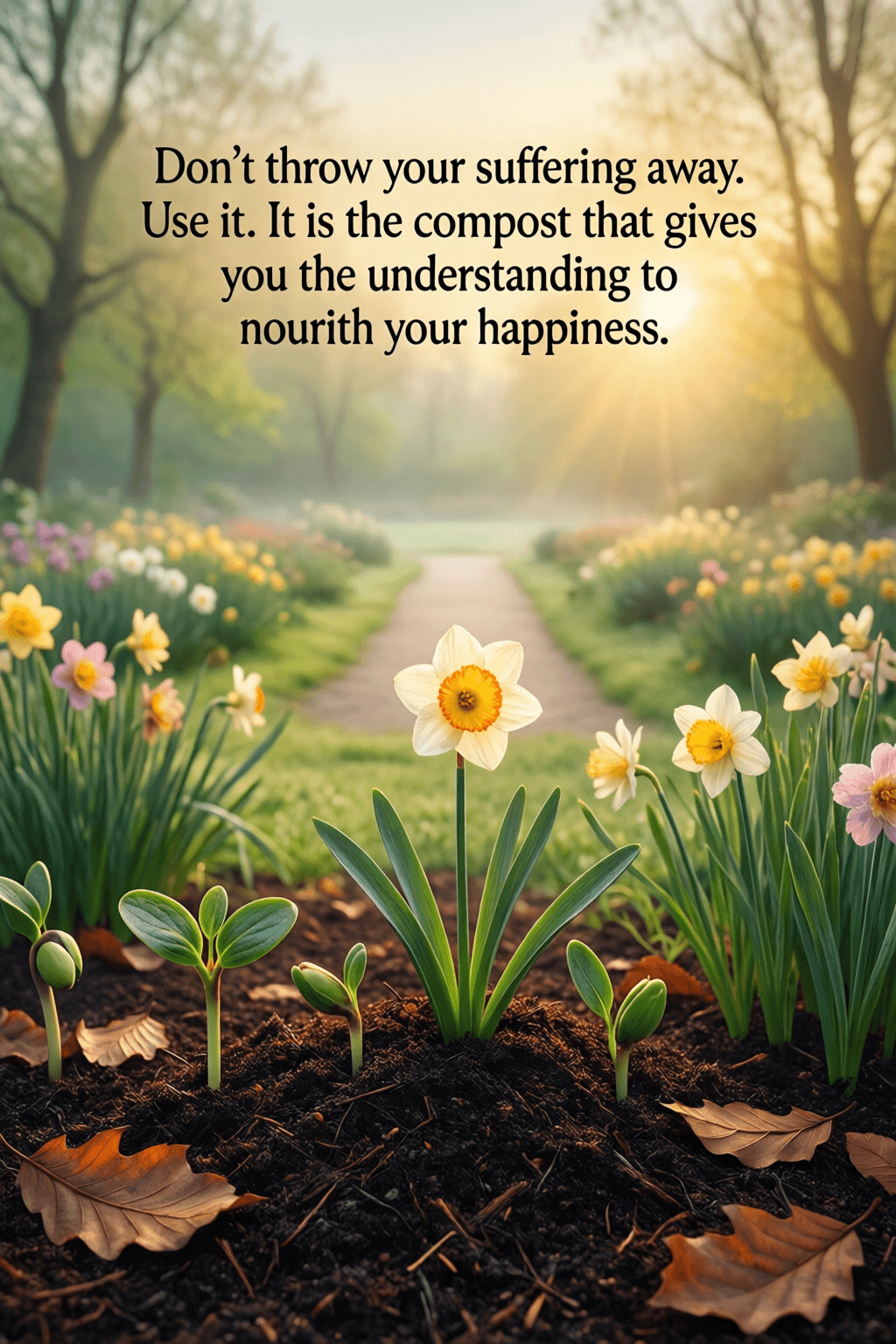
Don't throw your suffering away. Use it. It is the compost that gives you the understanding to nourish your happiness. — Thich Nhat Hanh
—What lingers after this line?
Pain as a Source of Growth
At first glance, Thich Nhat Hanh’s words reject the common impulse to discard pain as quickly as possible. Instead, he reframes suffering as something that can be transformed, much like compost becomes fertile soil. In this view, hardship is not glorified for its own sake; rather, it becomes meaningful when it deepens our capacity to understand what peace, relief, and happiness truly are.
The Compost Metaphor
More specifically, the image of compost is central to the quote’s power. Compost is made of what is broken down, unwanted, and decayed, yet it nourishes new life. In the same way, emotional wounds, disappointment, and loss can become the material from which wisdom grows. Thich Nhat Hanh develops this idea throughout No Mud, No Lotus (2014), where he argues that joy does not exist apart from suffering but emerges through our relationship to it.
Mindfulness and Transformation
From there, the quote naturally leads to mindfulness, a practice Thich Nhat Hanh taught for decades. To ‘use’ suffering does not mean clinging to it or dramatizing it; instead, it means observing it carefully, breathing with it, and understanding its causes. By doing so, we stop treating pain as an enemy and begin seeing it as a messenger, one that reveals our fears, attachments, and unmet needs.
Why Happiness Needs Contrast
Furthermore, the quotation suggests that happiness is not fully intelligible without contrast. Just as light is most visible after darkness, joy often becomes clearer after grief, frustration, or struggle. This insight appears across traditions: the Buddha’s First Noble Truth begins with the recognition of suffering, and only then moves toward liberation. In that sequence, suffering is not the end of the story but the beginning of understanding.
Compassion Born From Hurt
Just as importantly, suffering can widen the heart. People who have endured loneliness, illness, or failure often become more sensitive to the pain of others, and that sensitivity can mature into compassion. Viktor Frankl’s Man’s Search for Meaning (1946) similarly shows how pain, when met with reflection, can produce purpose rather than bitterness. Thus, the happiness nourished by suffering is rarely shallow pleasure; it is a steadier, more humane form of joy.
A Practical Way to Live
Finally, the quote offers a practical ethic rather than a mere consolation. It invites us, when hurt arises, to ask not only how to escape it but also what it might teach. This does not deny the need for healing, support, or justice; instead, it suggests that even while healing, we can transform pain into insight. In that sense, happiness becomes less a lucky accident and more a cultivated garden, enriched by what we once wished to throw away.
One-minute reflection
Why might this line matter today, not tomorrow?
Related Quotes
6 selectedWhen you learn how to suffer, you suffer far less. Resilience is not about avoiding the fire; it is about becoming fireproof. — Thich Nhat Hanh
Thich Nhat Hanh
At first glance, Thich Nhat Hanh’s quote appears paradoxical: how could learning to suffer make suffering lighter? Yet his point is that pain intensifies when we resist it, fear it, or treat it as a personal failure.
Read full interpretation →You must love in such a way that the person you love feels free. — Thich Nhat Hanh
Thich Nhat Hanh
At its core, Thich Nhat Hanh’s statement redefines love as an act of care that does not confine. To love someone so that they feel free means offering affection without turning it into control, guilt, or dependence.
Read full interpretation →The most precious gift we can offer others is our presence. — Thich Nhat Hanh
Thich Nhat Hanh
Thich Nhat Hanh’s line quietly overturns a common assumption: that giving is mainly about objects, money, or impressive gestures. Instead, he points to something less tangible but more foundational—showing up with full a...
Read full interpretation →To walk away from suffering is to cease striving for happiness. — Thich Nhat Hanh
Thich Nhat Hanh
Thich Nhat Hanh’s statement encapsulates a profound paradox: avoiding suffering might also mean abandoning the quest for happiness. Rather than seeing happiness and suffering as opposites, he suggests they are inherently...
Read full interpretation →We must find ways to see the world not merely in terms of our own interests. — Thich Nhat Hanh
Thich Nhat Hanh
Thich Nhat Hanh encourages us to broaden our perspective beyond our personal interests. By doing so, we can develop a more compassionate and understanding view of the world.
Read full interpretation →The sort of fearless openness required to turn toward our suffering is only possible within the spacious receptivity of love. — Frank Ostaseski
Frank Ostaseski
Frank Ostaseski’s statement begins with a striking claim: real courage is not simply toughness or willpower. Instead, the bravery required to face suffering honestly arises from love’s presence.
Read full interpretation →More From Author
More from Thich Nhat Hanh →You must love in such a way that the person you love feels free. — Thich Nhat Hanh
At its core, Thich Nhat Hanh’s statement redefines love as an act of care that does not confine. To love someone so that they feel free means offering affection without turning it into control, guilt, or dependence.
Read full interpretation →We are not islands; we are threads in a tapestry. To pull away from the weave is to lose the very texture that makes life hold together. — Thich Nhat Hanh
At its core, Thich Nhat Hanh’s image of threads in a tapestry rejects the fantasy of total self-sufficiency. A single thread may exist on its own, yet it gains meaning, strength, and beauty only through its relation to o...
Read full interpretation →When you learn how to suffer, you suffer far less. Resilience is not about avoiding the fire; it is about becoming fireproof. — Thich Nhat Hanh
At first glance, Thich Nhat Hanh’s quote appears paradoxical: how could learning to suffer make suffering lighter? Yet his point is that pain intensifies when we resist it, fear it, or treat it as a personal failure.
Read full interpretation →Slow down, and you will find that the rhythm of your own heart becomes the master of your work. — Thich Nhat Hanh
At first glance, Thich Nhat Hanh’s words seem to offer simple advice about working more slowly, yet they point to something deeper: a different relationship with time itself. To slow down is not merely to reduce speed, b...
Read full interpretation →