
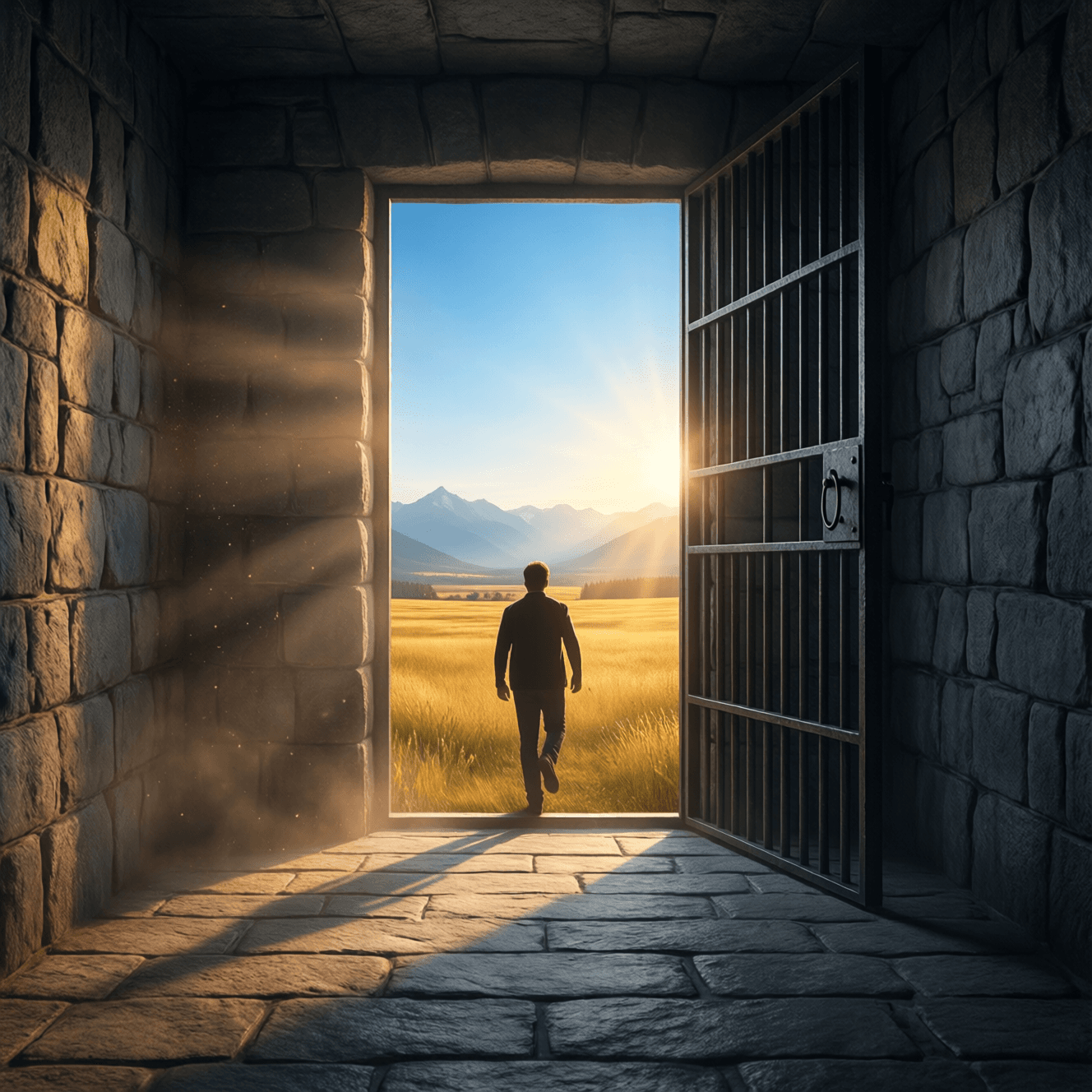
Why do you stay in prison when the door is so wide open? — Rumi
—What lingers after this line?
Rumi’s Provocative Question
Rumi’s line, “Why do you stay in prison when the door is so wide open?” confronts the listener with an unsettling possibility: that confinement is not always imposed from outside. Instead of offering comfort, he offers a question that shifts responsibility back to the self, implying that the first barrier to freedom may be our own reluctance to step through what is already available. From there, the quote works like a mirror. If the door is open, then what keeps us inside cannot be locks and chains alone, but habits of thought, fear of change, or a belief that we are unworthy of release—subtle forces that can feel as binding as iron.
The Prison of the Mind
To make sense of this “prison,” it helps to treat it as an inner structure: a set of stories we repeat until they become walls. The mind can turn past failures into permanent identity—“I’m not that kind of person”—and once that narrative is accepted, it becomes self-enforcing. In this way, Rumi’s open door suggests that insight, growth, or healing may already be within reach, but we remain stuck because the mind prefers the familiar cell to the uncertainty of freedom. The tragedy is not ignorance of the exit, but the quiet decision to call captivity normal.
Fear of Freedom and the Familiar Cell
Even when liberation is possible, freedom brings risk: responsibility, exposure, and the loss of excuses. Psychologist Erich Fromm’s The Fear of Freedom (1941) argues that people sometimes flee freedom because it removes the protective structure of certainty, even if that structure is oppressive. Rumi’s question gains force here: the open door does not automatically entice us; it can intimidate us. Staying inside may feel safer because the rules are known. Stepping out means admitting we could have changed sooner—and that realization can be harder than the prison itself.
Spiritual Awakening as Leaving the Cell
Within Rumi’s Sufi context, the prison is often the ego—attachment to status, control, and separateness. The open door points to surrender, a movement from narrow self-concern toward a larger reality. In this reading, freedom is not merely self-improvement but awakening: realizing that what we cling to is the very source of our confinement. Accordingly, the question is not asked to shame but to invite. It implies that grace is already present, that the exit is “wide open,” and that liberation is less about acquiring something new than about releasing what we insist on carrying.
Everyday Doors We Refuse to Walk Through
The quote also lands in ordinary life, where doors stand open in small but consequential ways: apologizing, setting a boundary, leaving a harmful job, or asking for help. Someone might endure a draining friendship for years, not because they cannot leave, but because they fear being seen as “the bad one” for choosing their own well-being. Seen this way, Rumi highlights how inertia masquerades as fate. The open door may be a single conversation, a practical plan, or a first step taken privately. What looks like imprisonment can be, at least in part, a postponed decision.
Turning the Question into Practice
If Rumi’s line is an invitation, then the practical response is to locate the door and name what keeps you from it. That might mean identifying one belief that functions like a lock—“It’s too late,” “I’ll fail,” “I don’t deserve better”—and testing it against reality with a modest, concrete action. Finally, the quote suggests that freedom often arrives as permission you give yourself. The door is open, but walking through requires courage, patience, and repetition. Over time, the act of choosing becomes the widening of the doorway itself—until what once felt like a prison is revealed as a place you have outgrown.
One-minute reflection
What feeling does this quote bring up for you?
Related Quotes
6 selectedGive up defining yourself—to yourself or to others. You won't die. You will come to life. — Eckhart Tolle
Eckhart Tolle
At its core, Eckhart Tolle’s statement urges us to loosen our grip on the identities we constantly construct. We define ourselves through profession, status, history, beliefs, and even wounds, imagining that these descri...
Read full interpretation →The best day of your life is the one on which you decide your life is your own. No apologies or excuses. — Elaine Maxwell
Elaine Maxwell
Elaine Maxwell’s quote frames transformation not as something that happens to us, but as a decision we make. The ‘best day’ is not defined by luck, wealth, or praise; instead, it begins when a person accepts full ownersh...
Read full interpretation →Discipline is not about being harsh with yourself; it is about aligning your actions with your purpose. It is a quiet form of freedom. — Ryan Holiday
Ryan Holiday
At first glance, discipline is often mistaken for punishment, deprivation, or relentless self-criticism. Ryan Holiday’s quote overturns that assumption by presenting discipline as a gentler, more intentional force: the p...
Read full interpretation →If you want to be free, be free. If you are chained, you are chained. But don't tell me you are free while wearing shackles. — Khalil Gibran
Khalil Gibran
Gibran’s words begin with a blunt distinction: freedom is real, and bondage is real, but confusion between them is a form of dishonesty. He is not merely speaking about physical captivity; rather, he is confronting the h...
Read full interpretation →The boundaries of your life are merely a creation of the self. — Robin Sharma
Robin Sharma
Robin Sharma’s line reframes “boundaries” as something less like a fence in the world and more like a frame in the mind. What we often call limits—who we are, what we can do, what we deserve—can be stories we repeat unti...
Read full interpretation →I'll tell you what freedom is to me: no fear. I mean really, no fear! — Nina Simone
Nina Simone
Nina Simone’s line refuses abstractions and replaces them with something bodily and immediate: fearlessness. By saying “I’ll tell you what freedom is to me,” she frames freedom not as a slogan or a legal condition but as...
Read full interpretation →More From Author
More from Rumi →Everything that happens is a form of instruction if you choose to listen. — Rumi
At its core, Rumi’s line reframes ordinary experience as a living classroom. Nothing is merely random noise if one approaches it with attention; instead, each success, disappointment, encounter, or delay carries the poss...
Read full interpretation →Do not mistake movement for progress; a spinning top stays in one place, while a seed grows by staying rooted in the dark. — Rumi
Rumi’s image draws an immediate contrast between busyness and true development. A spinning top dazzles with speed and motion, yet it remains fixed in essentially the same place.
Read full interpretation →You don't need to escape the chaos to find peace—it's already inside you, waiting to be remembered. — Rumi
At first glance, Rumi’s line overturns a common assumption: that peace must be found by fleeing noise, conflict, or uncertainty. Instead, he suggests that peace is not an external destination but an inner condition alrea...
Read full interpretation →Confidence is silent. Insecurities are loud. Do not feel the need to broadcast your worth to a world that doesn't understand your path. — Rumi
At its core, this saying contrasts two very different emotional states: confidence, which rests quietly within, and insecurity, which seeks constant outward expression. The point is not that confident people never speak,...
Read full interpretation →