
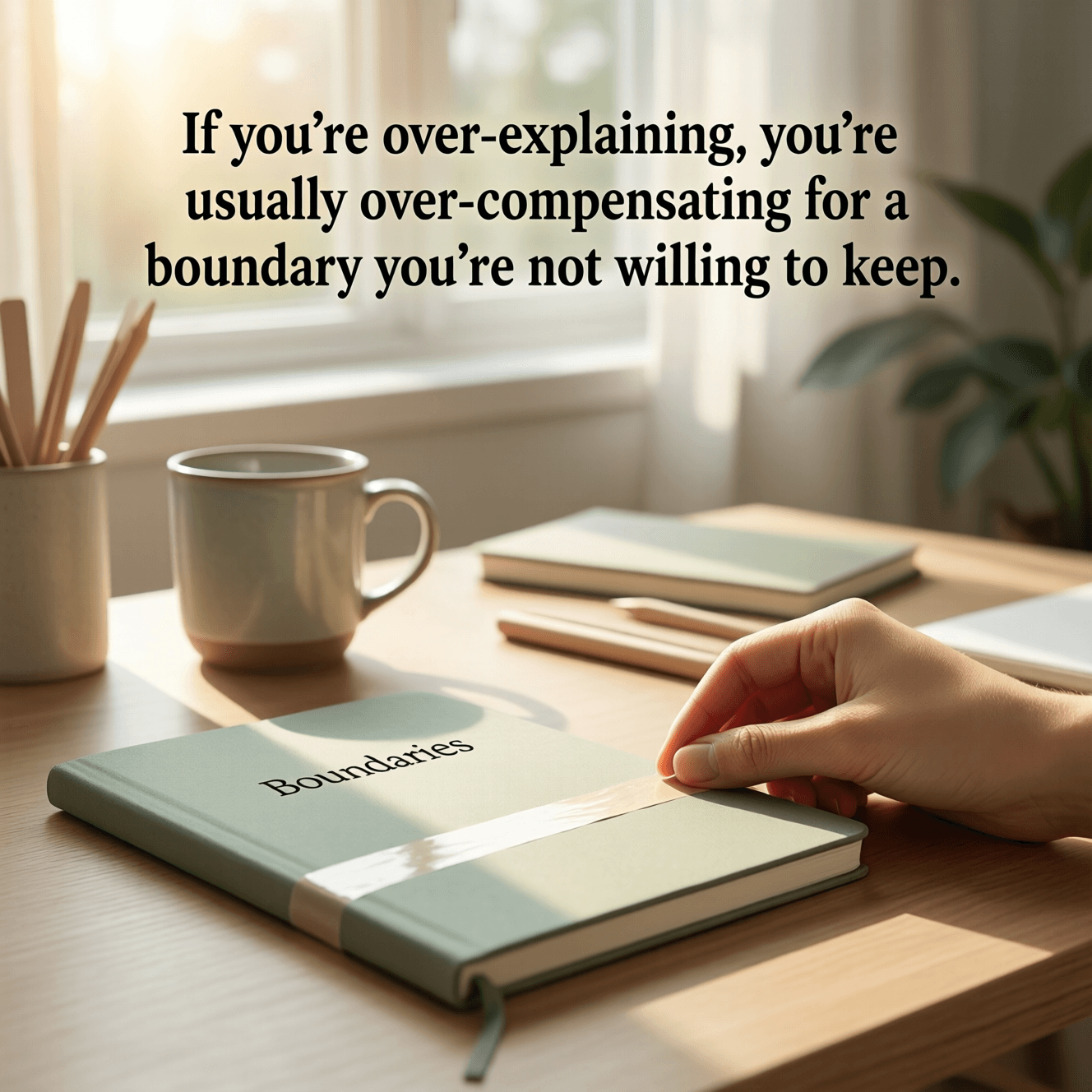
If you're over-explaining, you're usually over-compensating for a boundary you're not willing to keep. — Nedra Glover Tawwab
—What lingers after this line?
What the Quote Is Really Pointing To
Nedra Glover Tawwab’s line reframes over-explaining as more than a communication quirk; it becomes a clue about inner conflict. When someone keeps adding reasons, clarifications, and context, they may be trying to earn permission for a choice they already know they want to make. In that sense, the extra explanation isn’t for understanding—it’s for approval. From there, the quote suggests a specific tension: if a boundary feels solid, a simple statement often suffices. When the boundary feels shaky—or when the person anticipates pushback—language can swell into a kind of self-defense, as if more words might prevent disappointment, conflict, or rejection.
The Hidden Bargain: “If You Understand, You Won’t Be Mad”
Over-explaining often carries an unspoken negotiation: “If I can make this make sense to you, you’ll accept it.” This turns boundary-setting into persuasion, where the goal shifts from stating a limit to convincing someone not to react badly. The speaker may hope that a perfectly crafted rationale will reduce the other person’s frustration. However, this is precisely where the compensation happens. Instead of allowing another person to have feelings, the over-explainer tries to preempt those feelings with logic and detail. As the explanation grows, it can reveal how much emotional responsibility the speaker is taking on—responsibility that actually belongs to the listener.
Why Boundaries Trigger Guilt and Over-Justification
The urge to over-explain frequently comes from guilt, people-pleasing habits, or fear of being seen as “difficult.” If someone learned that saying no leads to punishment, withdrawal, or conflict, they may develop a reflex to soften every limit with extensive context. In adulthood, that reflex can show up as long texts, repeated apologies, or over-sharing personal details to make the boundary seem more acceptable. As a result, the explanation becomes a way to manage anxiety: more detail feels like more control. Yet the quote implies a hard truth—control isn’t the same as clarity. The real issue is often not that the boundary is unclear, but that the speaker isn’t yet willing to tolerate the discomfort that enforcing it might create.
How Over-Explaining Invites Debate and Erodes Authority
Once a boundary is presented as an argument, it can be treated like one. A long justification provides multiple points for the other person to challenge: the timing, the reasons, the evidence, the tone. Instead of “This is my limit,” the message becomes “Here’s my case,” and the listener may respond as if they’re entitled to cross-examine it. Consequently, over-explaining can weaken the boundary it’s meant to protect. It subtly signals uncertainty and invites bargaining—exactly what firm boundaries are designed to prevent. A shorter statement may feel blunt at first, but it leaves less room for negotiation and more room for self-respect.
What a Kept Boundary Sounds Like
A boundary you’re willing to keep is usually simple, specific, and not dependent on the other person’s agreement. It might sound like: “I can’t make it,” “I’m not available for that,” or “I’m not discussing this further.” The strength comes from the follow-through rather than the explanation, because the boundary is a decision, not a request for validation. Importantly, keeping the boundary doesn’t require coldness. You can be kind and still concise: “I understand you’re disappointed, and I’m still not able to do that.” This preserves empathy without turning empathy into an invitation to override your limit.
Building Tolerance for the Discomfort of “No”
If over-explaining is compensation, the long-term solution is increasing your tolerance for the reactions you can’t control. That means practicing the idea that someone can be unhappy with your boundary and you can remain steady anyway. In practical terms, it often helps to choose one brief line, repeat it if needed, and stop adding new justifications. Over time, this shifts the internal focus from “How do I make them accept this?” to “How do I honor what I said?” In that transition, Tawwab’s point lands: less explanation isn’t a lack of care—it can be evidence of a boundary you’re finally willing to keep.
One-minute reflection
What's one small action this suggests?
Related Quotes
6 selectedBoundaries are not walls to keep others out, but gates to protect your own nervous system. — Nedra Glover Tawwab
Nedra Glover Tawwab
At first glance, boundaries are often mistaken for rejection, distance, or emotional coldness. Yet Nedra Glover Tawwab’s image of gates rather than walls shifts the entire meaning: boundaries are not built to punish othe...
Read full interpretation →A boundary is a cue to others on how to love and respect you. — Nedra Glover Tawwab
Nedra Glover Tawwab
Nedra Glover Tawwab’s line reframes a boundary as something generous: a clear signal that helps other people understand what care looks like for you. Rather than being a wall that shuts others out, a boundary acts like a...
Read full interpretation →A boundary is a door, not a wall. It is the distance at which I can love you and still love myself. — Nedra Glover Tawwab
Nedra Glover Tawwab
Nedra Glover Tawwab flips a common assumption: boundaries are often treated like cold barricades, but she calls them “a door.” That image matters because doors are meant to open and close with intention, letting closenes...
Read full interpretation →Self-care is more than a spa day. It is the ability to say no to people and situations that drain your energy. — Nedra Glover Tawwab
Nedra Glover Tawwab
Nedra Glover Tawwab’s quote begins by dismantling a common misconception: that self-care is primarily about treats, products, or occasional relaxation rituals. While comfort can be restorative, she argues that it’s not t...
Read full interpretation →If it costs my peace, it's outside my boundary. — Adam J. Jackson
Adam J. Jackson
At its core, Adam J. Jackson’s line reframes boundaries as more than rules we impose on others; they become protections for our inner life.
Read full interpretation →It is about knowing who you are, and just doing what is comfortable for you, and not letting people pull you in a thousand different directions. — Jay-Z
Z
At its core, Jay-Z’s statement argues that self-knowledge is the foundation of a stable life. To know who you are is to possess an inner anchor that holds even when outside expectations become noisy or contradictory.
Read full interpretation →More From Author
More from Nedra Glover Tawwab →It is not a sign that you are doing something wrong to need a break; it is a sign that you are human. — Nedra Glover Tawwab
At its core, Nedra Glover Tawwab’s quote rejects the harsh belief that constant productivity is the measure of worth. Instead, it reframes the need for a break as evidence of our basic humanity: bodies tire, minds overlo...
Read full interpretation →The most powerful relationship you will ever have is the relationship with yourself. — Nedra Glover Tawwab
Nedra Glover Tawwab’s quote places self-relationship at the center of human life, suggesting that every other bond is filtered through the one we have with ourselves. In other words, the way we speak to ourselves, interp...
Read full interpretation →Boundaries are not walls to keep others out, but gates to protect your own nervous system. — Nedra Glover Tawwab
At first glance, boundaries are often mistaken for rejection, distance, or emotional coldness. Yet Nedra Glover Tawwab’s image of gates rather than walls shifts the entire meaning: boundaries are not built to punish othe...
Read full interpretation →You do not have to fix everything today, this week, or alone. You can rebuild—gently, slowly, and sustainably. — Nedra Glover Tawwab
Nedra Glover Tawwab’s words begin by challenging a familiar pressure: the belief that healing must happen immediately and completely. By saying, “You do not have to fix everything today, this week, or alone,” she interru...
Read full interpretation →