
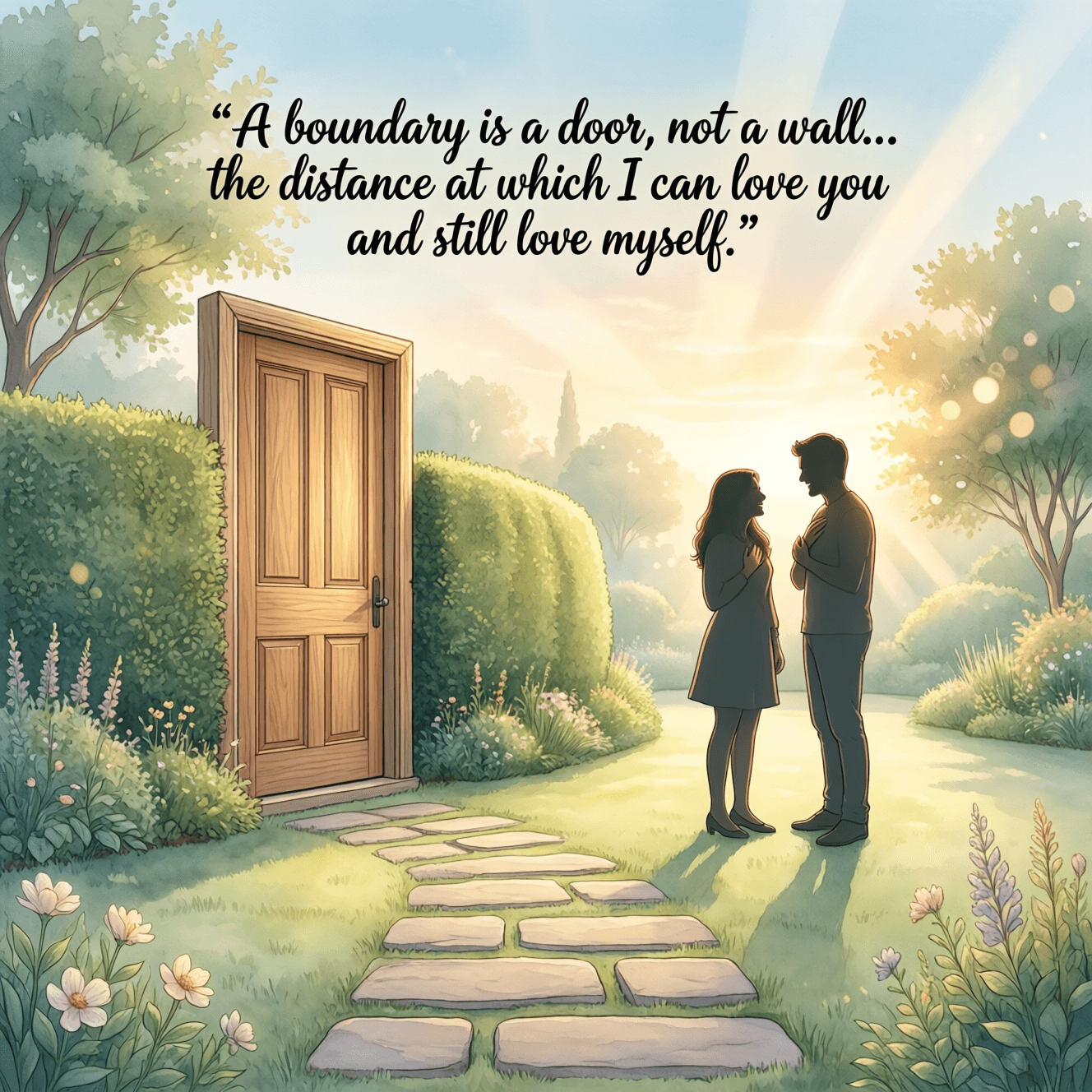
A boundary is a door, not a wall. It is the distance at which I can love you and still love myself. — Nedra Glover Tawwab
—What lingers after this line?
Reframing Boundaries as Connection
Nedra Glover Tawwab flips a common assumption: boundaries are often treated like cold barricades, but she calls them “a door.” That image matters because doors are meant to open and close with intention, letting closeness in while still preserving safety. In this view, a boundary isn’t a rejection of someone—it’s a tool for staying in relationship without losing yourself. From there, the quote suggests a gentler purpose behind limits. Instead of being the end of intimacy, boundaries can be the structure that makes intimacy sustainable, especially when love starts to demand self-erasure.
The “Distance” Where Love Stays Honest
The word “distance” points to something practical: every relationship needs a workable amount of emotional space. Too little space can turn affection into obligation, while too much can become avoidance. Tawwab’s framing implies that healthy distance is not measured by miles or silence, but by whether you can remain caring without abandoning your needs. As a result, boundaries become a way of telling the truth about your capacity. Saying “I can talk for twenty minutes, but I can’t stay on the phone all night” is not a lack of love; it’s a clear statement of what love can look like without exhaustion.
Love Without Self-Abandonment
When Tawwab says “love you and still love myself,” she highlights a pattern many people slip into: confusing sacrifice with devotion. Healthy love may involve compromise, but it does not require chronic self-neglect, resentment, or fear of consequences for having preferences. The quote insists that self-love is not a competitor to relational love; it is part of what makes it possible. Building on that idea, boundaries protect the “self” that shows up in relationships—your energy, values, body, time, and dignity. Without those protections, love can become performative: you give, but you’re not really present because you’re depleted or silently angry.
Doors Have Handles: Choice and Consent
A door implies agency: you decide when to open, when to close, and under what conditions someone is welcome inside. This connects boundaries to consent—not only in physical terms, but emotionally and socially. You can care about someone and still say, “I’m not available for shouting,” or “I won’t discuss that topic,” or “I need a day to think before I respond.” In that sense, boundaries are less about controlling others and more about controlling your participation. The door metaphor also reminds us that access can change; as trust grows, doors may open wider, and when trust is harmed, they may need to close until repair is possible.
How Boundaries Reduce Resentment
Resentment often appears when people repeatedly do what they don’t truly consent to do. Tawwab’s “distance” becomes a preventative measure: if you set limits early, you’re less likely to explode later. For example, a friend who always calls in crisis may not realize the toll it takes; a boundary like “I can talk, but not after 10 p.m.” can keep the relationship intact instead of quietly poisoning it. Consequently, boundaries can be an act of generosity. They clarify expectations and reduce the guessing game, which helps both people interact with less tension and fewer unspoken debts.
Boundaries as Invitations to Mature Relationships
A wall ends conversation; a door invites negotiation. By presenting boundaries this way, Tawwab suggests that mature relationships can tolerate “no” without turning it into punishment or abandonment. When someone responds well to your limits, it’s evidence of relational safety; when they respond with guilt, rage, or coercion, it reveals dynamics that may need serious change. Ultimately, the quote positions boundaries as a path toward love that is both compassionate and self-respecting. The goal is not distance for its own sake, but the specific spacing that allows closeness to be real—chosen, steady, and free of self-betrayal.
One-minute reflection
Where does this idea show up in your life right now?
Related Quotes
6 selectedBoundaries are not walls to keep others out, but gates to protect your own nervous system. — Nedra Glover Tawwab
Nedra Glover Tawwab
At first glance, boundaries are often mistaken for rejection, distance, or emotional coldness. Yet Nedra Glover Tawwab’s image of gates rather than walls shifts the entire meaning: boundaries are not built to punish othe...
Read full interpretation →A boundary is a cue to others on how to love and respect you. — Nedra Glover Tawwab
Nedra Glover Tawwab
Nedra Glover Tawwab’s line reframes a boundary as something generous: a clear signal that helps other people understand what care looks like for you. Rather than being a wall that shuts others out, a boundary acts like a...
Read full interpretation →If you're over-explaining, you're usually over-compensating for a boundary you're not willing to keep. — Nedra Glover Tawwab
Nedra Glover Tawwab
Nedra Glover Tawwab’s line reframes over-explaining as more than a communication quirk; it becomes a clue about inner conflict. When someone keeps adding reasons, clarifications, and context, they may be trying to earn p...
Read full interpretation →Self-care is more than a spa day. It is the ability to say no to people and situations that drain your energy. — Nedra Glover Tawwab
Nedra Glover Tawwab
Nedra Glover Tawwab’s quote begins by dismantling a common misconception: that self-care is primarily about treats, products, or occasional relaxation rituals. While comfort can be restorative, she argues that it’s not t...
Read full interpretation →Setting boundaries is an act of self-love. — Oprah Winfrey
Oprah Winfrey
At first glance, Oprah Winfrey’s statement reframes self-love as something practical rather than sentimental. Instead of treating self-love as a private feeling, she presents it as a visible decision about what we will a...
Read full interpretation →Healthy boundaries are gates that allow you to enjoy the beauty of your own garden. — Lydia Hall
Lydia Hall
Lydia Hall’s image of a “garden” gently frames the self as something living—made up of emotions, time, values, and dignity—that must be tended to flourish. Gardens do not thrive by accident; they require attention, seaso...
Read full interpretation →More From Author
More from Nedra Glover Tawwab →Stop shrinking yourself to make others comfortable. Your peace is worth more than their approval. — Nedra Glover Tawwab
Nedra Glover Tawwab’s words begin with a quiet but powerful warning: when we constantly make ourselves smaller to keep others comfortable, we often pay with our confidence, honesty, and emotional well-being. This kind of...
Read full interpretation →It is not a sign that you are doing something wrong to need a break; it is a sign that you are human. — Nedra Glover Tawwab
At its core, Nedra Glover Tawwab’s quote rejects the harsh belief that constant productivity is the measure of worth. Instead, it reframes the need for a break as evidence of our basic humanity: bodies tire, minds overlo...
Read full interpretation →The most powerful relationship you will ever have is the relationship with yourself. — Nedra Glover Tawwab
Nedra Glover Tawwab’s quote places self-relationship at the center of human life, suggesting that every other bond is filtered through the one we have with ourselves. In other words, the way we speak to ourselves, interp...
Read full interpretation →Boundaries are not walls to keep others out, but gates to protect your own nervous system. — Nedra Glover Tawwab
At first glance, boundaries are often mistaken for rejection, distance, or emotional coldness. Yet Nedra Glover Tawwab’s image of gates rather than walls shifts the entire meaning: boundaries are not built to punish othe...
Read full interpretation →