
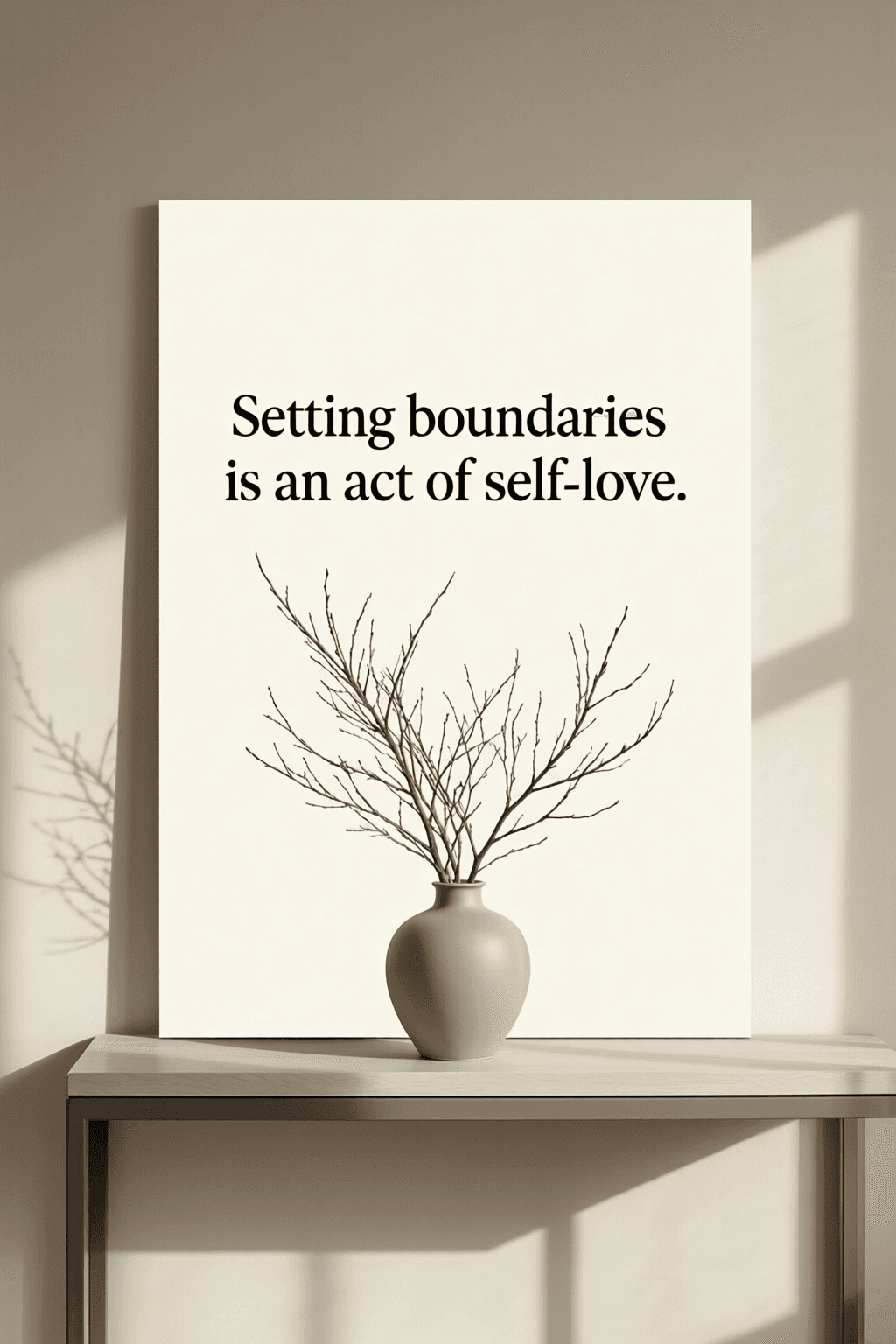
Setting boundaries is an act of self-love. — Oprah Winfrey
—What lingers after this line?
Self-Love as Daily Practice
At first glance, Oprah Winfrey’s statement reframes self-love as something practical rather than sentimental. Instead of treating self-love as a private feeling, she presents it as a visible decision about what we will and will not allow in our lives. In that sense, boundaries become a daily practice of honoring one’s energy, dignity, and emotional limits. This idea matters because many people confuse self-love with indulgence, when in fact it often requires discipline. Saying no, asking for respect, or stepping back from harmful dynamics can feel uncomfortable in the moment; however, those choices protect the inner conditions needed for well-being. Thus, boundaries are not walls against love but structures that make healthier love possible.
The Difference Between Care and Compliance
From there, the quote invites a crucial distinction: caring for others is not the same as endlessly complying with them. Many people are taught that kindness means availability at all times, yet constant accommodation can quietly turn into self-erasure. Oprah’s insight challenges that pattern by suggesting that true care does not demand the abandonment of the self. Psychologist Harriet Lerner’s work in The Dance of Anger (1988) similarly argues that clear boundaries are essential to mature relationships. In her view, overfunctioning for others often breeds resentment rather than closeness. Consequently, a boundary can be an honest message: I value this relationship enough to make it truthful, not merely convenient.
Boundaries Preserve Emotional Integrity
Once that distinction is clear, boundaries can be seen as a way of preserving emotional integrity. They help individuals stay aligned with their values instead of being pulled entirely by guilt, fear, or external pressure. Whether in family life, friendship, or work, a person without boundaries may slowly lose the ability to tell what they genuinely feel. For that reason, setting limits is not just about managing other people; it is also about remaining in touch with oneself. Brené Brown writes in Rising Strong (2015) that compassionate people are often also the most boundaried. Her point is revealing: far from making a person cold, boundaries create the clarity needed to offer generosity without bitterness.
Why Guilt Often Appears First
Even so, boundary-setting rarely feels graceful at the beginning. People who are used to pleasing others often experience guilt the first time they say no or ask for space. That discomfort can create the illusion that a boundary is selfish, when in reality it may simply be unfamiliar. The emotional friction comes not from wrongdoing but from breaking an old pattern. This is why Oprah’s wording is so powerful: it treats boundaries as self-love precisely when they are hardest to maintain. In many personal accounts, people describe feeling temporarily anxious after asserting a limit, only to discover later that their relationships became more respectful. The initial guilt, then, is often the threshold to greater self-trust.
Healthier Relationships Through Clear Limits
As the idea unfolds, it becomes clear that boundaries do not weaken relationships; they refine them. Clear expectations reduce confusion, prevent simmering resentment, and make mutual respect easier to sustain. In this way, boundaries act less like barriers and more like definitions, showing where one person ends and another begins. Literature and philosophy have long supported this balance. In Aristotle’s Nicomachean Ethics (4th century BC), virtue is rooted in moderation and right relation, not excess. Applied here, love without limits can become imbalance, while love shaped by boundaries creates room for reciprocity. Therefore, self-love and relational love are not rivals; properly understood, one strengthens the other.
A Quiet Declaration of Worth
Ultimately, Oprah Winfrey’s quote carries a simple but transformative message: every boundary is a quiet declaration of worth. To say, “This is not acceptable,” or “I need rest,” is to affirm that one’s needs and humanity matter. Such statements may be brief, yet they reshape a person’s life by teaching others how to engage with them. In the end, self-love is not proven by grand affirmations alone but by consistent acts of protection and respect. Boundaries are among the clearest of those acts because they translate inner value into outward behavior. What begins as a limit, then, becomes something larger: a stable foundation for peace, dignity, and genuine connection.
Recommended Reading
As an Amazon Associate, we earn from qualifying purchases.
One-minute reflection
What feeling does this quote bring up for you?
Related Quotes
6 selectedSelf-respect is the radical act of saying 'no' to anything that violates your spirit, even if it's an opportunity you think you 'should' want. — Oprah Winfrey
Oprah Winfrey
At its core, Oprah Winfrey’s quote reframes the word “no” as an act of identity rather than denial. To reject what violates your spirit is not to miss out; instead, it is to declare that your inner life has value and mus...
Read full interpretation →Boundaries are not selfish; they are a necessary act of self-care. Your peace is worth defending. — Dr. Titilayo Akinsola
Dr. Titilayo Akinsola
At first glance, boundaries can be mistaken for distance, rejection, or even selfishness. Yet Dr.
Read full interpretation →Boundaries are a part of self-care. They are healthy, normal, and necessary. — Doreen Virtue
Doreen Virtue
At first glance, Doreen Virtue’s quote reframes self-care as something deeper than rest, indulgence, or temporary relief. By calling boundaries a part of self-care, she emphasizes that caring for oneself also means prote...
Read full interpretation →Daring to set boundaries is about having the courage to love ourselves. — Brené Brown
Brené Brown
Brené Brown’s line invites a shift in perspective: boundaries are not primarily about pushing others away, but about choosing what we will protect within ourselves. When we say “no,” we are often saying “yes” to our well...
Read full interpretation →Daring to set boundaries is about having the courage to love ourselves. — Brené Brown
Brené Brown
Brené Brown’s line turns a common misconception on its head: boundaries aren’t primarily walls meant to keep others out, but commitments meant to keep us intact. When people hear “boundary,” they often imagine coldness o...
Read full interpretation →Daring to set boundaries is about having the courage to love ourselves. — Brené Brown
Brené Brown
Brené Brown frames boundaries not as a polite preference, but as something we “dare” to do—implying risk, exposure, and the possibility of disappointing others. That word choice highlights a common truth: many people kno...
Read full interpretation →More From Author
More from Oprah Winfrey →Real integrity is doing the right thing, knowing that nobody's going to know whether you did it or not. — Oprah Winfrey
At its core, Oprah Winfrey’s remark defines integrity as an inner standard rather than a public performance. Doing the right thing when no recognition is possible strips away applause, reputation, and reward, leaving onl...
Read full interpretation →Self-respect is the radical act of saying 'no' to anything that violates your spirit, even if it's an opportunity you think you 'should' want. — Oprah Winfrey
At its core, Oprah Winfrey’s quote reframes the word “no” as an act of identity rather than denial. To reject what violates your spirit is not to miss out; instead, it is to declare that your inner life has value and mus...
Read full interpretation →Family should be the place where you can be your most complete self. Where you're accepted and appreciated, seen and valued, even in moments of disagreement. — Oprah Winfrey
At its core, Oprah Winfrey’s reflection imagines family as more than a social unit; it becomes a sanctuary where a person does not need to fragment their identity to belong. In this view, home is the rare place where str...
Read full interpretation →I have a lot of things to prove to myself. One is that I can live my life fearlessly. — Oprah Winfrey
At first glance, Oprah Winfrey’s words shift the idea of achievement away from public applause and toward an inner reckoning. She is not speaking about proving worth to critics, rivals, or even admirers; rather, she iden...
Read full interpretation →