
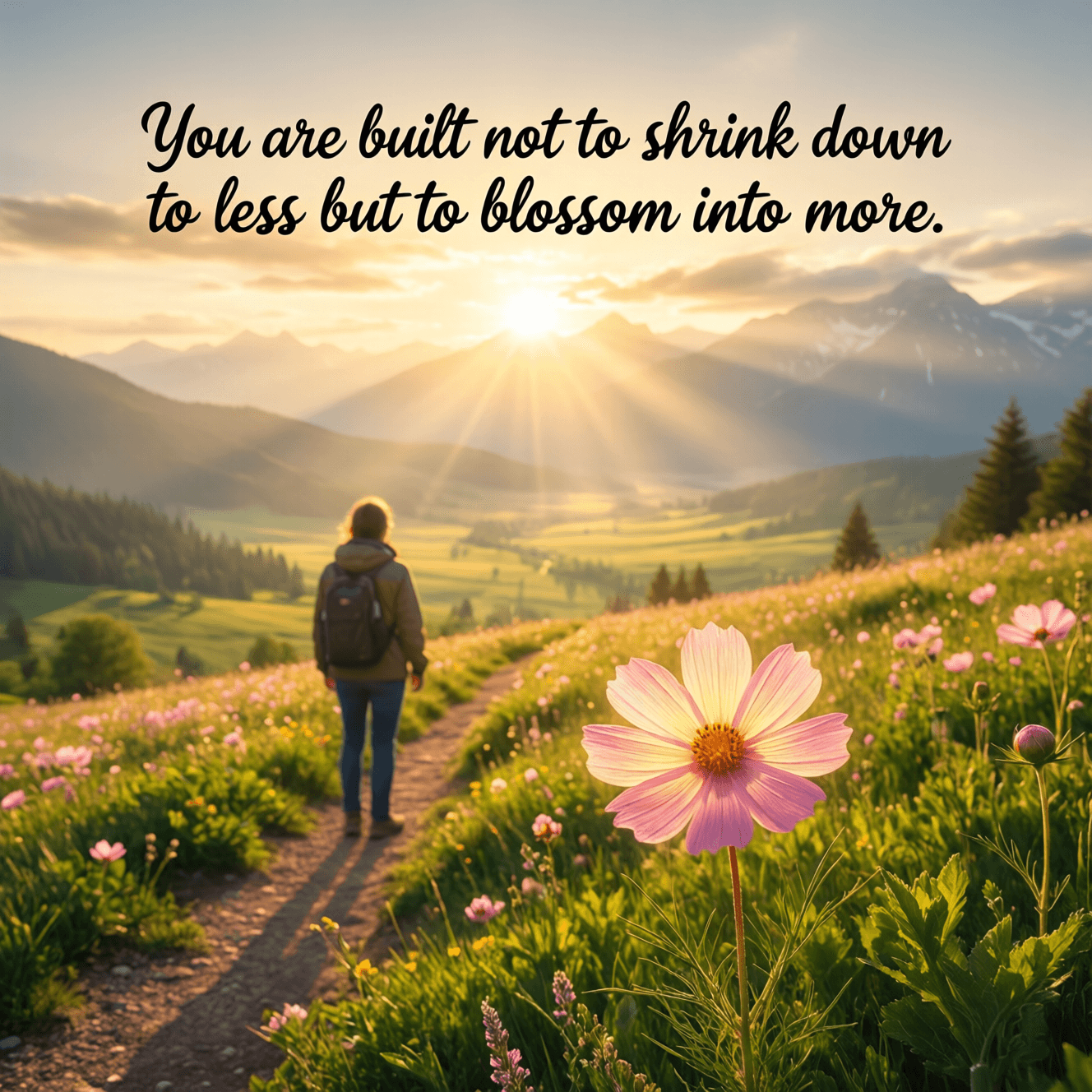
You are built not to shrink down to less but to blossom into more. — Oprah Winfrey
—What lingers after this line?
A Metaphor for Human Expansion
Oprah Winfrey’s line hinges on a vivid contrast: “shrink down” suggests self-erasure, caution, and living smaller than one’s nature, while “blossom into more” evokes organic growth—slow, embodied, and inevitable when conditions are right. Rather than framing development as a harsh self-overhaul, she implies a natural unfolding, like a plant orienting toward light. From the outset, this metaphor also reframes ambition. It isn’t about grabbing more status; it’s about becoming more fully yourself, expanding capacity, voice, and presence. In that sense, the quote reads less like a slogan and more like an instruction to cooperate with your own potential instead of negotiating it away.
Unlearning the Habit of Making Yourself Small
If blossoming is the goal, the first obstacle is the learned reflex to contract. Many people “shrink” to avoid conflict, rejection, or being seen as too much—too loud, too eager, too talented, too different. This is often reinforced socially: families reward compliance, workplaces reward quiet endurance, and peer groups can punish distinction. Yet, once you notice the pattern, it becomes clear how costly it is. Shrinking doesn’t only hide you from judgment; it also hides you from opportunity, intimacy, and meaningful contribution. That realization sets up Winfrey’s pivot: growth isn’t merely permitted—it’s what you were made for.
Growth as an Inner Calling, Not a Performance
Next, the quote suggests that “more” is not a costume you put on for others but an inner direction you follow. This aligns with ideas of self-actualization described by Abraham Maslow in “A Theory of Human Motivation” (1943), where people move toward fulfilling capacities once basic needs are sufficiently met. Winfrey’s wording resonates with that upward pull: expansion is less a boast than a human drive. Seen this way, blossoming isn’t about constant external achievement. It can mean developing courage, honesty, skill, or generosity—forms of “more” that may look quiet from the outside but feel undeniable from within.
The Role of Environment: Light, Soil, and Support
Because blossoming is an organic image, it naturally raises the question of conditions. Even the healthiest seed struggles in poor soil, and likewise people often fail to grow not from laziness but from depleted environments—relationships that punish initiative, systems that undervalue them, routines that leave no room for reflection. Therefore, the quote implicitly invites a practical shift: curate the light. Seek mentors, communities, and work that reward development rather than diminishment. This is not escapism; it’s stewardship—recognizing that your “more” may require different inputs than your “less” ever did.
Courageous Expansion in Daily Choices
After environment comes action, because blossoming still involves risk. You expand by speaking when you would normally stay silent, applying before you feel ready, setting a boundary that disappoints someone, or sharing creative work that might be judged. These small choices add up, turning growth from an abstract identity into a lived practice. In this sense, Winfrey’s statement isn’t only inspirational; it’s diagnostic. When you feel yourself shrinking—explaining away a desire, minimizing an achievement, tolerating what you’ve outgrown—it can be a signal that the next step is precisely the one that stretches you.
Becoming More Without Losing Yourself
Finally, the quote clarifies that “more” is not self-inflation. Blossoming doesn’t mean becoming louder, busier, or perpetually positive; it means becoming more congruent—less split between what you are and what you present. Paradoxically, that kind of growth often produces steadiness, not chaos, because you stop spending energy on self-editing. Taken together, Winfrey’s message offers a hopeful frame: you are designed for expansion, and the task is to stop negotiating your life downward. With time, support, and brave repetition, “more” becomes less a destination and more a way of inhabiting your own possibilities.
One-minute reflection
What's one small action this suggests?
Related Quotes
6 selectedLearning to love yourself is like learning to walk – essential, life-changing, and the only way to stand tall. — Vironika Tugaleva
Vironika Tugaleva
Vironika Tugaleva’s comparison begins with a simple but powerful truth: self-love is not a luxury, but a basic human necessity. Just as walking allows a child to move through the world with growing independence, learning...
Read full interpretation →The most gifted members of the human species are at their creative best when they cannot have their way, and must compensate for what they miss by realizing and cultivating their capacities. — Bryant H. McGill
Bryant H. McGill
Bryant H. McGill’s observation begins with a striking reversal: gifted people may not reach their highest potential when everything comes easily, but when something blocks their path.
Read full interpretation →A mind grows by staying with difficulty long enough for the experience to change it. — Mary Catherine Bateson
Mary Catherine Bateson
Mary Catherine Bateson’s observation begins with a quiet but demanding truth: the mind does not grow merely by encountering difficulty, but by remaining with it. Challenge becomes transformative only when we resist the u...
Read full interpretation →Consistency is a superpower. — Ryan Holiday
Ryan Holiday
Ryan Holiday’s line begins with a deceptively simple idea: greatness is rarely built through dramatic gestures. More often, it emerges from repeated actions that seem ordinary in isolation but become extraordinary over t...
Read full interpretation →Confidence is silent. Insecurities are loud. — Unknown (Wait—skip/replace with: True nobility is being superior to your former self. — Ernest Hemingway)
Ernest Hemingway
At its core, Hemingway’s line redefines nobility as an inward achievement rather than a social rank. Instead of measuring worth by wealth, pedigree, or dominance over others, it points to a quieter standard: becoming bet...
Read full interpretation →You are under no obligation to be consistent with the person you were yesterday. — James McCrae
James McCrae
At its core, James McCrae’s line challenges the quiet pressure to remain legible to others. Many people feel bound to opinions, habits, or identities simply because they once claimed them, as though consistency were a mo...
Read full interpretation →More From Author
More from Oprah Winfrey →Real integrity is doing the right thing, knowing that nobody's going to know whether you did it or not. — Oprah Winfrey
At its core, Oprah Winfrey’s remark defines integrity as an inner standard rather than a public performance. Doing the right thing when no recognition is possible strips away applause, reputation, and reward, leaving onl...
Read full interpretation →Self-respect is the radical act of saying 'no' to anything that violates your spirit, even if it's an opportunity you think you 'should' want. — Oprah Winfrey
At its core, Oprah Winfrey’s quote reframes the word “no” as an act of identity rather than denial. To reject what violates your spirit is not to miss out; instead, it is to declare that your inner life has value and mus...
Read full interpretation →Family should be the place where you can be your most complete self. Where you're accepted and appreciated, seen and valued, even in moments of disagreement. — Oprah Winfrey
At its core, Oprah Winfrey’s reflection imagines family as more than a social unit; it becomes a sanctuary where a person does not need to fragment their identity to belong. In this view, home is the rare place where str...
Read full interpretation →I have a lot of things to prove to myself. One is that I can live my life fearlessly. — Oprah Winfrey
At first glance, Oprah Winfrey’s words shift the idea of achievement away from public applause and toward an inner reckoning. She is not speaking about proving worth to critics, rivals, or even admirers; rather, she iden...
Read full interpretation →