
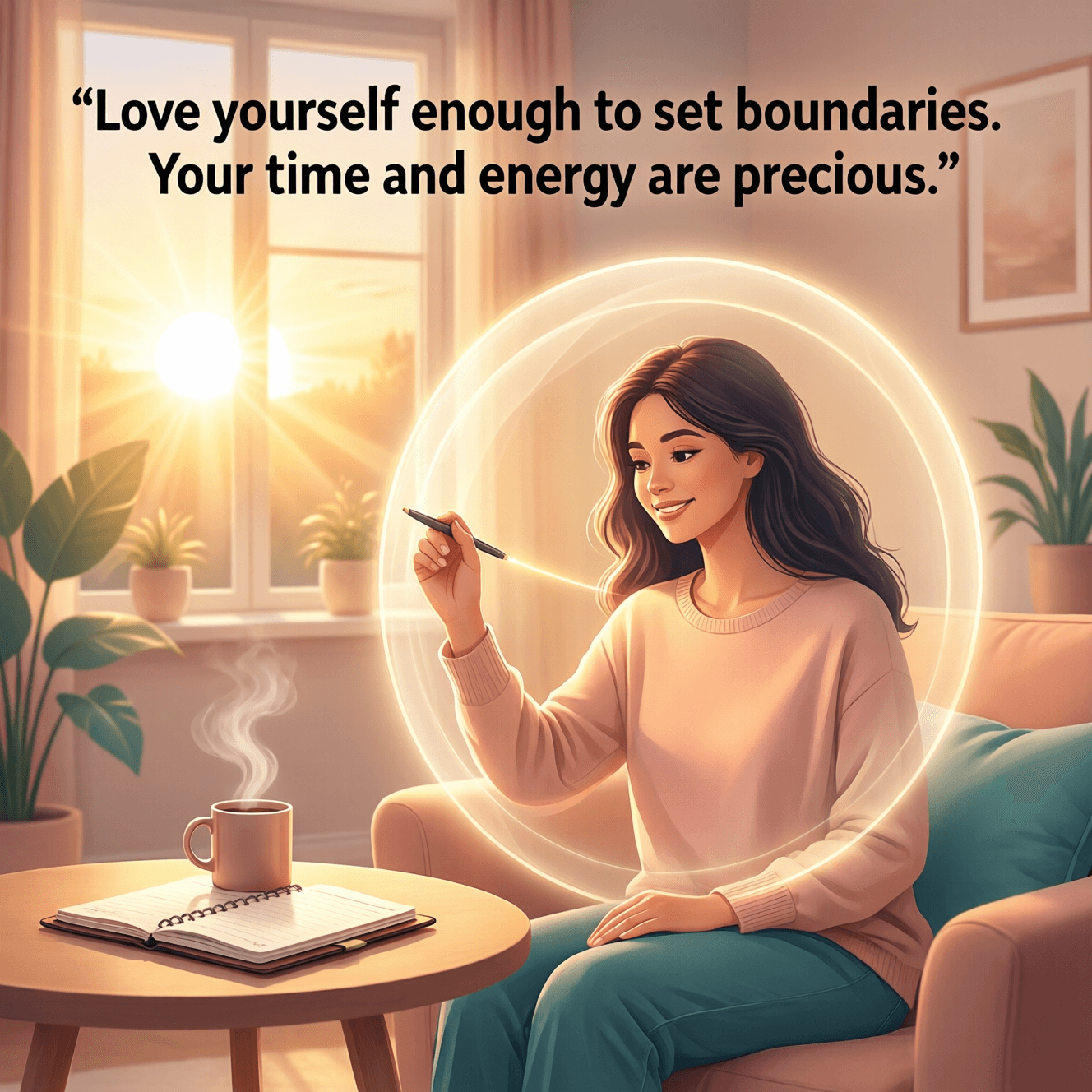
Love yourself enough to set boundaries. Your time and energy are precious. — Anna Taylor
—What lingers after this line?
Boundaries as an Act of Self-Respect
Anna Taylor’s quote frames boundaries not as walls, but as a practical expression of self-love. To “love yourself enough” implies an inner valuation that shows up in daily decisions—what you allow, what you decline, and what you reserve for your own well-being. From there, the message becomes clear: boundaries are less about controlling others and more about honoring your own limits. When you treat your needs as legitimate, you stop negotiating your worth through constant availability and start relating from a place of dignity.
Why Time and Energy Are Truly Precious
The emphasis on time and energy highlights scarcity: both are finite, and neither can be recovered once spent. Unlike money, an hour given away to resentment or burnout can’t be earned back in the same form, which makes attention a kind of personal currency. Building on that idea, boundaries become a way to invest wisely. Each “yes” carries hidden costs—focus, rest, emotional labor—so the quote invites a more intentional approach: spend your limited resources where they align with your values, not merely with other people’s demands.
The Hidden Cost of People-Pleasing
When someone struggles to set boundaries, it’s often not laziness but fear—of conflict, rejection, or seeming selfish. Yet the pattern of chronic accommodation tends to produce quiet consequences: fatigue, irritability, and a growing sense that life is happening “to” you rather than being shaped by you. As this accumulates, resentment can replace generosity, even toward people you care about. In that sense, Taylor’s point is preventative: boundaries protect relationships from the slow corrosion that comes from giving more than you can sustainably offer.
Clarity Is Kinder Than Overcommitment
A common myth is that boundaries are harsh, but the opposite is often true. Clear limits reduce confusion and unspoken expectations, making it easier for others to engage with you honestly rather than guessing your tolerance and stumbling into frustration. Consider the everyday example of agreeing to help a friend move when you’re already exhausted, then showing up tense and withdrawn. A respectful “I can’t this weekend, but I can drop off supplies on Friday” may feel uncomfortable in the moment, yet it ultimately preserves trust by matching your promise to your capacity.
How to Set Boundaries Without Guilt
The quote implies that boundary-setting is a skill rooted in self-worth, and skills can be practiced. Starting small helps: use direct language, avoid overexplaining, and offer alternatives only when you genuinely want to. Simple phrases like “I’m not available for that” or “I need to think about it” create space to choose rather than react. Over time, guilt often fades as you see the results—more steadiness, fewer blowups, and a stronger sense of integrity. In that progression, the boundary is no longer a defensive move; it becomes a consistent way of living in alignment with your priorities.
Sustainable Generosity and a Healthier Life
Finally, valuing your time and energy doesn’t mean withdrawing from others; it means giving from a stable foundation. When you protect rest, focus, and emotional bandwidth, you’re more capable of showing up with real presence rather than depleted obligation. This is where Taylor’s statement lands as a life philosophy: self-love isn’t only internal affirmation—it’s visible in the structure of your days. Boundaries create that structure, turning precious resources into a life that feels chosen, balanced, and genuinely yours.
One-minute reflection
What does this quote ask you to notice today?
Related Quotes
6 selectedYou are in control of your life. Set new boundaries by removing all of the toxic people from your inner circle. — Jeanette Coron
Jeanette Coron
Jeanette Coron’s statement begins with a direct reminder: you are not merely reacting to life, but participating in its design. By saying you are in control, the quote shifts attention away from blame and toward agency,...
Read full interpretation →Learning to love yourself is like learning to walk – essential, life-changing, and the only way to stand tall. — Vironika Tugaleva
Vironika Tugaleva
Vironika Tugaleva’s comparison begins with a simple but powerful truth: self-love is not a luxury, but a basic human necessity. Just as walking allows a child to move through the world with growing independence, learning...
Read full interpretation →If it costs my peace, it's outside my boundary. — Adam J. Jackson
Adam J. Jackson
At its core, Adam J. Jackson’s line reframes boundaries as more than rules we impose on others; they become protections for our inner life.
Read full interpretation →I have an everyday religion that works for me: love yourself first, and everything else falls into line. — Lucille Ball
Lucille Ball
Lucille Ball frames self-love not as vanity, but as a practical belief system for daily life. By calling it an “everyday religion,” she gives the idea both intimacy and seriousness: this is not an abstract philosophy res...
Read full interpretation →Self-respect is the first step to self-love. It is the invisible coat of mail that keeps you safe from the noise of the world. — Henry Wadsworth Longfellow
Henry Wadsworth Longfellow
Longfellow begins with a sequence that feels both simple and profound: before a person can truly love themselves, they must first respect themselves. In other words, self-love is not merely a warm feeling or a moment of...
Read full interpretation →You yourself, as much as anybody in the entire universe, deserve your love and affection. — Dalai Lama
Dalai Lama
At its core, this Dalai Lama quotation insists that self-love is not vanity but fairness. We often extend patience, kindness, and forgiveness to friends while withholding the same warmth from ourselves.
Read full interpretation →More From Author
More from Anna Taylor →