
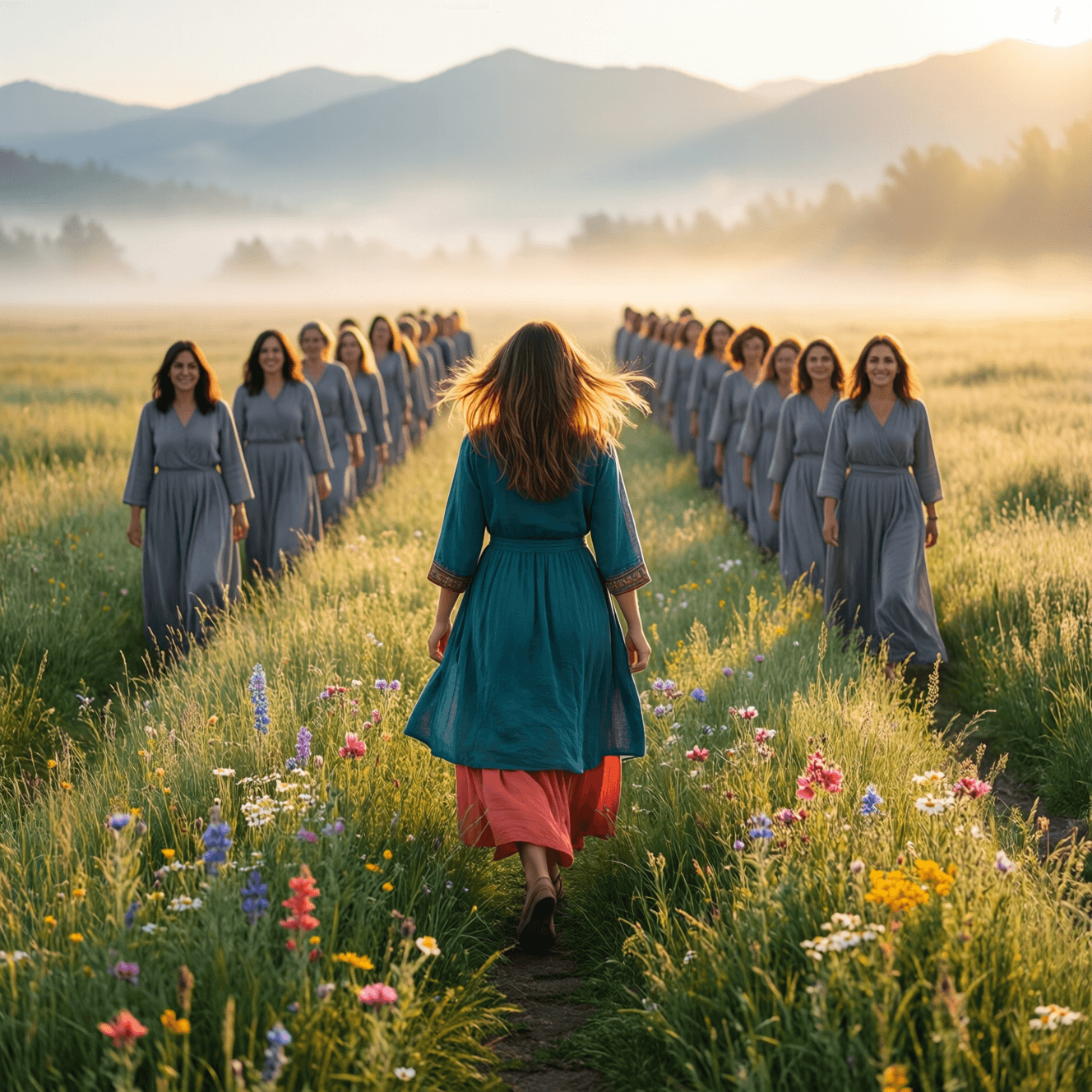
When a woman is forced to be like everyone else, she will soon be unable to do anything else. — Clarissa Pinkola Estés
—What lingers after this line?
A Warning About Learned Narrowness
Clarissa Pinkola Estés frames conformity not as a harmless social preference but as a training process that shrinks a person’s range. If a woman is repeatedly pressured to be “like everyone else,” the pressure doesn’t merely change her outward behavior; it gradually reshapes what she believes is possible. Over time, the adapted self becomes the only self that feels safe to inhabit. From there, the quote pivots to its sharper consequence: once conformity becomes habitual, it can harden into incapacity. What begins as strategic compliance—don’t stand out, don’t disrupt—can end as a genuine inability to imagine, attempt, or sustain anything different.
How Social Rewards Enforce Sameness
The mechanism Estés points to is subtle: societies often reward women for being agreeable, readable, and unthreatening, while punishing divergence with ridicule, exclusion, or moral judgment. As a result, fitting in becomes less a choice than a survival tactic, especially in workplaces, families, or communities where reputations carry real consequences. Once that reward-and-punishment loop is internalized, conformity no longer requires external policing. The woman learns to anticipate disapproval and edits herself preemptively, which makes “being like everyone else” feel natural—even when it comes at the expense of her original temperament, ambitions, or creative instincts.
From Performance to Identity
Estés’ second clause—“she will soon be unable to do anything else”—describes a shift from performance to identity. At first, blending in can be a role: code-switching, softening opinions, dressing down a talent so it doesn’t invite scrutiny. Yet repeated long enough, that role can become the self, because the psyche tends to conserve what keeps it socially safe. In other words, conformity is sticky. The more often a woman suppresses a trait—anger, assertiveness, sensuality, eccentric curiosity—the more unfamiliar it feels to express it later, until it resembles a lost language: once spoken fluently, now difficult to retrieve under pressure.
The Psychological Logic of Self-Silencing
Modern psychology offers a parallel vocabulary for this pattern. Concepts like “self-silencing” and role-based expectations describe how people, and disproportionately women, may mute needs and perceptions to preserve belonging; Dana Jack’s work on women’s self-silencing (1991) argues that chronic suppression can distort self-knowledge and increase distress. Estés’ line captures that same arc in poetic compression. What makes the process so effective is that it often masquerades as virtue: being “easygoing,” “low-maintenance,” or “not making a fuss.” Gradually, the cost appears only when a woman tries to act beyond the script and discovers how much confidence, skill, and spontaneity were traded away.
Creativity and Wildness as Human Necessities
Estés, known for Women Who Run With the Wolves (1992), frequently treats “wildness” as a metaphor for instinct, creativity, and inner authority. In that framework, forcing sameness is not merely social control; it is a kind of spiritual malnourishment. When the inner life is repeatedly trimmed to fit an external mold, the person may still function, but with less vitality and fewer original impulses. Consequently, the quote isn’t only about rights or fairness; it’s about human ecology. A community that demands uniformity from women also loses the innovations, perspectives, and forms of care that emerge precisely from difference.
The Slow Recovery of Difference
If conformity can become a cage, the way out is usually incremental rather than dramatic. Reclaiming the capacity to do “anything else” often starts with small acts of divergence—naming a preference without apology, pursuing a neglected craft, setting one boundary that feels slightly scary. These actions rebuild the muscles of agency that uniformity weakens. Finally, Estés’ warning implies a communal responsibility: environments matter. When families, schools, and workplaces make room for women’s complexity—anger and tenderness, ambition and rest, intellect and intuition—they don’t merely “allow individuality.” They prevent the tragedy the quote describes: a life narrowed until sameness is all that remains possible.
One-minute reflection
What feeling does this quote bring up for you?
Related Quotes
6 selectedTo be part of society is to lose a part of yourself; do what you would do if you were the only person on Earth. — Derek Sivers
Derek Sivers
Derek Sivers’ line begins with a sober observation: joining society often means trimming away parts of the self to fit shared expectations. Manners, careers, tastes, and even ambitions can become performances shaped by a...
Read full interpretation →The world accommodates you for fitting in, but only rewards you for standing out. — Matshona Dhliwayo
Matshona Dhliwayo
Matshona Dhliwayo’s quote begins with a social truth: the world often makes room for people who adapt to its expectations. Fitting in can bring acceptance, safety, and access, because groups tend to welcome those who und...
Read full interpretation →Children do not need us to shape them. They need us to respond to who they are. — Naomi Aldort
Naomi Aldort
Naomi Aldort’s statement begins by rejecting a familiar adult impulse: the desire to mold children into predetermined forms. Instead, she proposes a quieter and more demanding task—paying attention to the person already...
Read full interpretation →If the family were a fruit, it would be an orange, a circle of sections, held together but separable—each segment distinct. — Letty Cottin Pogrebin
Letty Cottin Pogrebin
At first glance, Letty Cottin Pogrebin’s image feels simple, yet it captures family structure with unusual precision. By comparing a family to an orange, she evokes something whole, rounded, and naturally unified.
Read full interpretation →You're born an original—don't die a copy. — John Mason
John Mason
At its core, John Mason’s line is a sharp reminder that every person begins life with a distinct combination of temperament, talent, and perspective. To be “born an original” suggests that individuality is not something...
Read full interpretation →Everyone pretends to be 'free thinkers,' but few individuals pass the line into expressive territories that may be detrimental to their own social well-being. — Criss Jami
Criss Jami
Criss Jami’s remark begins with a sharp contrast: many people proudly identify as “free thinkers,” yet far fewer are willing to follow their thoughts into speech or action when social consequences appear. In that sense,...
Read full interpretation →More From Author
More from Clarissa Pinkola Estés →Quietly and without fuss, you must trust your own heart. Your instincts are more reliable than the noise of the world. — Clarissa Pinkola Estés
At its core, Clarissa Pinkola Estés’s line invites a quiet act of courage: to believe that the heart can perceive truths the outside world often obscures. Rather than demanding dramatic rebellion, she emphasizes trust ex...
Read full interpretation →To create one must be willing to be stone stupid, to sit upon a throne on top of a jackass and spill rubies from one's mouth. — Clarissa Pinkola Estés
Clarissa Pinkola Estés begins with a provocation: anyone who wants to create must accept appearing “stone stupid.” In other words, genuine making starts where polish, certainty, and social dignity begin to fail. The arti...
Read full interpretation →You are not broken. You are becoming. — Clarissa Pinkola Estés
At its core, Clarissa Pinkola Estés’s line transforms the way we interpret hardship. Instead of treating pain, confusion, or loss as proof of damage, she invites us to see them as signs of movement.
Read full interpretation →If you have not been called a defiant, incorrigible, unmannerly woman, there is still time. — Clarissa Pinkola Estés
Clarissa Pinkola Estés turns a familiar set of accusations—“defiant,” “incorrigible,” “unmannerly”—into a kind of initiation rather than a shame sentence. The line suggests that these labels often appear not when someone...
Read full interpretation →