
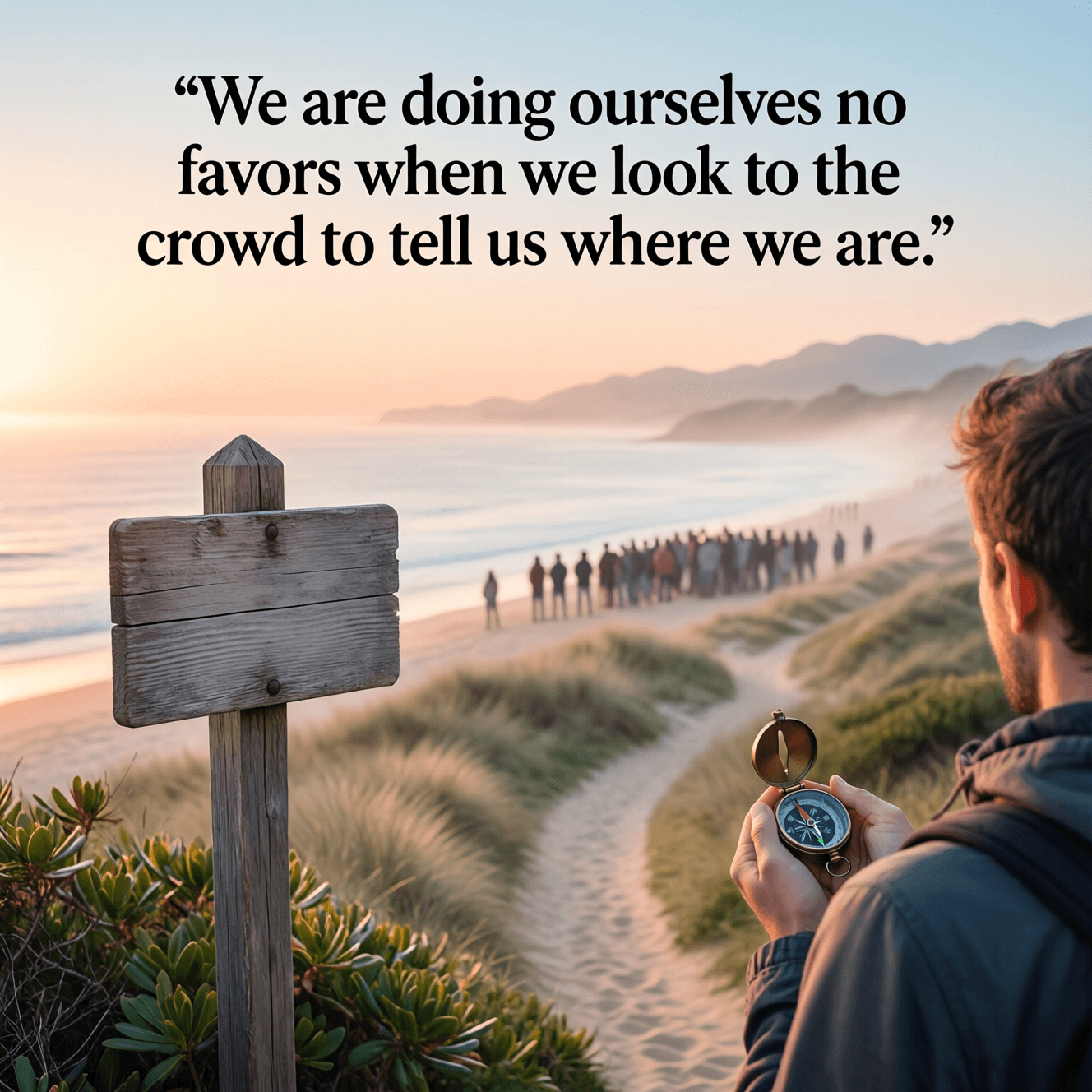
We are doing ourselves no favors when we look to the crowd to tell us where we are. — Erin Loechner
—What lingers after this line?
The Hidden Cost of Outsourcing Identity
Erin Loechner’s line points to a quiet habit many of us treat as normal: using other people’s reactions to locate our worth, success, or direction. When we “look to the crowd,” we hand over the compass, letting likes, praise, silence, or criticism tell us who we are. Yet this doesn’t actually clarify our position—it blurs it, because crowds are inconsistent and often responding to their own needs, tastes, and fears. As a result, we may feel briefly steadied by approval, but we become more anxious over time, needing constant updates from others to feel real. In that sense, the quote isn’t anti-community; it’s a warning about dependence. Before we can benefit from feedback, we need an inner reference point that doesn’t change with the room.
Crowd Signals Are Noisy, Not True
Even when the crowd is well-meaning, it is rarely accurate. Public consensus tends to reward what is familiar, easy to summarize, and socially safe, while undervaluing what is slow, complex, or ahead of its time. History repeatedly shows this: the reception of Van Gogh’s work during his lifetime contrasts sharply with his later acclaim, illustrating how collective judgment can lag behind genuine value. Therefore, using the crowd as a positioning system is like navigating with shifting weather instead of a map. You might occasionally catch a helpful gust, but you cannot build a stable route on something that changes by the hour. Loechner’s point lands here: the crowd’s volume can feel like certainty, yet it often masks randomness.
Comparison Distorts the Internal Map
Once we start checking ourselves against other people to “find where we are,” comparison quietly replaces self-knowledge. We begin measuring our progress using someone else’s timeline, resources, and calling, which makes our own path feel either behind or illegitimate. Social platforms intensify this by compressing countless lives into a single scroll, encouraging snap judgments rather than grounded reflection. Consequently, we can misread normal seasons—learning, recovery, rebuilding—as failure because they don’t look impressive from the outside. Instead of asking, “Am I becoming who I mean to be?” we ask, “How am I ranking?” The first question builds direction; the second builds agitation.
Approval as a Trap for Decision-Making
When the crowd becomes our reference point, decisions subtly shift from integrity to performance. We choose what will be understood quickly, applauded widely, or defended easily, and we avoid what might draw confusion or disapproval—even if it’s right for us. Over time, this can create a life that looks coherent externally but feels disconnected internally. This dynamic resembles what social psychologist Solomon Asch demonstrated in his conformity experiments (1951), where individuals often aligned with an incorrect group answer rather than risk standing alone. Likewise, the crowd can pull us toward safety over truth. Loechner’s warning is practical: if you let the crowd tell you where you are, it will eventually tell you where to go.
A Better Locator: Values and Self-Assessment
If the crowd is a poor mirror, what replaces it? A steadier approach is values-based self-assessment: clarifying what you’re aiming to practice—honesty, creativity, service, courage—and using those as coordinates. This doesn’t reject feedback; it puts feedback in its proper place, as information rather than identity. For instance, a person changing careers might feel “behind” when peers seem established, yet their real measure could be alignment: moving toward meaningful work, learning transferable skills, and building resilience. In that framework, uncertainty isn’t evidence of being lost; it may be evidence of being in transition. The crowd can comment, but it cannot locate you as accurately as your commitments can.
Community Without Dependence
Finally, Loechner’s insight leaves room for healthier belonging. Community can support growth when it offers perspective, accountability, and care without demanding conformity. The difference is whether you approach others to be seen and sharpened, or to be defined. In the first case, you remain an agent; in the second, you become an audience member in your own life. Seen this way, the quote is an invitation to mature confidence: to listen without surrendering, to receive input without needing permission to exist. Once you stop asking the crowd to tell you where you are, you can engage people more freely—less as judges and more as companions on a path you are actually choosing.
One-minute reflection
What does this quote ask you to notice today?
Related Quotes
6 selectedHow to guarantee failure: let other people's opinions determine your priorities. — Alex Hormozi
Alex Hormozi
Alex Hormozi’s warning begins with a simple but uncomfortable truth: failure often starts when a person hands over the authority to decide what matters. Other people’s opinions may sound like advice, concern, criticism,...
Read full interpretation →You rise and fall by your own efforts. Remember, it is a waste of time to worry about anyone else in this struggle. — Rudyard Kipling
Rudyard Kipling
At its heart, Kipling’s statement insists that the decisive force in a person’s life is personal effort. To rise or fall is not, in the first instance, a matter of spectators, rivals, or public opinion, but of one’s own...
Read full interpretation →When you feel like you are drowning in life, don't blame the ocean. You have to learn how to swim. — Anne Lamott
Anne Lamott
Anne Lamott’s line begins with a blunt but compassionate shift in perspective: when life feels overwhelming, the first impulse is often to blame circumstances, other people, or fate itself. Yet the quote redirects attent...
Read full interpretation →When jarred, unavoidably, by circumstance, revert at once to yourself, and don't lose the rhythm more than you can help. — Marcus Aurelius
Marcus Aurelius
Marcus Aurelius urges a swift inward recovery when life shakes us out of balance. In this short instruction, the disturbance itself is treated as inevitable, but the real test lies in how quickly we return to our center.
Read full interpretation →It is not what you do for your children, but what you have taught them to do for themselves, that will make them successful human beings. — Ann Landers
Ann Landers
At its core, Ann Landers’s quote shifts attention from parental sacrifice to parental formation. She argues that success does not primarily grow out of everything a parent provides, arranges, or fixes, but from the habit...
Read full interpretation →The secret of all great undertakings is hard work and self-reliance, manifested in the smallest daily tasks. — Mary Lyon
Mary Lyon
Mary Lyon’s statement compresses a large philosophy into a simple formula: greatness is not born from dramatic moments alone, but from steady labor and personal responsibility. At first glance, “great undertakings” may s...
Read full interpretation →More From Author
More from Erin Loechner →