
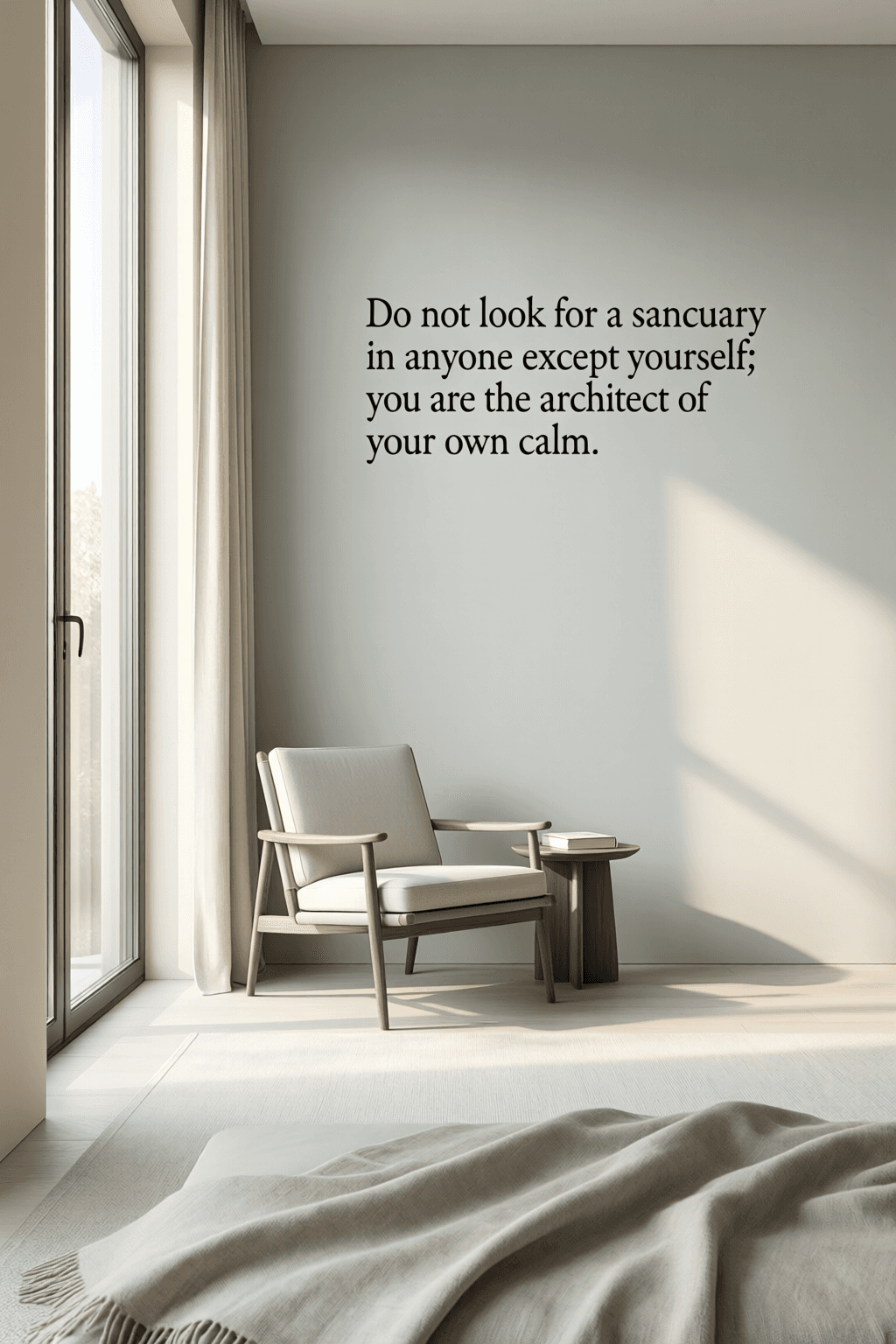
Do not look for a sanctuary in anyone except yourself; you are the architect of your own calm. — Maya Angelou
—What lingers after this line?
Self-Reliance as Refuge
Maya Angelou’s statement begins by redirecting a common human impulse: the desire to seek safety in other people. Rather than condemning connection, she gently warns against making another person the sole shelter for our peace. In this light, sanctuary is not something borrowed from someone else’s steadiness, but something built within, where it can endure even when relationships shift. This idea carries particular force because it frames calm as an act of personal authorship. By calling us the “architect” of our own peace, Angelou suggests that inner stability is not accidental; it is designed through thought, discipline, and self-knowledge. Thus, the quote moves from comfort to responsibility, urging us to become active builders rather than passive seekers.
The Limits of External Validation
From there, the quote also exposes the fragility of peace that depends entirely on outside approval. If calm rests on another person’s affection, reassurance, or presence, it becomes vulnerable to absence, misunderstanding, or change. In other words, what is given by others can also be withdrawn, leaving the self emotionally unmoored. Psychology often echoes this concern through discussions of emotional regulation and dependency. For example, Carl Rogers’s work in On Becoming a Person (1961) emphasizes the growth that occurs when individuals develop an internal locus of evaluation rather than relying solely on external judgment. Angelou’s insight fits this tradition, reminding us that peace deepens when it is rooted in a stable inner foundation.
Calm as a Deliberate Construction
Because Angelou uses the language of architecture, her metaphor implies patience, structure, and repeated effort. No building appears in an instant, and neither does inner calm. It is assembled slowly through habits such as reflection, boundaries, forgiveness, and the ability to sit with discomfort without collapsing under it. Seen this way, serenity is less a mood than a craft. Much like Marcus Aurelius in Meditations (c. 180 AD), who repeatedly returned to the discipline of governing his own mind, Angelou points toward a calm made durable by practice. The metaphor is powerful precisely because it rejects magical solutions and replaces them with intentional inner design.
Strength Without Isolation
Importantly, the quote does not argue for loneliness or emotional withdrawal. Rather, it distinguishes between loving others and outsourcing the entire burden of one’s peace to them. Healthy relationships can support, nourish, and steady us, yet they cannot substitute for the inner work that gives those relationships balance. This distinction matters because self-possession often makes intimacy stronger, not weaker. When people arrive with some measure of inner grounding, they are less likely to cling, control, or demand rescue. In that sense, Angelou’s message is not anti-relationship; instead, it proposes that genuine connection flourishes best when each person has begun building a sanctuary within.
A Quiet Ethics of Responsibility
Finally, Angelou’s words carry a moral undertone: we are answerable for the atmosphere we create inside ourselves. Although life brings injury, grief, and unpredictability, the quote insists that our response still matters. This is not a denial of hardship, but a refusal to surrender all agency to circumstance or to other people. That insistence has long resonated in Angelou’s broader body of work, especially in Letter to My Daughter (2008), where resilience and self-definition recur as central themes. Her message here follows the same path: dignity begins when we stop waiting to be saved and start shaping a steadier inner world. As a result, calm becomes not a gift we receive, but a home we build.
One-minute reflection
Why might this line matter today, not tomorrow?
Related Quotes
6 selectedTo be at home in one's own skin is the ultimate sanctuary. — Maya Angelou
Maya Angelou
Maya Angelou’s words recast home as something deeper than walls, geography, or possession. To be “at home in one’s own skin” means living without chronic self-rejection, inhabiting one’s body and identity with a sense of...
Read full interpretation →There is a deep peace that comes from creating something that didn't exist before. It is your way of telling the universe that you were here, and you felt something. — Maya Angelou
Maya Angelou
At its heart, Maya Angelou’s reflection suggests that creation is not merely productive but restorative. To make something that did not exist before—a poem, a garden, a melody, even a repaired room—is to experience a rar...
Read full interpretation →Each of us needs to withdraw from the cares which will not withdraw from us. — Maya Angelou
Maya Angelou
Maya Angelou’s line begins with a sober recognition: some cares don’t politely fade when we ask them to. Bills, grief, conflict, deadlines, and uncertainty can keep pressing, and if we wait for life to quiet down before...
Read full interpretation →Inner calm is not a state you wait for, but a space you build within the daily noise. — Pico Iyer
Pico Iyer
At its core, Pico Iyer’s line shifts calm from something passive to something made. Rather than imagining peace as a rare mood that descends when life finally becomes quiet, he presents it as an inner architecture built...
Read full interpretation →The mind is a sanctuary of calm thoughts, and you hold the keys. You are the architect of your own inner peace. — Akiroq Brost
Akiroq Brost
At its core, Akiroq Brost’s quote imagines the mind not as a battlefield but as a sanctuary—a protected space where calm thoughts can dwell. This metaphor immediately shifts responsibility inward: peace is not merely fou...
Read full interpretation →Self-mastery begins the moment you decide that your internal peace is more valuable than the external approval you were chasing. — Epictetus
Epictetus
At its core, this saying frames self-mastery as a decisive inner shift. The moment a person values peace of mind over praise, status, or acceptance, power begins to move inward rather than outward.
Read full interpretation →More From Author
More from Maya Angelou →The only way to exist in a world that feels increasingly cold is to be the warmth you wish to receive from others. — Maya Angelou
At its core, Maya Angelou’s line reframes loneliness as a call to action rather than a verdict on the world. If life feels impersonal, distant, or harsh, she suggests that waiting passively for kindness may only deepen t...
Read full interpretation →Home is the place where one finally allows the armor to drop and the spirit to breathe. — Maya Angelou
At its core, Maya Angelou’s reflection defines home not merely as a structure but as a sanctuary of emotional safety. The image of letting “the armor drop” suggests that daily life often requires protection—composure, re...
Read full interpretation →The true value of our journey is found in the people who walk beside us, turning simple moments into our most enduring milestones. — Maya Angelou
At its heart, this reflection suggests that life is not valued only by destinations reached, but by the companions who share the road. Maya Angelou’s thought reframes success away from solitary achievement and toward rel...
Read full interpretation →When we come together as a family, love multiplies, and hearts grow. — Maya Angelou
Maya Angelou’s words begin with a simple but powerful claim: family togetherness does not merely preserve love, it increases it. By saying that love multiplies, she moves beyond the idea of affection as a limited resourc...
Read full interpretation →