
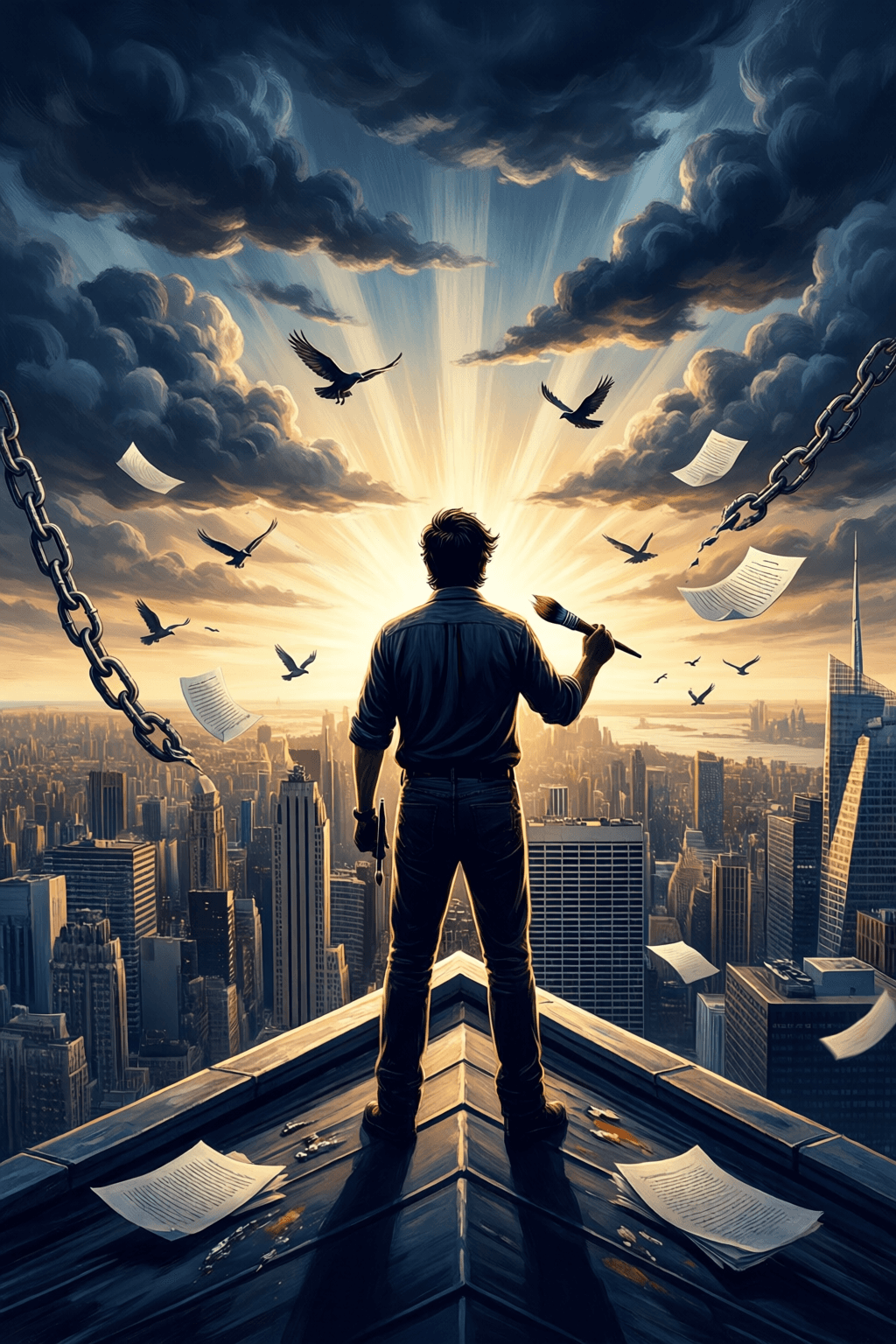
The artist must elect to fight for freedom or for slavery. I have made my choice. I had no alternative. — Maya Angelou
—What lingers after this line?
A Declaration Without Neutral Ground
Maya Angelou’s statement begins with a stark premise: the artist cannot stand outside history. By saying an artist must choose between freedom and slavery, she rejects the comforting illusion of neutrality and insists that creative work always carries moral weight. In this framing, even silence becomes a form of consent, because refusing to resist oppression leaves oppressive systems undisturbed. From there, her second sentence deepens the force of the claim. “I have made my choice” sounds less like self-congratulation than testimony, the voice of someone who understands art as public responsibility. The final phrase, “I had no alternative,” transforms that choice into an ethical necessity, suggesting that for a conscience awake to injustice, freedom is not merely preferable but obligatory.
Why the Artist Is Never Apolitical
Seen in this light, Angelou is arguing that art does more than entertain: it shapes feeling, memory, and public imagination. A poem, song, novel, or painting can humanize the marginalized, or it can normalize domination by repeating the values of the powerful. Because art influences how societies see themselves, artists inevitably participate in political and moral life whether they admit it or not. Accordingly, history offers many examples. Harriet Beecher Stowe’s Uncle Tom’s Cabin (1852), despite later criticism of its limitations, helped many readers confront the brutality of slavery. Likewise, Pablo Picasso’s Guernica (1937) turned the bombing of civilians into an enduring anti-war image. Angelou’s words fit squarely within this tradition: the artist’s medium may vary, but the demand to choose remains.
Freedom as a Human Imperative
Angelou’s pairing of freedom and slavery is deliberately absolute, and that absolutism matters. Freedom here is not only legal independence but the full recognition of human dignity—the right to speak, create, move, remember, and belong without being reduced to property or silence. Slavery, by contrast, names both literal bondage and broader systems of dehumanization that deny people agency. Therefore, her quote resonates beyond its historical reference to chattel slavery. It also speaks to censorship, racism, misogyny, colonialism, and any structure that trains people to accept the diminishing of others. In that sense, Angelou is not using exaggerated rhetoric; she is clarifying moral stakes. Once the issue is human freedom, compromise begins to look less like wisdom and more like surrender.
The Authority of Lived Experience
The force of Angelou’s words also comes from who is speaking. In I Know Why the Caged Bird Sings (1969), she chronicled trauma, racism, and the struggle to reclaim voice, making freedom not an abstract principle but a lived necessity. Her life as a poet, memoirist, performer, and civil rights activist alongside figures such as Martin Luther King Jr. and Malcolm X gave her unusual authority to speak about art’s obligations. Because of that background, “I had no alternative” carries biographical truth. It suggests that her art emerged from conditions in which silence would have meant betrayal—of self, of community, and of reality itself. Rather than separating aesthetics from ethics, Angelou’s career demonstrates how beauty, testimony, and resistance can become inseparable.
Art as Witness and Resistance
Once Angelou’s premise is accepted, art becomes more than expression; it becomes witness. The artist records what official narratives omit, preserving voices that power would rather erase. This is why so much transformative art arises under pressure: it answers distortion with memory and fear with form. James Baldwin’s essays, for instance, exposed the moral evasions of American racism, while Nina Simone’s “Mississippi Goddam” (1964) converted grief and fury into public protest. At the same time, resistance in art does not always require slogans. Sometimes it appears in the simple insistence on complexity, tenderness, or truth about people reduced by stereotype. By rendering the oppressed as fully human, the artist already sides with freedom. Angelou’s quote captures that dynamic in its most uncompromising form.
The Enduring Challenge to Creators
Ultimately, Angelou’s statement remains urgent because every generation faces new versions of the same choice. Contemporary artists confront propaganda, algorithmic manipulation, political intimidation, and market pressures that reward spectacle over conscience. Yet her words remind them that talent alone is not enough; what matters is the use to which talent is put. In the end, the quote challenges audiences as much as artists. If creators must choose, so must those who consume, fund, teach, and share their work. Angelou leaves little room for comfortable detachment. She asks us to see art as a field of moral action, where freedom is defended not only in laws and protests but also in language, image, rhythm, and memory.
One-minute reflection
Where does this idea show up in your life right now?
Related Quotes
6 selectedResistance is fertile; it grows the flowers of freedom. — Maya Angelou
Maya Angelou
By describing resistance as 'fertile,' the quote likens resistance to fruitful soil from which positive outcomes, such as freedom, can grow.
Read full interpretation →Your home should lower your shoulders the moment you walk in. — Unknown (attributed to design philosophy/experts, but skipping as per rules: switching to:) The boundary to what we can accept is the boundary to our freedom. — Tara Brach
Tara Brach
At first glance, Tara Brach’s statement sounds simple, yet it points to a profound inner mechanism: the limits of our freedom are often set not only by external conditions, but by what we refuse to face within ourselves....
Read full interpretation →The boundary to what we can accept is the boundary to our freedom. — Tara Brach
Tara Brach
At first glance, Tara Brach’s statement suggests that freedom is not only shaped by external circumstances but also by our inner willingness to face reality. What we cannot accept—whether grief, uncertainty, fear, or imp...
Read full interpretation →True freedom is found in the discipline to choose what you want most over what you want in this fleeting moment. — Arden Mahlberg
Arden Mahlberg
At first glance, freedom is often imagined as the ability to do whatever one wants at any given moment. Arden Mahlberg’s statement gently overturns that assumption by suggesting that real freedom is not impulsive indulge...
Read full interpretation →Freedom is knowing what is yours to influence. — Zeno of Citium
Zeno of Citium
At its heart, Zeno’s statement defines freedom not as unlimited power, but as clear discernment. The founder of Stoicism, writing in the early 3rd century BC, argued that human beings suffer when they confuse what belong...
Read full interpretation →The things you own end up owning you. It is only after you lose everything that you're free to do anything. — Chuck Palahniuk
Chuck Palahniuk
At first glance, Palahniuk’s line appears to criticize materialism, yet it goes further by describing a reversal of power. We believe we possess objects, but gradually those objects begin to dictate our time, anxiety, an...
Read full interpretation →More From Author
More from Maya Angelou →The only way to exist in a world that feels increasingly cold is to be the warmth you wish to receive from others. — Maya Angelou
At its core, Maya Angelou’s line reframes loneliness as a call to action rather than a verdict on the world. If life feels impersonal, distant, or harsh, she suggests that waiting passively for kindness may only deepen t...
Read full interpretation →Home is the place where one finally allows the armor to drop and the spirit to breathe. — Maya Angelou
At its core, Maya Angelou’s reflection defines home not merely as a structure but as a sanctuary of emotional safety. The image of letting “the armor drop” suggests that daily life often requires protection—composure, re...
Read full interpretation →The true value of our journey is found in the people who walk beside us, turning simple moments into our most enduring milestones. — Maya Angelou
At its heart, this reflection suggests that life is not valued only by destinations reached, but by the companions who share the road. Maya Angelou’s thought reframes success away from solitary achievement and toward rel...
Read full interpretation →When we come together as a family, love multiplies, and hearts grow. — Maya Angelou
Maya Angelou’s words begin with a simple but powerful claim: family togetherness does not merely preserve love, it increases it. By saying that love multiplies, she moves beyond the idea of affection as a limited resourc...
Read full interpretation →