
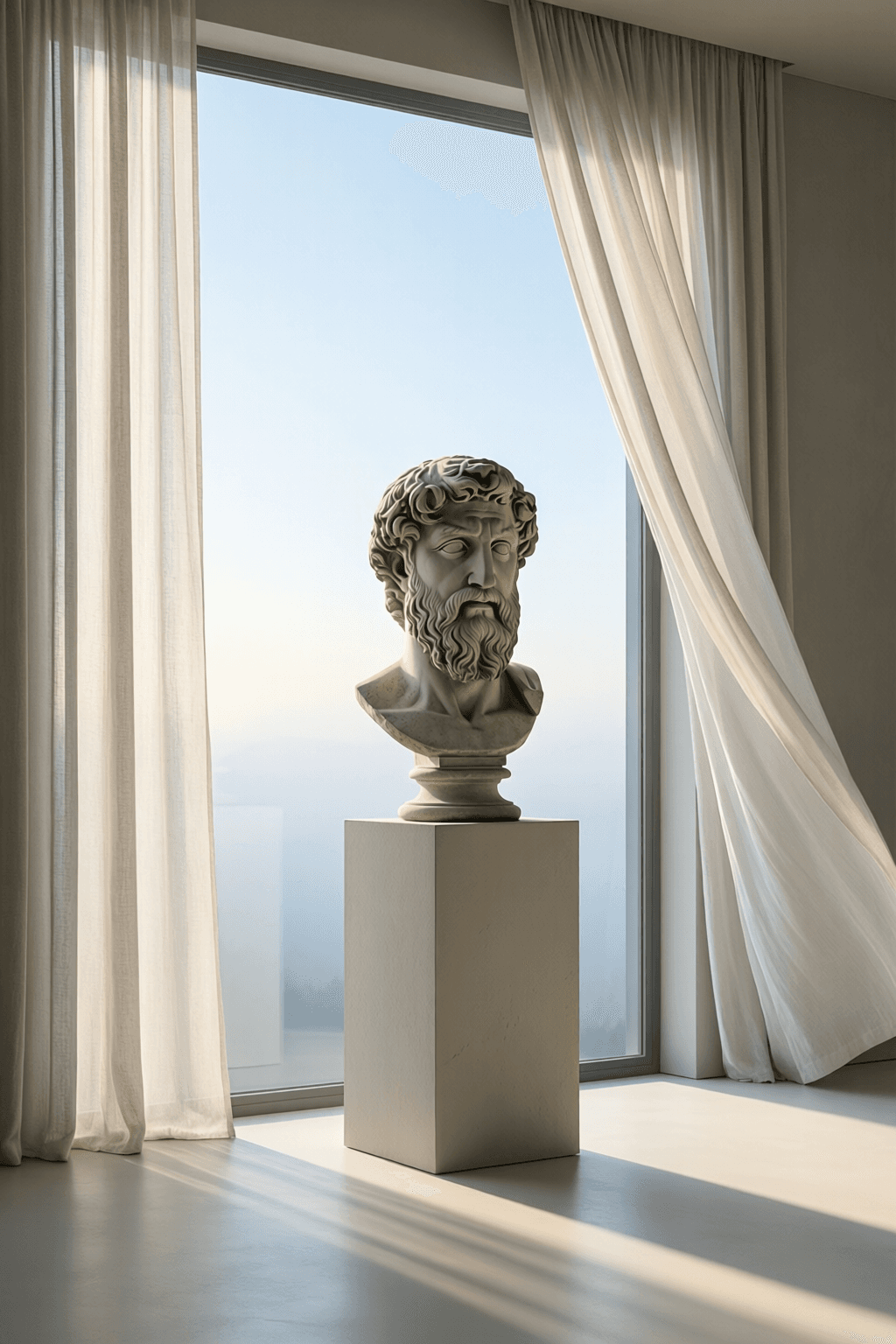
If you want to be free, stay away from things that are not in your power. — Epictetus
—What lingers after this line?
Freedom Through Inner Boundaries
Epictetus begins with a stark but liberating distinction: some things belong to us, and some do not. Our judgments, choices, and responses lie within our power, while reputation, outcomes, and other people’s behavior do not. In that light, freedom is not the ability to command the world; rather, it is the discipline of refusing to chain our peace to what the world may withhold. This idea runs through Epictetus’s Discourses and Enchiridion (2nd century AD), where he argues that suffering often begins when we confuse external events with personal possessions. By drawing firm inner boundaries, a person becomes less vulnerable to disappointment and fear. Thus, freedom appears not as escape from life, but as mastery over dependence.
The Stoic Division of Control
From that foundation, the quote expresses one of Stoicism’s central teachings: the division between what is “up to us” and what is not. Epictetus does not deny that externals matter in practical life; instead, he warns against treating them as the source of identity or emotional security. Once we do, our well-being becomes hostage to chance. In Enchiridion 1, he famously writes that opinion, desire, aversion, and action are our own, whereas body, property, office, and reputation are not fully ours. Consequently, the path to freedom is not passive withdrawal but accurate valuation. We may pursue goals, relationships, and success, yet we remain inwardly steady when we understand that their final outcome never belonged entirely to us.
How Attachment Creates Servitude
Moreover, Epictetus suggests that misplaced attachment quietly turns desire into slavery. If a person needs praise to feel secure, then anyone with the power to praise or insult becomes a master. If one cannot bear failure, then fortune itself becomes a tyrant. What feels like ambition or love of status can, under scrutiny, reveal a life governed by anxiety. This is why Stoic freedom sounds severe at first: it asks us to loosen our grip on cherished externals. Yet the severity is medicinal. Seneca’s Letters to Lucilius (c. 65 AD) echo the same point, arguing that the person dependent on luxury, applause, or luck is never truly independent. By reducing dependence, one recovers dignity and self-command.
A Practical Rule for Daily Life
Seen practically, the quote offers a rule for everyday frustrations. Before entering a difficult conversation, taking an exam, or applying for a job, we can ask: what here is mine to govern? Preparation, honesty, effort, and composure belong to us; the other person’s reaction, the market’s verdict, or the final result do not. This shift does not remove effort—it clarifies where effort should go. In modern terms, the advice resembles psychological approaches that emphasize response over circumstance. Viktor Frankl’s Man’s Search for Meaning (1946) later framed a similar insight: even when conditions are constrained, one’s attitude remains a final domain of freedom. Therefore, Epictetus’s counsel remains strikingly contemporary, helping people exchange helpless rumination for deliberate action.
Detachment Without Indifference
However, staying away from what is not in our power does not mean becoming cold, inactive, or uncaring. Stoicism is often misunderstood as emotional numbness, when in fact it asks for committed action without emotional captivity. A parent still loves a child, a citizen still serves the community, and a worker still pursues excellence; the difference is that they do so without believing they can fully control the unfolding of events. Here the philosophy becomes humane rather than harsh. Marcus Aurelius’s Meditations (c. 180 AD) repeatedly joins duty with acceptance, urging himself to act justly while yielding outcomes to nature. In that sense, detachment protects love and service from turning into panic. We engage deeply, but we do not surrender our freedom to uncertainty.
The Quiet Strength of Self-Mastery
Finally, Epictetus presents freedom not as dramatic rebellion but as quiet self-mastery. The freest person, by this measure, is not the one with limitless options, wealth, or influence, but the one whose inner life cannot be bullied by circumstances. Such freedom is subtle, often invisible, yet it is durable in a way external power never is. As a former slave teaching philosophy in Rome, Epictetus embodied the paradox he described: a person may be outwardly constrained and still possess inward liberty. That biographical fact gives the quote unusual force. In the end, his message is both demanding and consoling: reclaim your mind from what was never yours to command, and freedom will begin there.
Recommended Reading
As an Amazon Associate, we earn from qualifying purchases.
One-minute reflection
Why might this line matter today, not tomorrow?
Related Quotes
6 selectedIf you want to be free, stop trying to control what is not yours to command. — Seneca
Seneca
At its heart, Seneca’s line expresses a central Stoic principle: freedom does not come from mastering the world, but from mastering one’s response to it. In letters such as the *Epistulae Morales* (c.
Read full interpretation →Authentic power is not about controlling the world around you, but governing the inner landscape of your own reactions. — Seneca
Seneca
At first glance, Seneca overturns the usual definition of power. Rather than equating strength with influence, status, or command over others, he locates true authority within the self.
Read full interpretation →Freedom is knowing what is yours to influence. — Zeno of Citium
Zeno of Citium
At its heart, Zeno’s statement defines freedom not as unlimited power, but as clear discernment. The founder of Stoicism, writing in the early 3rd century BC, argued that human beings suffer when they confuse what belong...
Read full interpretation →If you want to be free, you must practice self-mastery. — Naval Ravikant
Naval Ravikant
At first glance, Naval Ravikant’s statement reframes freedom as something deeper than external choice or social permission. He implies that liberty is not simply the absence of restraint; rather, it is the ability to gov...
Read full interpretation →Freedom is born of self-discipline. No individual, no nation, can achieve or maintain liberty without self-control. — Alan Valentine
Alan Valentine
At first glance, Alan Valentine’s statement seems paradoxical: freedom is often imagined as the absence of restraint, yet he argues that it begins with restraint of the self. His point is that liberty cannot survive wher...
Read full interpretation →If you want to be free, you must be able to govern yourself. — Aristotle
Aristotle
At first glance, Aristotle’s statement seems to redefine freedom in an unexpected way. Rather than treating liberty as the absence of rules, he presents it as the ability to direct one’s own life through discipline and j...
Read full interpretation →More From Author
More from Epictetus →Stillness is the birthplace of strength. — Epictetus
At first glance, Epictetus turns a common assumption upside down: strength does not begin in noise, force, or visible struggle, but in stillness. The Stoic philosopher suggests that real power is born when the mind becom...
Read full interpretation →If you would live your life with ease, do what you ought, not what you please. — Epictetus
At its heart, Epictetus argues that a peaceful life does not come from indulging every passing preference, but from aligning action with obligation and principle. In other words, ease is not the same as comfort.
Read full interpretation →With each person you meet, remind yourself that you share a common humanity. — Epictetus
At its core, Epictetus’s advice asks for a disciplined shift in perception. Rather than meeting others as rivals, strangers, or obstacles, we are urged to begin with a deeper truth: each person participates in the same f...
Read full interpretation →Self-mastery begins the moment you decide that your internal peace is more valuable than the external approval you were chasing. — Epictetus
At its core, this saying frames self-mastery as a decisive inner shift. The moment a person values peace of mind over praise, status, or acceptance, power begins to move inward rather than outward.
Read full interpretation →