
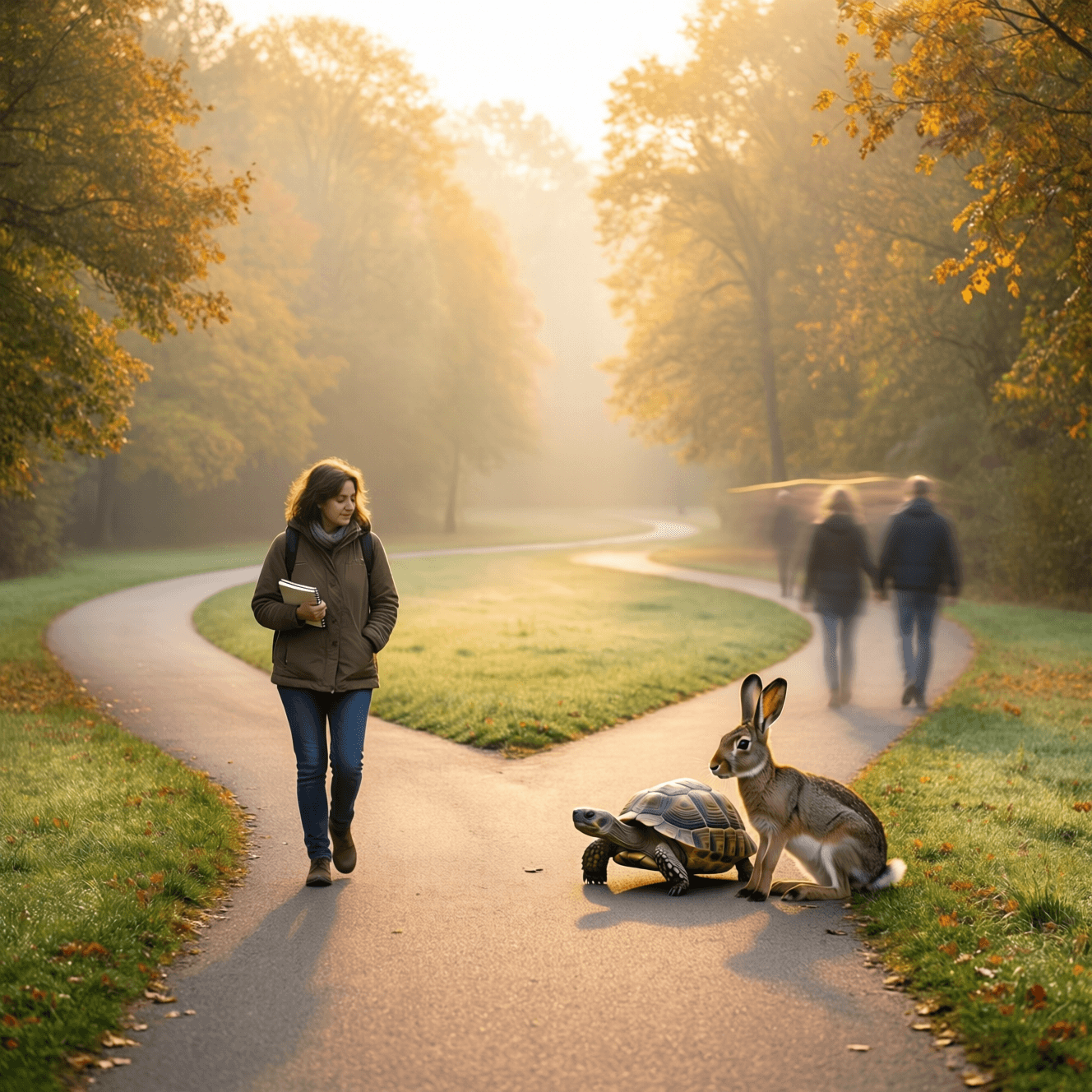
The slow philosophy is not about doing everything in tortoise mode. It's about doing everything at the right speed. — Carl Honoré
—What lingers after this line?
Clearing Up the Misunderstanding of “Slow”
Carl Honoré begins by dismantling a common caricature: that “slow” living is merely an aesthetic of delay, a kind of self-imposed sluggishness. By saying it’s not “tortoise mode,” he rejects the idea that slowness is a fixed tempo applied to every task, regardless of context. Instead, the quote frames “slow” as a philosophy of discernment. The point is not to idolize leisure or inefficiency, but to resist the reflex that faster is always better. That shift prepares the ground for a more practical, humane definition: the right pace depends on what you’re doing and why you’re doing it.
Right Speed as a Form of Wisdom
From there, “the right speed” sounds less like a lifestyle trend and more like a classic virtue: practical wisdom. Aristotle’s idea of the mean in the Nicomachean Ethics (c. 350 BC) treats excellence as contextual—courage differs from recklessness and cowardice depending on circumstances, just as speed differs from haste and stagnation. In that light, Honoré’s “right speed” becomes an ethical and cognitive skill: matching tempo to purpose. Some moments call for swift action—responding to danger, meeting a deadline, seizing an opportunity—while others demand slowness to prevent error, deepen understanding, or show care.
How Speed Shapes Attention and Quality
Once speed is seen as a choice, its effects become visible in everyday outcomes. Rushing often narrows attention: you optimize for completion rather than comprehension, and quantity can masquerade as productivity. By contrast, slowing down at key points—planning, listening, revising—can improve results without necessarily adding much time overall. A simple anecdote captures this: someone answers emails instantly all morning yet feels oddly behind, then spends ten focused minutes clarifying priorities and suddenly the day becomes coherent. The philosophy here isn’t to work slowly, but to place slowness where it multiplies quality—like sharpening the blade before cutting.
Resisting the Culture of Constant Acceleration
Honoré’s line also implies a cultural critique: modern life often treats acceleration as default, and anyone who slows down risks seeming unambitious. Yet the drive for speed can become self-reinforcing—more tools to move faster create more expectations to do more, which then demands even greater speed. Against that backdrop, choosing the “right speed” is a quiet act of autonomy. It asks you to decide what deserves immediacy and what deserves deliberation, rather than letting social pressure or technology set your tempo. The goal is not withdrawal from modernity, but a more intentional relationship with it.
Knowing When to Go Fast
Importantly, the quote protects slow philosophy from becoming another rigid rulebook. Doing everything slowly can be as unthinking as doing everything fast, just in the opposite direction. Honoré’s phrasing makes room for speed when speed serves the moment: rapid iteration in a crisis, brisk exercise for health, quick decisions when information is already clear. This is where the philosophy becomes pragmatic: fast can be mindful, and slow can be careless. The measure is fit. If you’re moving quickly with presence and purpose, you’re still practicing the “right speed,” because you’re choosing tempo rather than being dragged by it.
Making “Right Speed” a Daily Practice
Finally, Honoré’s idea becomes actionable when treated as a recurring question: what pace does this task deserve? Reading a contract, having a difficult conversation, or caring for a child may warrant slowness, while scheduling logistics or clearing routine messages may not. The discipline lies in switching gears deliberately. Over time, this practice can restore a sense of control and reduce the friction of living at one unvarying tempo. Slow philosophy, as Honoré frames it, is ultimately about rhythm: aligning speed with values so that life feels not merely busy or quiet, but appropriately lived.
One-minute reflection
What does this quote ask you to notice today?
Related Quotes
6 selectedTo be slow means that you govern the rhythms of your life. You are in control of deciding how fast you have to go. — Carl Honoré
Carl Honoré
Carl Honoré’s line challenges the modern assumption that faster is automatically better. Instead of treating urgency as an objective requirement, he frames speed as a choice—one that can be accepted, negotiated, or refus...
Read full interpretation →When I slow down, I can dive deeper—and that's how I prefer to live. — Carl Honoré
Carl Honoré
At its core, Carl Honoré’s reflection presents slowness not as laziness but as a conscious way of inhabiting life more fully. By saying that slowing down allows him to “dive deeper,” he suggests that speed often keeps us...
Read full interpretation →The great benefit of slowing down is reclaiming the time and tranquility to make meaningful connections. — Carl Honoré
Carl Honoré
Carl Honoré frames slowing down not as laziness but as a practical recovery of something we constantly lose: usable time. When life is lived at full speed, hours get consumed by deadlines, notifications, and “efficient”...
Read full interpretation →In an age of speed, I began to think nothing is as precious as slowness. — Alice Walker
Alice Walker
Alice Walker’s line begins with a modern assumption—life is accelerating—and then performs a quiet reversal: the rarer something becomes, the more it is worth. In an age that prizes quick replies, rapid production, and c...
Read full interpretation →We need, above all things, to slow down and get ourselves to amble through life instead of to rush through it. — Bertrand Russell
Bertrand Russell
At its core, Bertrand Russell’s remark argues that the speed of modern life can become a form of self-impoverishment. To rush through existence is not merely to move quickly; it is to miss texture, reflection, and the qu...
Read full interpretation →Be fast when it makes sense to be fast, and be slow when slowness is called for. — Carl Honoré
Carl Honoré
Carl Honoré’s line begins with a practical admission: speed is not the enemy. There are moments when urgency, efficiency, and quick response are exactly what life requires.
Read full interpretation →More From Author
More from Carl Honoré →Be fast when it makes sense to be fast, and be slow when slowness is called for. — Carl Honoré
Carl Honoré’s line begins with a practical admission: speed is not the enemy. There are moments when urgency, efficiency, and quick response are exactly what life requires.
Read full interpretation →When we are calm, ununrried, and free from stress and distractions, the brain slips into a richer, more nuanced mode of thought. — Carl Honoré
At its core, Carl Honoré’s observation suggests that the mind does not always think best at high speed. When we are calm, unhurried, and mentally unburdened, thought becomes less reactive and more reflective.
Read full interpretation →There is a kind of vitality that is not about speed, but about the depth of our attention to the things we choose to cultivate. — Carl Honoré
At first glance, vitality is often mistaken for motion, speed, or constant productivity. Carl Honoré challenges that assumption by suggesting that real aliveness comes not from rushing through life, but from how fully we...
Read full interpretation →When I slow down, I can dive deeper—and that's how I prefer to live. — Carl Honoré
At its core, Carl Honoré’s reflection presents slowness not as laziness but as a conscious way of inhabiting life more fully. By saying that slowing down allows him to “dive deeper,” he suggests that speed often keeps us...
Read full interpretation →