
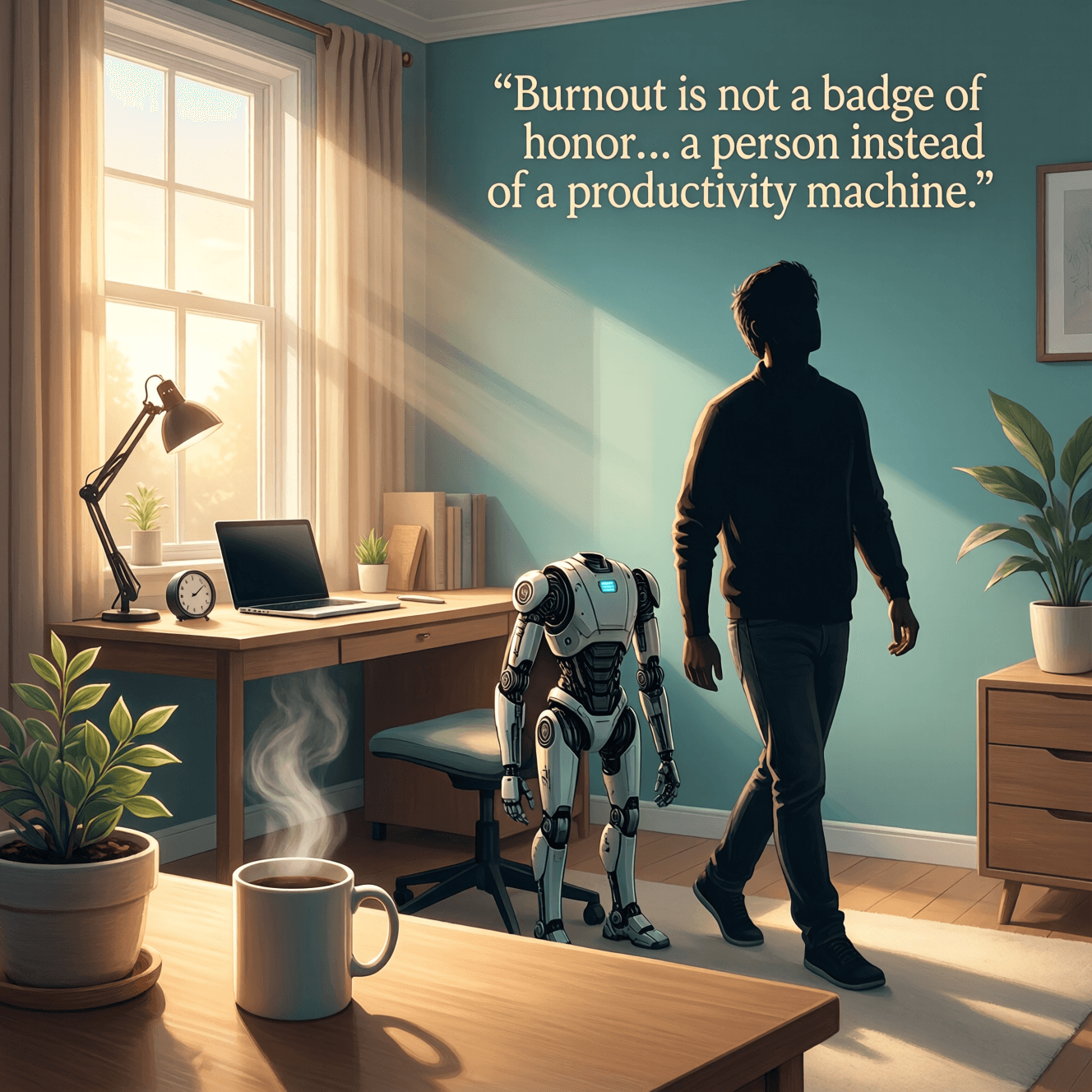
Burnout is not a badge of honor; it is a sign that you have forgotten how to be a person instead of a productivity machine. — Arianna Huffington
—What lingers after this line?
Rejecting the Myth of Noble Exhaustion
Arianna Huffington’s line begins by confronting a familiar cultural script: if you’re depleted, you must be important. By calling burnout “not a badge of honor,” she reframes exhaustion from a status symbol into a warning light—less proof of dedication than evidence of unsustainable living. From there, the quote nudges us to notice how easily workplaces and social media reward visible strain. Long hours, constant availability, and the performance of being overwhelmed can read as commitment, but Huffington suggests this is a distortion: the body and mind are not failing morally; they are signaling that something essential is being neglected.
Burnout as Identity Erosion
The second clause deepens the critique by describing burnout as a “sign” that you’ve forgotten how to be a person. This implies that the harm is not only fatigue but a gradual narrowing of identity—where curiosity, relationships, play, and rest become secondary or even feel undeserved. As that narrowing continues, the self is increasingly measured by outputs: emails answered, tasks closed, metrics hit. In that shift, personhood becomes conditional, granted only after productivity goals are met, which makes recovery difficult because the very activities that restore humanity are treated as distractions.
The Productivity Machine Metaphor
By contrasting “a person” with “a productivity machine,” Huffington highlights the dehumanizing logic that treats attention and energy like endlessly extractable resources. Machines are valued for uptime, efficiency, and predictability; people, however, are cyclical—needing sleep, meaning, and connection to function well. This metaphor also exposes how optimization culture can flatten life into a dashboard: habits, calendars, and performance systems may be useful, yet when they become the only lens, they reduce experience to throughput. The result is a life that looks impressive on paper but feels increasingly mechanical from the inside.
The Hidden Costs of Constant Output
Once life is organized around perpetual production, burnout becomes less an event and more a trajectory: chronic stress, diminished concentration, irritability, and a sense of cynicism or detachment. Christina Maslach and Michael Leiter’s research on burnout (e.g., “The Truth About Burnout,” 1997) describes this pattern through exhaustion, depersonalization/cynicism, and reduced efficacy—outcomes that mirror Huffington’s warning about losing the “person” behind the work. Importantly, these costs rarely stay confined to the office. Relationships suffer when attention is scarce, health deteriorates when rest is postponed, and creativity dries up when every moment is instrumentalized for results.
Relearning How to Be a Person
If burnout is a sign of forgetting, the remedy begins with remembering—rest as a biological requirement, not a reward; boundaries as self-respect, not selfishness; and leisure as part of a meaningful life, not wasted time. Huffington’s point isn’t anti-ambition so much as pro-wholeness: the goal is to work from a full life rather than sacrifice life to work. From that perspective, small practices become acts of reclamation: device-free meals, protected sleep, walks without podcasts, unstructured time with friends, and saying no to “urgent” tasks that are merely loud. Each restores the sense that you are more than your output.
A Cultural Shift From Hustle to Sustainability
Finally, the quote implies that personal change is inseparable from workplace norms. If organizations reward overwork and punish limits, individuals will continue to perform machinic endurance, even when it harms them. Sustainable cultures, by contrast, treat recovery as part of performance and design systems that don’t depend on constant sacrifice. This is where Huffington’s message becomes both ethical and practical: honoring humanity isn’t just kindness—it’s a strategy for long-term excellence. When people are allowed to be people, the work that follows is often clearer, more creative, and far more enduring than the brittle productivity of burnout.
One-minute reflection
What feeling does this quote bring up for you?
Related Quotes
6 selectedYou can't pour from an empty cup. Take care of yourself first. — Arianna Huffington
Arianna Huffington
At its heart, Arianna Huffington’s line turns self-care into an image anyone can understand: a cup cannot nourish others if it has nothing left to give. The metaphor is gentle, but its message is firm.
Read full interpretation →Burnout is not a sign of weakness; it is a signal that change is needed. — Arianna Huffington
Arianna Huffington
At first glance, burnout is often mistaken for personal failure, as though exhaustion proves someone is not resilient enough. Arianna Huffington’s quote reverses that assumption by treating burnout not as weakness, but a...
Read full interpretation →We are human beings, not human doings. You must prioritize your personal well-being as a necessity, not a luxury. A well-rested mind is the most effective tool you possess. — Arianna Huffington
Arianna Huffington
Arianna Huffington’s quote begins by challenging a modern habit: measuring human value by output alone. By saying we are “human beings, not human doings,” she shifts attention from performance to personhood, suggesting t...
Read full interpretation →Nervous system regulation is the new mental fitness. You cannot pour from an empty cup, nor can you build a sanctuary while the world is still burning. — April Koh
April Koh
April Koh’s quote reframes wellness by suggesting that mental fitness is no longer just about discipline, productivity, or positive thinking. Instead, it begins with the body’s capacity to return to steadiness after stre...
Read full interpretation →Burnout rarely comes from working too much. It comes from working without recovery built in. The most resilient people treat restoration as a condition for performing, not a reward. — Ritu Mohanka
Ritu Mohanka
Ritu Mohanka’s insight reframes burnout not as a simple consequence of long hours, but as the result of sustained effort without renewal. This distinction matters because many people assume exhaustion is proof of ambitio...
Read full interpretation →The most productive thing you can do when you are burned out is to stop trying to be productive and simply rest. — Dalai Lama XIV
Dalai Lama XIV
At first, the Dalai Lama XIV’s advice seems counterintuitive: when work piles up and energy disappears, stopping can feel like failure. Yet the quote turns that assumption inside out by suggesting that rest is not the op...
Read full interpretation →More From Author
More from Arianna Huffington →You can't pour from an empty cup. Take care of yourself first. — Arianna Huffington
At its heart, Arianna Huffington’s line turns self-care into an image anyone can understand: a cup cannot nourish others if it has nothing left to give. The metaphor is gentle, but its message is firm.
Read full interpretation →Rest is not laziness; it is the essential fuel that allows your creativity to ignite once more. — Arianna Huffington
At first glance, Arianna Huffington’s statement challenges a deep cultural bias: the tendency to equate nonstop activity with virtue and rest with weakness. By insisting that rest is not laziness, she reframes it as a ne...
Read full interpretation →Burnout is not a sign of weakness; it is a signal that change is needed. — Arianna Huffington
At first glance, burnout is often mistaken for personal failure, as though exhaustion proves someone is not resilient enough. Arianna Huffington’s quote reverses that assumption by treating burnout not as weakness, but a...
Read full interpretation →The most productive thing you can do is learn to manage your energy, not just your time. — Arianna Huffington
Arianna Huffington’s quote reframes productivity at its foundation. Instead of treating time as the only scarce resource, she points to energy as the real force that determines whether hours become meaningful work or mer...
Read full interpretation →