
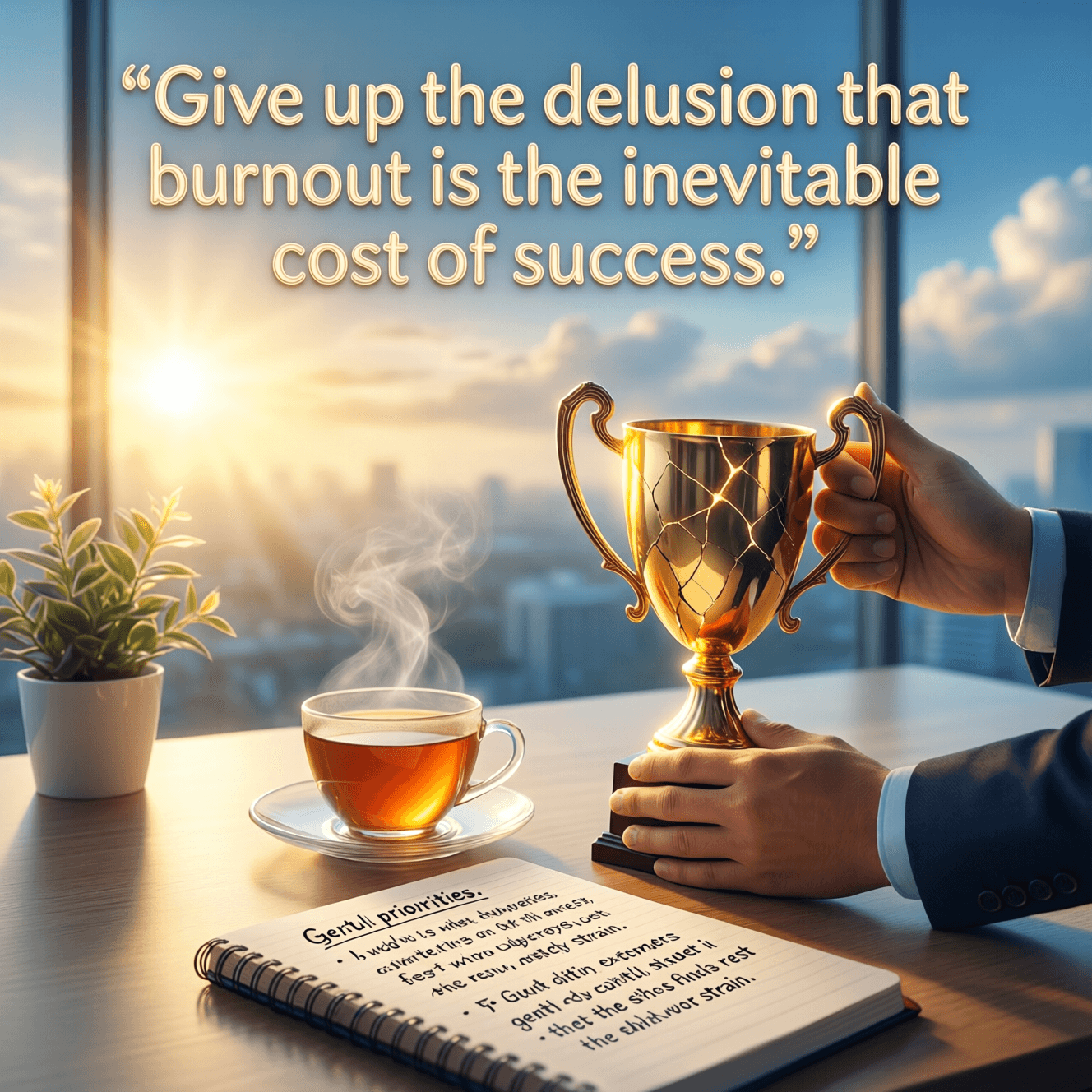
Give up the delusion that burnout is the inevitable cost of success. — Arianna Huffington
—What lingers after this line?
Challenging the Cultural Script
Arianna Huffington’s line opens by naming a belief many people absorb without noticing: that exhaustion is the price of doing meaningful work. By calling it a “delusion,” she reframes burnout not as a badge of honor, but as a mistaken story we tell ourselves and reward in others. That shift matters, because what a culture treats as normal quickly becomes what individuals feel pressured to accept. From there, her message nudges us to ask a sharper question than “How much can I endure?” Instead, it asks, “What kind of success am I building, and what is it costing me?”
Redefining What “Success” Measures
Once the myth is questioned, the definition of success becomes the next hinge. If success is only speed, visibility, and output, burnout can look like proof of commitment. However, if success includes clarity, creativity, health, and longevity, then chronic depletion is less a sacrifice and more a warning sign that the system is poorly designed. This broader view echoes older philosophies that tie achievement to a well-lived life; Aristotle’s idea of eudaimonia in the *Nicomachean Ethics* (c. 4th century BC) treats flourishing as an integrated whole rather than a single performance metric.
Burnout as a Signal, Not a Standard
With success re-scoped, burnout can be understood as feedback—your body and mind reporting that demand has outpaced recovery. That perspective aligns with research that frames burnout as a work-related syndrome characterized by exhaustion, cynicism, and reduced efficacy; the World Health Organization’s ICD-11 (2019) describes it as an occupational phenomenon rather than a personal moral failing. Consequently, the quote pushes against self-blame. Instead of “I’m not tough enough,” it encourages “My workload, boundaries, or environment are unsustainable,” which is a solvable problem rather than a character defect.
The Hustle Myth and Its Social Rewards
Even after recognizing burnout as a signal, people cling to the delusion because it is socially rewarded. Long hours are easy to measure, public to perform, and often mistaken for seriousness. In many workplaces, being perpetually busy becomes a kind of currency—one that buys praise, promotions, or at least protection from scrutiny. Yet this creates a trap: the more success is linked to visible self-sacrifice, the harder it becomes to rest without guilt. Huffington’s wording targets that trap directly, implying that the “inevitability” is manufactured by norms, not fate.
Sustainable Ambition and Better Performance
From this point, the argument turns practical: letting go of the delusion is not about lowering standards but about upgrading the engine. Sleep, recovery, and psychological safety are not luxuries; they are performance infrastructure. In that sense, refusing burnout is a strategic choice that protects judgment, learning, and resilience—the very capacities that compound over time. The transition here is crucial: the quote isn’t anti-achievement. It suggests that ambition survives longer, and often reaches further, when it is paired with rhythms that allow the mind to reset and the body to repair.
What “Giving Up” Looks Like in Real Life
Finally, “give up the delusion” implies an internal decision expressed through external habits. That might mean setting a hard stop to the workday, declining performative urgency, or redefining excellence as outcomes rather than constant availability. It can also mean renegotiating expectations—because if burnout is not inevitable, then someone can ask what resources, staffing, or timelines would make the work humane. In the end, Huffington’s statement reads like a permission slip backed by a challenge: keep pursuing success, but stop paying for it with your health when the bill is neither necessary nor wise.
Recommended Reading
As an Amazon Associate, we earn from qualifying purchases.
One-minute reflection
Why might this line matter today, not tomorrow?
Related Quotes
6 selectedIf you don't pick a day to relax, your body will pick it for you. — Courtney Carver
Courtney Carver
Courtney Carver’s line reads like friendly advice, but it carries the weight of a warning: rest is not optional in the long run. If we continually postpone recovery, the body will eventually enforce a pause through exhau...
Read full interpretation →Burnout doesn't build empires; it just ruins the view. Success counts for nothing if you're too exhausted to enjoy it. — Meenal Goel
Meenal Goel
Meenal Goel’s line reframes ambition as a mirage when it’s pursued at the cost of vitality. An “empire” built through constant overextension may look impressive from the outside, yet the builder can end up too depleted t...
Read full interpretation →If you are tired, learn to rest, not to quit. You are a human being, not a software update that needs to run 24/7. — Unknown
Unknown
The quote opens by challenging a common misinterpretation of tiredness: that it means we are failing or falling behind. Instead, fatigue becomes a signal—information from the body and mind that resources are depleted and...
Read full interpretation →I am a human being, not a human doing. Don't confuse your paycheck with your soul. — Kurt Vonnegut
Kurt Vonnegut
Vonnegut’s line pushes back against a culture that treats output as proof of worth. By insisting “I am a human being, not a human doing,” he separates existence from performance, reminding us that value is not something...
Read full interpretation →Burnout is not a badge of honor; it is a sign that you have forgotten how to be a person instead of a productivity machine. — Arianna Huffington
Arianna Huffington
Arianna Huffington’s line begins by confronting a familiar cultural script: if you’re depleted, you must be important. By calling burnout “not a badge of honor,” she reframes exhaustion from a status symbol into a warnin...
Read full interpretation →You cannot pour from an empty cup. — Unknown
Unknown
This quote emphasizes the importance of taking care of yourself before you can take care of others. If you are physically, emotionally, or mentally exhausted, you cannot effectively support or help those around you.
Read full interpretation →More From Author
More from Arianna Huffington →The most productive thing you can do is learn to manage your energy, not just your time. — Arianna Huffington
Arianna Huffington’s quote reframes productivity at its foundation. Instead of treating time as the only scarce resource, she points to energy as the real force that determines whether hours become meaningful work or mer...
Read full interpretation →We are human beings, not human doings. You must prioritize your personal well-being as a necessity, not a luxury. A well-rested mind is the most effective tool you possess. — Arianna Huffington
Arianna Huffington’s quote begins by challenging a modern habit: measuring human value by output alone. By saying we are “human beings, not human doings,” she shifts attention from performance to personhood, suggesting t...
Read full interpretation →We are not on this earth to accumulate victories, things, and experiences, but to be whittled and sandpapered until what's left is who we truly are. — Arianna Huffington
At first glance, Arianna Huffington’s quote rejects a familiar cultural script: that life’s purpose is to collect trophies, possessions, and memorable moments. Instead, she shifts attention from accumulation to transform...
Read full interpretation →Burnout is not a badge of honor; it is a sign that you have forgotten how to be a person instead of a productivity machine. — Arianna Huffington
Arianna Huffington’s line begins by confronting a familiar cultural script: if you’re depleted, you must be important. By calling burnout “not a badge of honor,” she reframes exhaustion from a status symbol into a warnin...
Read full interpretation →