
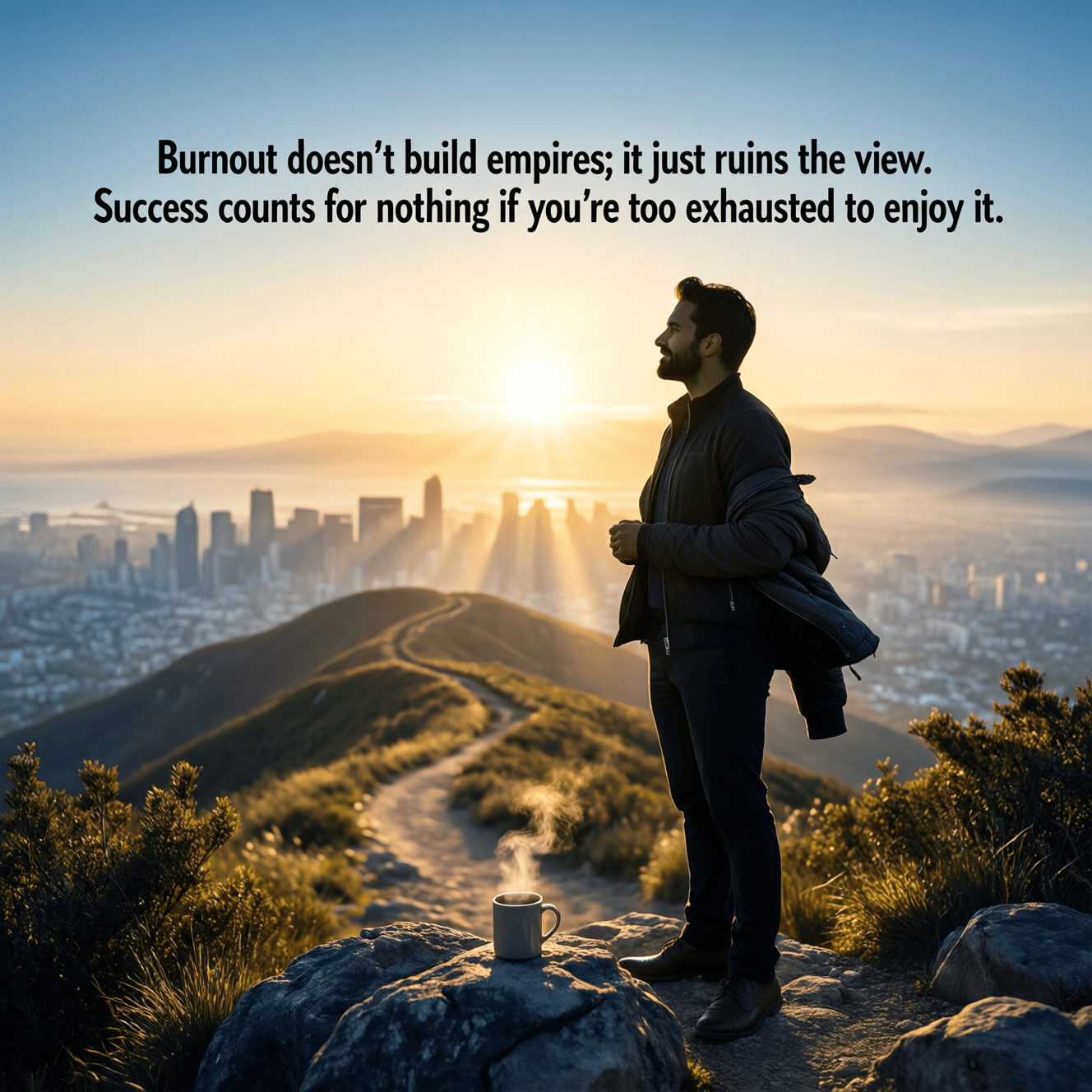
Burnout doesn't build empires; it just ruins the view. Success counts for nothing if you're too exhausted to enjoy it. — Meenal Goel
—What lingers after this line?
The Mirage of Exhausted Achievement
Meenal Goel’s line reframes ambition as a mirage when it’s pursued at the cost of vitality. An “empire” built through constant overextension may look impressive from the outside, yet the builder can end up too depleted to feel pride, pleasure, or even relief. In that sense, the view is “ruined” not because success is worthless, but because the senses required to appreciate it—energy, attention, health—have been drained. From here, the quote invites a simple question that cuts through hustle culture: if accomplishment removes your capacity to enjoy living, what exactly was gained? That tension becomes the foundation for understanding why burnout is not a badge of honor but a strategic and personal failure.
Burnout as a Human Limit, Not a Moral Flaw
To move beyond slogans, it helps to treat burnout as an identifiable condition rather than a weakness. The World Health Organization’s ICD-11 (2019) describes burnout as an occupational phenomenon tied to chronic workplace stress, marked by exhaustion, cynicism, and reduced professional efficacy. That framing matters because it shifts the narrative from “try harder” to “stress has accumulated past what the system can bear.” Once burnout is recognized as predictable under sustained overload, the quote’s warning becomes practical: if the cost of output is chronic depletion, the supposed path to “empire” is actually eroding the very abilities—creativity, judgment, patience—that made success possible in the first place.
When Productivity Peaks, Performance Often Drops
Next comes the paradox at the heart of overwork: it can look productive while quietly degrading results. Sleep loss and prolonged stress narrow attention, increase errors, and make problem-solving more rigid, so the hours keep rising while the quality and insight per hour fall. What feels like heroic persistence can turn into expensive rework, strained relationships, and poor decisions made under fatigue. In that light, “ruins the view” also means losing perspective. Exhaustion can make every task feel urgent and every setback feel catastrophic, which makes it harder to prioritize and easier to confuse busyness with progress—an especially dangerous confusion for leaders and founders.
Success Without Enjoyment Becomes a Hollow Scoreboard
The quote then pushes from efficiency to meaning: success “counts for nothing” if there’s no capacity to enjoy it. Enjoyment here isn’t frivolous—it’s the emotional registration that one’s effort led to a life worth living. Without recovery and presence, milestones become fleeting checkmarks, and the goalposts move the moment they’re reached. This is why many people report feeling strangely flat after major achievements. If the body is running on stress hormones and sleep debt, celebration can feel inaccessible. The empire may stand, but the person inside it experiences only numbness, irritation, or dread about maintaining it.
The Cultural Trap of Glorifying Overwork
Zooming out, Goel’s message implicitly critiques cultures that confuse self-sacrifice with seriousness. Stories of late-night grind can become social proof, making rest feel like laziness and boundaries feel like a lack of ambition. Yet historically, many disciplines have prized rhythms instead of constant output; even in Aristotle’s *Nicomachean Ethics* (4th century BC), the good life is tied to flourishing rather than mere accumulation. Seen this way, burnout is not just an individual problem but a collective incentive problem. When recognition rewards visible struggle more than sustainable excellence, people learn to exhaust themselves to be seen—until the view disappears.
Building an Empire You Can Actually Live In
Finally, the quote offers an implicit alternative: aim for success that preserves the ability to feel it. That means designing work around recovery—sleep, breaks, realistic timelines, and support—so that accomplishment doesn’t cannibalize health. It also means measuring outcomes not only in revenue or titles but in stamina, relationships, and long-term clarity. In practice, the “view” is protected by boundaries that seem small but compound: stopping at a set hour, taking real days off, delegating, and treating rest as part of the job. The result is not less ambition, but ambition that remains inhabitable—an empire with windows, not walls.
Recommended Reading
As an Amazon Associate, we earn from qualifying purchases.
One-minute reflection
What does this quote ask you to notice today?
Related Quotes
6 selectedBurnout is not a personal failure. It is the body's signal that you have been trying to live in a season of endless harvest without ever letting the field lie fallow. — Tessa, MSc Psychologist
Tessa, MSc Psychologist
At its core, Tessa’s quote rejects the harsh idea that burnout reflects weakness, poor character, or personal inadequacy. Instead, it reframes exhaustion as a meaningful signal from the body and mind: something essential...
Read full interpretation →Burnout occurs when your body and mind can no longer keep up with the tasks you demand of them. Don't try to force yourself to do the impossible. — Del Suggs
Del Suggs
At its core, Del Suggs’s statement frames burnout not as a personal failure, but as a signal that human limits have been exceeded. The body and mind are presented as partners in effort, and when both begin to falter, the...
Read full interpretation →Rest is revolutionary—it defies the pressure to always be 'on' and reminds us that we're human, not machines. — Ken Breniman
Ken Breniman
At its core, Ken Breniman’s quote reframes rest as more than a personal luxury: it becomes a form of resistance. In a culture that rewards relentless productivity, being constantly ‘on’ is often treated as a virtue, as i...
Read full interpretation →You do not need to burn out to prove your commitment. — Tessa, MSc Psychologist
Tessa, MSc Psychologist
At first glance, Tessa’s statement challenges a deeply ingrained modern belief: that real commitment must be proven through exhaustion. In many workplaces and caregiving roles, burnout is worn almost like a badge of hono...
Read full interpretation →Burnout is not a badge of honor; it is a sign that your operating system has been running unauthorized programs for too long. — Adam Grant
Adam Grant
At first glance, Adam Grant’s metaphor dismantles a common modern myth: that exhaustion proves dedication. By saying burnout is not a badge of honor, he challenges cultures that celebrate overwork as moral virtue.
Read full interpretation →Rule your mind or it will rule you; most burnout is just a failure to set boundaries between your peace and your output. — Horace
Horace
At its core, the quotation argues that self-governance is not a luxury but a necessity. To ‘rule your mind’ means refusing to let impulses, anxieties, and external demands dictate the shape of one’s life.
Read full interpretation →More From Author
More from Meenal Goel →