
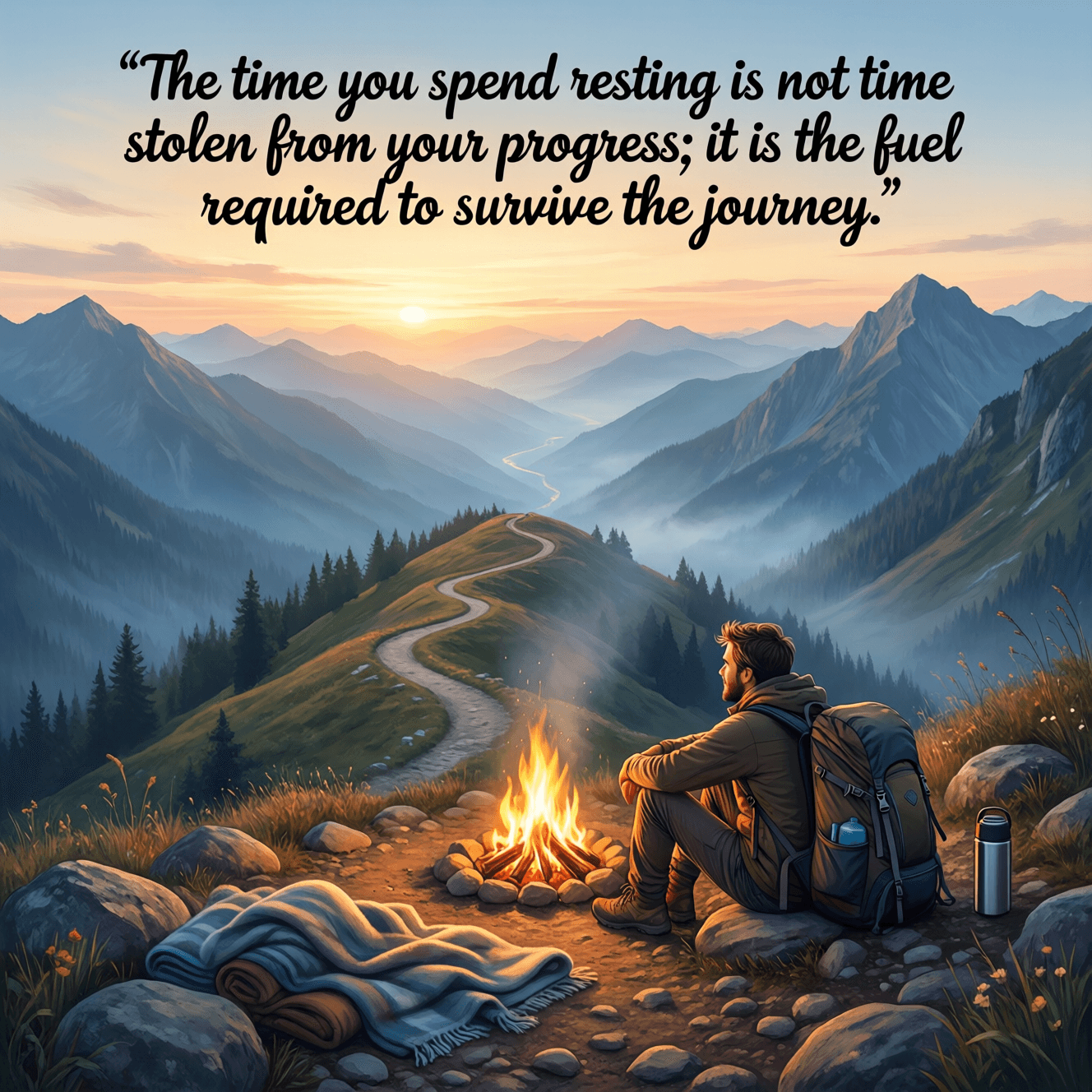
The time you spend resting is not time stolen from your progress; it is the fuel required to survive the journey. — Pema Chödrön
—What lingers after this line?
Redefining Rest and Effort
At first glance, Pema Chödrön’s statement challenges a deeply rooted modern assumption: that every pause is a loss. Instead, she reframes rest as part of progress itself, not a detour from it. In this view, recovery is not evidence of weakness or laziness, but a practical necessity for anyone undertaking a long and meaningful journey. This shift matters because many people measure worth through constant output. Yet Chödrön invites us to see the human spirit as something that cannot endlessly produce without renewal. Just as a traveler must stop for water before crossing difficult terrain, a person must rest in order to continue with clarity, strength, and purpose.
The Journey Metaphor
From there, the quote’s image of survival becomes especially important. Chödrön does not describe life as a sprint but as a journey, which implies uncertainty, distance, and endurance. By choosing the word “fuel,” she suggests that rest actively powers movement; it does not simply interrupt it. The metaphor turns stillness into preparation. Moreover, the language of survival adds emotional depth. This is not merely about maximizing performance, but about preserving one’s inner resources through difficulty. In that sense, rest becomes a form of wisdom: the recognition that persistence depends not on endless strain, but on knowing when to stop and replenish.
A Buddhist Undercurrent
Seen in the context of Pema Chödrön’s Buddhist teaching, the quote also reflects a broader philosophy of gentleness toward oneself. In works such as When Things Fall Apart (1996), she often encourages people to meet pain, fear, and exhaustion without aggression. Rather than forcing the self forward at all costs, her approach favors awareness, compassion, and patience. Consequently, rest is not only physical but spiritual. It allows space to notice what the mind and body are carrying. Instead of treating exhaustion as an enemy to defeat, Chödrön’s perspective asks us to listen to it. That listening can become a quiet discipline, one that protects us from confusing self-punishment with dedication.
What Science Confirms
This insight is not only philosophical; it is also supported by modern research. Sleep studies, including work summarized by Matthew Walker in Why We Sleep (2017), show that rest is essential for memory, emotional regulation, and physical recovery. Likewise, performance research in athletics and creative work repeatedly demonstrates that periods of recovery improve long-term results more than constant overexertion. Therefore, Chödrön’s claim can be read as both poetic and practical. A tired mind makes poorer decisions, a strained body becomes vulnerable, and an exhausted heart loses resilience. Rest, then, is not the opposite of discipline; it is one of the conditions that makes discipline sustainable.
Resisting the Culture of Exhaustion
At the same time, the quote speaks directly to a culture that often glorifies burnout. In many workplaces and social environments, fatigue is worn like proof of seriousness, as though depletion were the price of ambition. Chödrön quietly resists that logic by insisting that rest does not rob us of achievement. In doing so, she exposes a damaging misconception: that slowing down means falling behind. On the contrary, people who ignore their limits frequently lose far more—health, focus, creativity, and even joy. Rest becomes a subtle act of resistance, a refusal to let productivity define human value so completely that survival itself is neglected.
A More Sustainable Kind of Progress
Finally, the quote points toward a more humane idea of success. If rest is fuel, then progress should be measured not only by how far one goes, but by whether one can continue going without collapse. Sustainable growth honors rhythms of effort and renewal, much like fields that must lie fallow before they can yield again. For that reason, Chödrön’s words offer more than comfort; they offer a method. To rest deliberately is to invest in one’s future strength. Far from stealing time, rest returns it in a usable form—clearer attention, steadier courage, and the endurance required to keep moving through the long road ahead.
One-minute reflection
What feeling does this quote bring up for you?
Related Quotes
6 selectedTo rest is not self-indulgent; to rest is to prepare to give the best of ourselves. — Annie Wright
Annie Wright
At first glance, Annie Wright’s line challenges a familiar modern suspicion: that rest is laziness dressed up as virtue. Instead, she recasts it as a form of responsibility, arguing that restoration is what enables meani...
Read full interpretation →Be gentle with yourself. You're doing the best you can. — Pema Chödrön
Pema Chödrön
This quote encourages individuals to be kind and compassionate towards themselves. It reminds us that we aren’t perfect and that's okay—self-acceptance is a crucial part of personal growth.
Read full interpretation →Rest is not a reward for your work. It is the soil where your future self grows. Stop running on empty and begin the recovery immediately. — Unknown
Unknown
The quote begins by challenging a familiar belief: that rest must be earned after productivity proves our worth. By rejecting rest as a “reward,” it reframes recovery as a basic condition of being human rather than a lux...
Read full interpretation →Rest is not a reward for work. It is the fuel for life. — Proverb
Proverb
The proverb challenges a common moral ledger in which rest is earned only after sufficient effort. By rejecting rest-as-reward, it shifts the focus from deservingness to necessity, implying that waiting to “merit” rest m...
Read full interpretation →Nervous system regulation is the new mental fitness. You cannot pour from an empty cup, nor can you build a sanctuary while the world is still burning. — April Koh
April Koh
April Koh’s quote reframes wellness by suggesting that mental fitness is no longer just about discipline, productivity, or positive thinking. Instead, it begins with the body’s capacity to return to steadiness after stre...
Read full interpretation →You can't pour from an empty cup. Take care of yourself first. — Arianna Huffington
Arianna Huffington
At its heart, Arianna Huffington’s line turns self-care into an image anyone can understand: a cup cannot nourish others if it has nothing left to give. The metaphor is gentle, but its message is firm.
Read full interpretation →More From Author
More from Pema Chödrön →The only way to move forward is to stop pretending that the past is still happening. — Pema Chödrön
Pema Chödrön’s line begins with a gentle but piercing insight: suffering often persists not only because something painful happened, but because part of us keeps reliving it as if it were still unfolding. In that sense,...
Read full interpretation →The best parts of your life are the ones that happen when absolutely no one is looking. — Pema Chödrön
Pema Chödrön’s quote turns attention away from applause and toward the private texture of living. At first glance, it suggests that life’s richest moments are not always the dramatic ones shared with an audience, but the...
Read full interpretation →Learning is not a sprint toward an end goal; it is a life-long rhythm of shedding what no longer serves you to make room for what does. — Pema Chödrön
At first glance, Pema Chödrön’s reflection challenges one of the most common assumptions about education: that learning is a race with a clear endpoint. Degrees, promotions, and certifications often tempt us to think of...
Read full interpretation →The truth is rarely comfortable, but it is the only thing that will actually set you free. Stop hiding from your reality and start owning your choices. — Pema Chödrön
At its core, Pema Chödrön’s statement argues that freedom does not come from denial, distraction, or carefully managed appearances. Instead, it begins with the willingness to confront what is real, even when that reality...
Read full interpretation →