
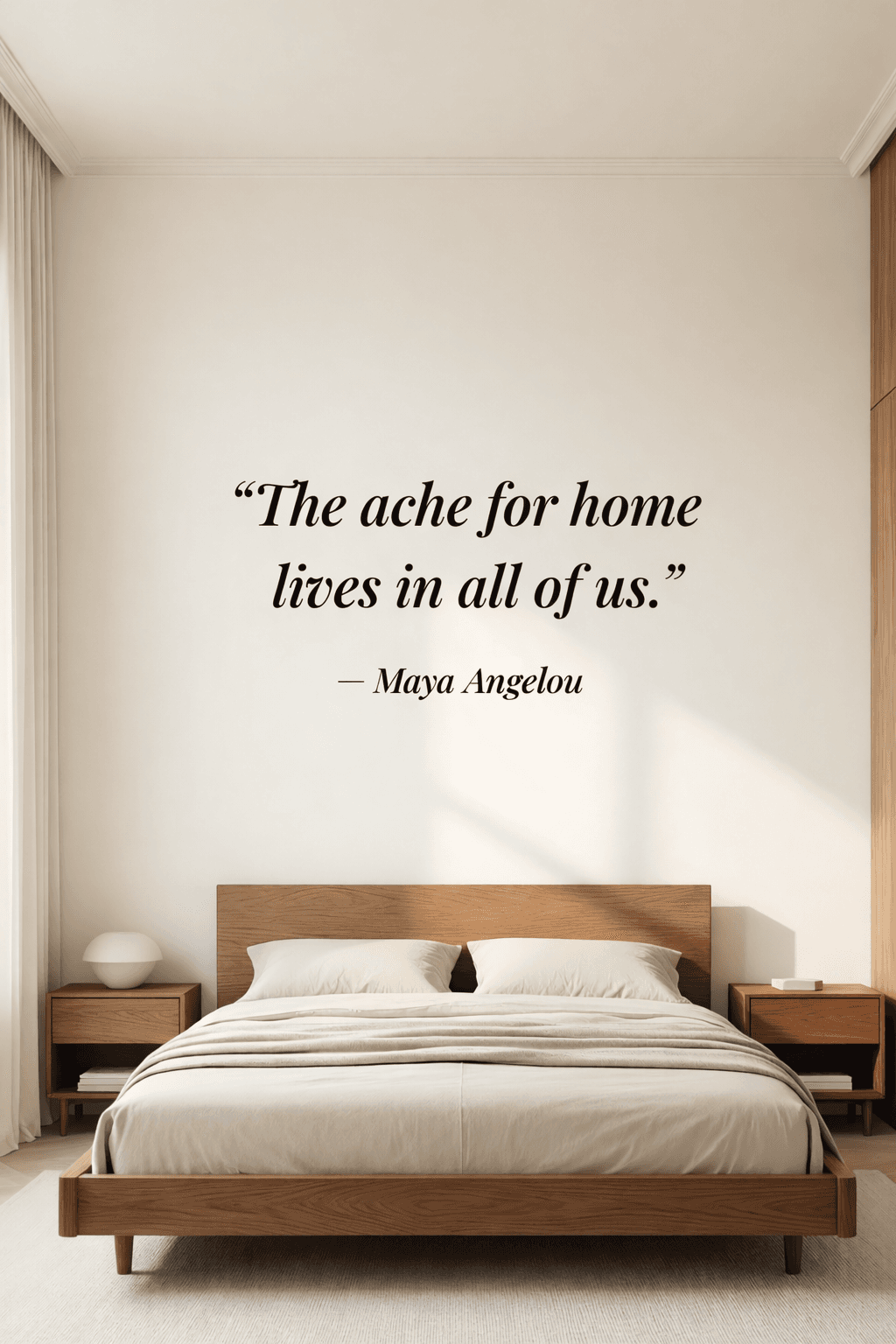
The ache for home lives in all of us. — Maya Angelou
—What lingers after this line?
A Universal Longing
Maya Angelou’s line distills a feeling so common that it often goes unnamed: the persistent yearning for a place of safety, recognition, and belonging. The word “ache” matters here, because it suggests that home is not merely a location we remember but an emotional need we carry within us. In that sense, Angelou turns home into a shared human condition rather than a private memory. From this starting point, the quotation reaches far beyond houses and hometowns. It implies that nearly everyone, whether settled or uprooted, knows the desire to return to somewhere—or someone—that makes life feel coherent. That is why the sentence feels immediately intimate: it names a hidden tenderness many people already know.
Home Beyond Geography
Yet Angelou’s insight deepens when we realize that home is rarely just an address. Home can be a grandmother’s voice, a familiar meal, a language spoken without effort, or a community where one is not required to explain oneself. In this way, the ache for home may persist even when a person is physically standing in the place where they were born. Consequently, the quotation invites us to think of home as an emotional architecture built from memory, ritual, and acceptance. Toni Morrison’s novels, especially Beloved (1987), often explore how fractured histories complicate the search for such a place. Angelou’s sentence belongs to that larger tradition of seeing home as something felt as deeply as it is inhabited.
Memory, Loss, and Return
Because home is bound to memory, longing for it is often inseparable from loss. We may ache for a childhood home that no longer exists, for relatives who are gone, or for a version of ourselves that once felt more secure. In this respect, the desire for home is not always a wish to go backward literally, but to recover a sense of wholeness that time has scattered. As a result, return becomes emotionally complex. Homer’s Odyssey, traditionally dated to the 8th century BC, centers on Odysseus’s struggle to get back to Ithaca, yet the epic also shows that return is never simple: the traveler changes, and so does the home awaited. Angelou’s line captures that same bittersweet truth in miniature.
Exile, Migration, and Belonging
The quotation becomes especially powerful when read through histories of displacement. For migrants, refugees, and diasporic communities, the ache for home can carry political as well as personal weight. It may involve interrupted ancestry, forced movement, or the daily labor of building belonging in places that do not fully welcome them. Accordingly, Angelou’s words resonate with writers such as James Baldwin, whose essays in Notes of a Native Son (1955) repeatedly examine estrangement and the complicated desire to belong in America. The ache she describes is therefore not sentimental alone; it can be sharpened by injustice. Even so, her phrasing remains inclusive, suggesting that while the causes differ, the longing itself is profoundly human.
The Inner Search for Refuge
At the same time, Angelou’s quote can be read inwardly. Sometimes the deepest ache is not for a distant place but for an inner home—a state of self-acceptance in which one feels at peace inside one’s own life. In that sense, the statement gestures toward psychological refuge: the hope of being known, integrated, and unafraid. This interpretation helps explain why the line speaks to people undergoing change, grief, or identity struggles. Home, then, becomes the name for emotional rest. Rather than pointing only to nostalgia, Angelou quietly suggests that human beings are always searching for a place where the divided parts of the self can finally sit together.
Why the Quote Still Resonates
Finally, the enduring force of Angelou’s sentence lies in its compassion. She does not describe the ache for home as weakness; instead, she presents it as one of the defining threads of human experience. That framing dignifies longing, especially in an era of mobility, upheaval, and constant reinvention, when many people live far from their origins or feel emotionally unmoored. Therefore, the quote continues to resonate because it offers both recognition and solace. It tells us that yearning for rootedness is not a private failure but a shared inheritance. In naming that ache so simply, Angelou makes readers feel less alone—and that, perhaps, is one of the closest things language can offer to home itself.
Recommended Reading
As an Amazon Associate, we earn from qualifying purchases.
One-minute reflection
What feeling does this quote bring up for you?
Related Quotes
6 selectedHealing is not linear. — Emi Nietfeld
Emi Nietfeld
At its heart, Emi Nietfeld’s line rejects the comforting but misleading idea that healing moves steadily from pain to peace. Instead, it acknowledges a more human pattern: progress mixed with setbacks, insight interrupte...
Read full interpretation →Home is where laughter and gratitude grow. — Melody Beattie
Melody Beattie
At first glance, Melody Beattie’s line reframes home as something more living than a building. Instead of focusing on property, décor, or permanence, it suggests that home is recognized by what flourishes inside it: laug...
Read full interpretation →Recovery isn't linear. You are not behind; you are rebuilding. — Anne Wright
Anne Wright
At its core, Anne Wright’s quote pushes back against a common and damaging assumption: that healing should move neatly upward, without setbacks or pauses. By saying recovery “isn’t linear,” she reframes difficult days no...
Read full interpretation →The goal is not to become superhuman, but to feel less overstimulated and stop forcing your nervous system to live in constant emergency mode. Calm is a skill in its own right. — Kettj Talon
Kettj Talon
At first glance, Kettj Talon’s quote rejects a familiar modern fantasy: the idea that growth means becoming endlessly efficient, invulnerable, or somehow superhuman. Instead, it reframes personal progress as the quieter...
Read full interpretation →Home should be the treasure chest of living. — Le Corbusier
Le Corbusier
At first glance, Le Corbusier’s remark transforms the idea of home from a simple structure into something intimate and precious. A treasure chest does not merely contain objects; it safeguards what is valued most.
Read full interpretation →Home is where you are loved the most and act the worst. — Marjorie Pay Hinckley
Marjorie Pay Hinckley
Marjorie Pay Hinckley’s remark captures a familiar contradiction: home is often the place of deepest affection and least polished behavior. Precisely because love feels secure there, people drop the social restraint they...
Read full interpretation →More From Author
More from Maya Angelou →Do not mistake exhaustion for a lack of talent; even the deepest wells need time to refill their waters. — Maya Angelou
At its core, Maya Angelou’s line asks us to make a crucial distinction: being drained is not the same as being deficient. People often interpret a season of low output as proof that they have lost their gifts, yet Angelo...
Read full interpretation →You are not a machine built for constant output; you are a human being meant for meaningful growth. — Maya Angelou
At its core, Maya Angelou’s statement challenges a culture that often measures worth by visible productivity alone. By contrasting a machine with a human being, she exposes the danger of treating life as an endless cycle...
Read full interpretation →A sense of belonging is the best medicine for the human heart; it is the feeling that we are part of something larger than ourselves. — Maya Angelou
Maya Angelou’s insight begins with a simple but profound truth: emotional healing rarely happens in isolation. By calling belonging “the best medicine,” she suggests that the heart is restored not only through comfort, b...
Read full interpretation →Do not mistake my silence for weakness. I am simply observing, listening, and gathering the strength to move with intention. — Maya Angelou
At first glance, silence is often misread as passivity, yet this quote immediately overturns that assumption. The speaker insists that quietness is not a sign of fear or frailty but a deliberate choice.
Read full interpretation →