
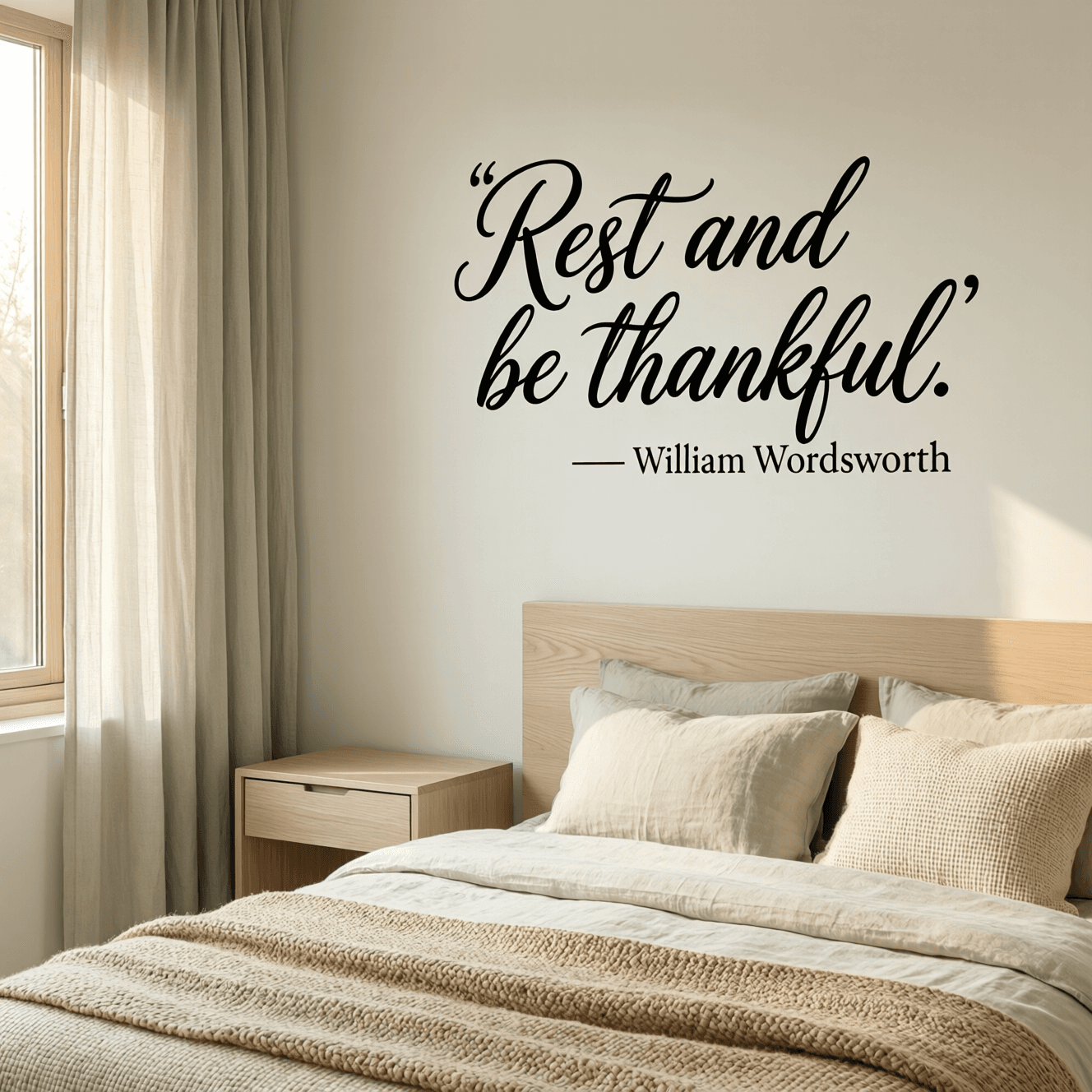
Rest and be thankful. — William Wordsworth
—What lingers after this line?
A Quiet Two-Part Command
Wordsworth’s brief line joins two simple acts—resting and giving thanks—as if one naturally completes the other. At first glance, it sounds almost like gentle advice from a trusted friend, yet its power lies in that calm certainty. He does not urge striving, proving, or acquiring; instead, he points toward stillness and appreciation. In this way, the quote quietly resists the modern habit of measuring life by productivity alone. Once the body and mind pause, gratitude has room to surface. Rest is not presented as laziness but as the condition that allows us to notice what is already good.
Wordsworth’s Romantic Sensibility
This thought fits naturally within Wordsworth’s broader poetic vision. In works such as “Lines Composed a Few Miles above Tintern Abbey” (1798), he returns to memory, nature, and inward calm as sources of renewal. His poetry repeatedly suggests that the human spirit recovers not through noise and ambition, but through reflection and quiet contact with the world. Seen in that context, “Rest and be thankful” becomes more than a pleasant phrase. It reflects the Romantic belief that wisdom often arrives when we slow down enough to feel our connection to life, landscape, and the sustaining rhythms around us.
Why Rest Makes Gratitude Possible
From there, the logic deepens: exhaustion narrows attention, while rest widens it. When people are overworked or overwhelmed, they often focus only on what remains unfinished. By contrast, after a moment of genuine pause, the mind can begin to register overlooked gifts—a meal, a friendship, a patch of sunlight, even the relief of breathing more slowly. Modern psychology supports this intuition. Research on stress and attention, including work in positive psychology such as Robert Emmons’s studies on gratitude (2003), suggests that appreciation becomes easier when people are not trapped in constant urgency. Thus, rest is not separate from thankfulness; it prepares the ground for it.
An Ethical Alternative to Endless Striving
Moreover, the line carries a subtle moral argument. It challenges the assumption that human worth depends on ceaseless effort, reminding us that receiving life gratefully is also a virtue. In many traditions, from the biblical call to Sabbath rest to Josef Pieper’s Leisure, the Basis of Culture (1948), rest is treated as essential to a fully human life rather than a reward reluctantly granted after labor. Because of that, thankfulness becomes an antidote to entitlement and rest becomes an antidote to self-exhaustion. Together they form a humane discipline: pause, acknowledge limits, and receive the world not merely as a task to conquer, but as a gift to inhabit.
The Everyday Practice of the Phrase
Finally, the endurance of Wordsworth’s line comes from its practicality. It can be lived in ordinary moments: sitting down after work without guilt, taking a walk before sunset, or ending the day by naming three things that went quietly right. Such habits may seem small, yet they reshape experience by teaching us that peace is found not only in achievement, but in attention. For that reason, “Rest and be thankful” remains both consolation and instruction. It asks us to stop long enough to notice that life is not made meaningful solely by what we produce. Sometimes the deepest wisdom is simply to pause, breathe, and give thanks.
One-minute reflection
What does this quote ask you to notice today?
Related Quotes
6 selectedBurnout rarely comes from working too much. It comes from working without recovery built in. The most resilient people treat restoration as a condition for performing, not a reward. — Ritu Mohanka
Ritu Mohanka
Ritu Mohanka’s insight reframes burnout not as a simple consequence of long hours, but as the result of sustained effort without renewal. This distinction matters because many people assume exhaustion is proof of ambitio...
Read full interpretation →You cannot out-train poor recovery. — Andrew Huberman
Andrew Huberman
Andrew Huberman’s statement cuts through a common fitness illusion: more training does not automatically mean more progress. Exercise creates stress and signals the body to adapt, but the actual rebuilding happens afterw...
Read full interpretation →Your best days lie ahead. The story starts when the individual gets sober and rebuilds their life; it doesn't conclude there. — Bucky Sinister
Bucky Sinister
Bucky Sinister’s words reframe sobriety as the opening chapter of a larger transformation. Rather than treating recovery as a final achievement, the quote insists that getting sober is where the real story begins: the pe...
Read full interpretation →The most productive thing you can do when you are burned out is to stop trying to be productive and simply rest. — Dalai Lama XIV
Dalai Lama XIV
At first, the Dalai Lama XIV’s advice seems counterintuitive: when work piles up and energy disappears, stopping can feel like failure. Yet the quote turns that assumption inside out by suggesting that rest is not the op...
Read full interpretation →Recovery is not a race. You don't have to feel guilty if it takes you longer than you thought it would. — Anne Lamott
Anne Lamott
Anne Lamott’s reminder begins by challenging one of the quiet cruelties of recovery: the belief that healing should follow a predictable schedule. Whether the wound is physical, emotional, or spiritual, people often comp...
Read full interpretation →Resting isn't quitting. It's repairing. — Unknown (Skipped - Replacing with: Recovery isn't a sign of weakness—it's an act of strength. — Curtis Tyrone Jones)
Curtis Tyrone Jones
At first glance, Curtis Tyrone Jones’s statement challenges a common cultural reflex: the idea that stopping means failing. Instead, it reframes recovery as purposeful action rather than passive retreat.
Read full interpretation →More From Author
More from William Wordsworth →Every great and original writer, in proportion as he is great and original, must himself create the taste by which he is to be relished. — William Wordsworth
Wordsworth’s claim begins with a bold premise: truly original writers cannot be fully judged by old measures because their work changes the very standards of appreciation. In other words, greatness is not simply a matter...
Read full interpretation →Poetry is the spontaneous overflow of powerful feelings: it takes its origin from emotion recollected in tranquility. — William Wordsworth
This quote highlights the idea that poetry is born from deep emotional experiences that are later contemplated and expressed in a moment of calm, underscoring the emotional depth that poetry can convey.
Read full interpretation →Fill your paper with the breathings of your heart. — William Wordsworth
This quote encourages writers to pour their genuine emotions and feelings into their work. Wordsworth urges writers to make their creations heartfelt and authentic.
Read full interpretation →Wisdom is oftentimes nearer when we stoop than when we soar. — William Wordsworth
William Wordsworth’s observation suggests that genuine wisdom emerges not in moments of pride, but through humility and self-awareness. Rather than equating greatness with lofty ambition, he reminds us that stooping—symb...
Read full interpretation →