
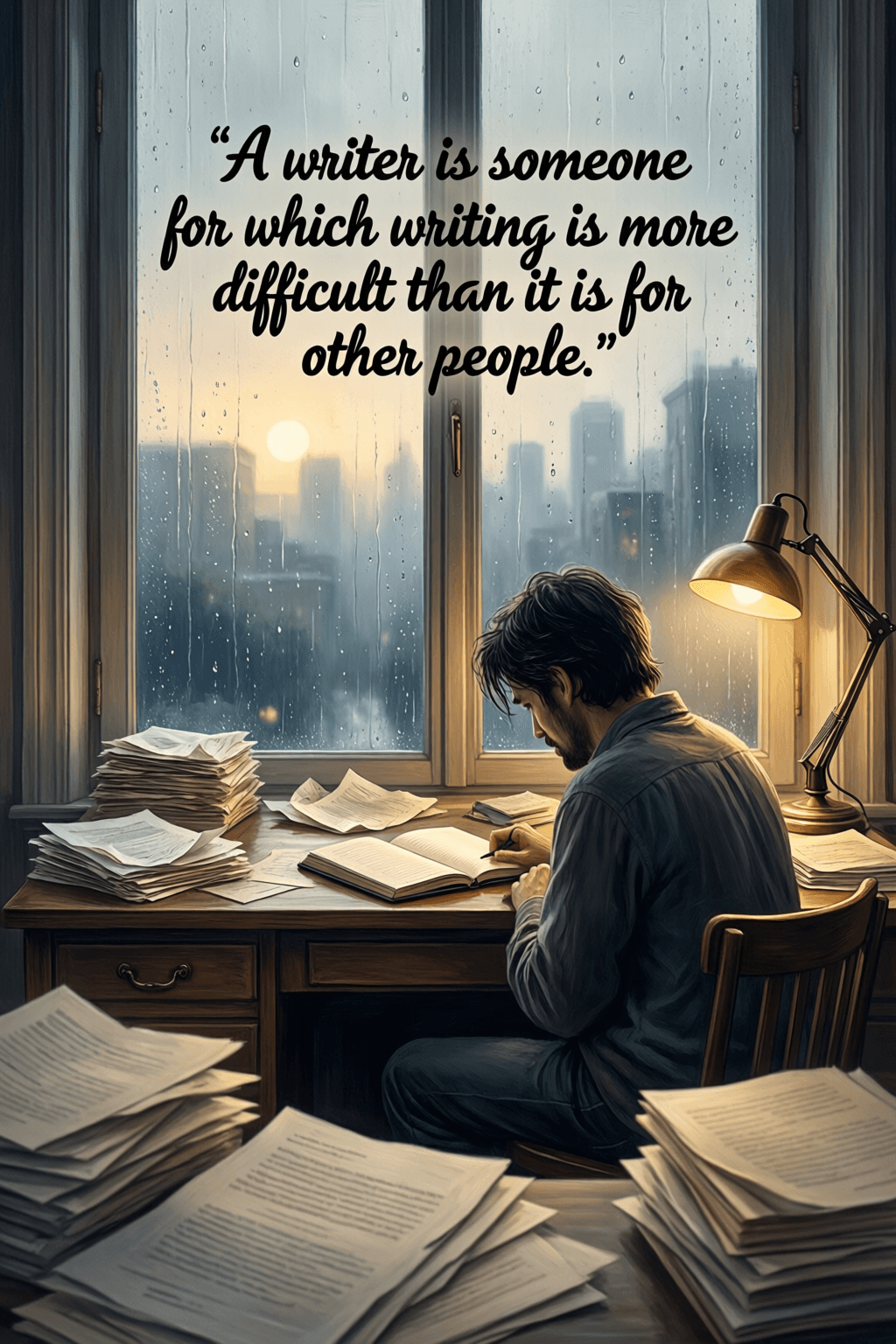
A writer is someone for whom writing is more difficult than it is for other people. — Thomas Mann
—What lingers after this line?
Difficulty as a Mark of Vocation
At first glance, Thomas Mann’s remark sounds ironic, yet it captures a serious truth: the writer is not defined by ease but by heightened struggle. For Mann, writing becomes difficult precisely because the writer cares intensely about precision, form, and meaning. What appears to others as a simple act of putting words on paper becomes, for the committed artist, an exacting confrontation with language itself. In that sense, difficulty is not a sign of inadequacy but of vocation. The writer feels the weight of every sentence because each one must do more than communicate; it must endure scrutiny, embody thought, and sound true. Thus Mann reverses the common assumption that talent makes expression effortless.
The Burden of Consciousness
From there, Mann’s insight points to the writer’s unusually alert mind. A true writer notices ambiguities, false notes, and unfinished ideas that others might let pass. This sharpened awareness makes composition slower and more painful, because every phrase invites revision and every image raises questions about whether it is exact enough. Gustave Flaubert’s letters, especially his correspondence from the 1850s, famously describe the torment of searching for le mot juste, the exactly right word. His struggle mirrors Mann’s claim: the more deeply a writer understands the possibilities of language, the harder it becomes to settle for anything less than what the work demands.
Perfectionism and Creative Friction
As a result, writing often becomes a field of friction between vision and execution. The writer may sense a rich inner form—a tone, rhythm, or insight—yet discover that language arrives imperfectly. That gap between intention and result produces the frustration Mann identifies, turning even a short paragraph into a prolonged act of negotiation. Still, this friction is often productive. Samuel Beckett’s famous line from Worstward Ho (1983), ‘Try again. Fail again. Fail better,’ suggests that artistic progress emerges through repeated insufficiency rather than smooth fluency. In this light, difficulty is not merely an obstacle but the medium through which serious writing is refined.
Why Ease Can Be Misleading
By contrast, people for whom writing feels entirely easy may not always be engaging the same demands. Fluent expression can be useful, even impressive, but Mann distinguishes between writing as functional output and writing as artistic labor. The latter asks the writer to wrestle with truth, structure, cadence, and emotional honesty, and such wrestling rarely feels effortless. Virginia Woolf’s A Room of One’s Own (1929) indirectly supports this view by showing how much inward and outward labor lies behind literary creation. Writing that seems graceful on the page may conceal years of disciplined attention. Consequently, ease in the final product often masks difficulty in the making.
The Ethics of Saying Things Exactly
Moreover, Mann’s statement implies an ethical dimension. Writers are troubled not only by style but by responsibility: to represent experience faithfully, to avoid cliché, and to resist cheap simplifications. Because words shape how readers see the world, the conscientious writer feels pressure to say things as exactly and honestly as possible. George Orwell’s essay ‘Politics and the English Language’ (1946) makes a similar argument, insisting that lazy language can corrupt thought itself. Seen this way, difficulty arises from moral seriousness. The writer struggles because imprecise language is not merely unattractive; it can be a form of betrayal.
A Paradox That Honors the Craft
Ultimately, Mann offers a paradox that honors rather than diminishes writers. He suggests that the real writer suffers more over writing because the task matters more to them than it does to others. Difficulty, then, becomes evidence of artistic conscience: the page resists because the writer refuses to treat language casually. This idea also comforts anyone who feels blocked or burdened at the desk. Rather than proving one is unsuited to writing, struggle may indicate a deeper engagement with the craft. In the end, Mann reminds us that literature is often born not from ease, but from the stubborn willingness to labor through uncertainty until words begin to live.
One-minute reflection
Why might this line matter today, not tomorrow?
Related Quotes
6 selectedDon't think. Thinking is the enemy of creativity. It's self-conscious, and anything self-conscious is lousy. — Ray Bradbury
Ray Bradbury
At first glance, Ray Bradbury’s line sounds almost rebellious: “Don’t think. Thinking is the enemy of creativity.” Yet his target is not intelligence itself, but the paralyzing kind of self-awareness that makes an artist...
Read full interpretation →You can be cautious or you can be creative, but there's no such thing as a cautious creative. — George Lois
George Lois
George Lois draws a sharp line between two mindsets: caution protects what already exists, while creativity risks making something new. At first glance, the statement sounds absolute, yet that severity is exactly its poi...
Read full interpretation →Almost always, the creative dedicated minority has made the world better. — Martin Luther King, Jr.
Martin Luther King Jr.
Martin Luther King, Jr. distills a sweeping historical truth into a single sentence: progress is often driven not by the passive majority but by a small, committed group willing to imagine a better order.
Read full interpretation →What keeps life fascinating is the constant creativity of the soul. — Deepak Chopra
Deepak Chopra
At its core, Deepak Chopra’s line suggests that life stays interesting not because the world is fixed and exciting on its own, but because the inner self continually reinterprets it. The phrase “creativity of the soul” p...
Read full interpretation →We are born makers. We move what we're learning from our heads to our hearts through our hands. — Brené Brown
Brené Brown
Brené Brown’s line begins with a striking claim: making is not a hobby added onto life, but part of our basic human design. To say “we are born makers” suggests that creativity is native to us, whether we are cooking, bu...
Read full interpretation →Creativity is intelligence having fun. — George Scialabba
George Scialabba
At first glance, George Scialabba’s line turns creativity into something disarmingly simple: intelligence at play. Rather than presenting invention as grim labor or mystical inspiration, the quote suggests that original...
Read full interpretation →More From Author
More from Thomas Mann →