
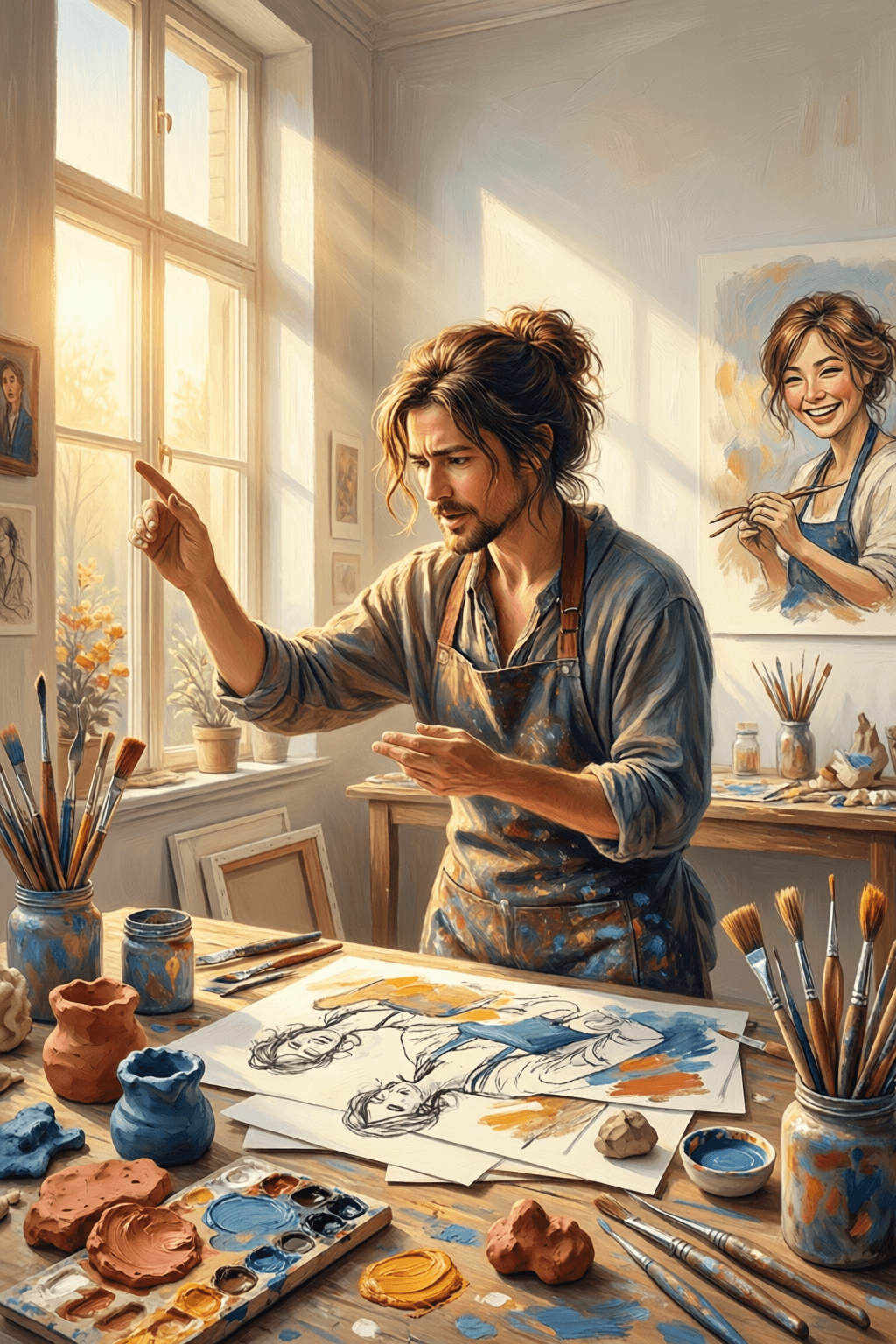
Serious art is born from serious play. — Julia Cameron
—What lingers after this line?
The Productive Paradox
At first glance, Julia Cameron’s line seems contradictory: how can play be serious, and how can seriousness produce art without becoming rigid? Yet that tension is precisely her point. Serious art rarely emerges from grim control alone; instead, it often grows out of a disciplined willingness to experiment, wander, and risk failure. In this sense, play is not the opposite of commitment but one of its deepest forms. By pairing the two words, Cameron reframes creativity as both joyful and demanding. The artist must enter a space of openness, curiosity, and improvisation, while still honoring the work with attention and persistence. Thus, serious play becomes the condition in which imagination can move freely enough to discover something true.
Why Play Unlocks Originality
From that paradox, a practical insight follows: play loosens the mind’s reliance on convention. When creators allow themselves to sketch badly, write nonsense, or test unlikely combinations, they bypass the inner censor that often blocks invention. Psychologist D. W. Winnicott argued in Playing and Reality (1971) that play is where the self becomes most alive, and this idea helps explain why experimentation so often precedes originality. In other words, play creates a protected space where mistakes are not final judgments but invitations. Many artistic breakthroughs begin not with a polished plan but with an accidental mark, a surprising phrase, or a moment of amused curiosity. What seems unserious at the beginning may, in fact, be the very path toward depth.
Discipline Hidden Inside Freedom
Still, Cameron’s quote does not celebrate aimless amusement. The word serious reminds us that fruitful play has structure, repetition, and intent behind it. A pianist rehearsing variations for hours, a painter reworking compositions, or a filmmaker testing scene rhythms is playing in a rigorous sense: each tries possibilities without yet fixing the final answer. Johann Huizinga’s Homo Ludens (1938) describes play as meaningful activity shaped by rules, and that framework fits artistic practice well. The studio, rehearsal room, or notebook becomes a bounded arena where freedom operates inside form. Consequently, serious art is born not from chaos alone, but from exploratory freedom sustained by craft.
Examples from Artistic Tradition
Seen historically, many major artists worked this way. Pablo Picasso’s constant stylistic shifts—from Blue Period melancholy to Cubist fragmentation—suggest an artist willing to test visual reality as though it were material for an ongoing game. Likewise, Beethoven’s sketchbooks reveal relentless trial and revision, showing that even monumental works often begin as playful variations rather than fully formed revelations. This pattern appears in literature as well. Virginia Woolf’s stream-like narrative experiments in Mrs Dalloway (1925) and To the Lighthouse (1927) feel daring because they treat form itself as something elastic. Therefore, Cameron’s claim is not merely inspirational; it reflects a long artistic history in which greatness grows from exploratory courage.
A Remedy for Creative Fear
Moreover, the idea of serious play offers a humane response to perfectionism. Many artists stall because they treat every draft as a verdict on talent. Play interrupts that fear by changing the emotional terms of creation: instead of asking whether the work is already good, the artist asks what might happen next. That shift preserves momentum, which is often more valuable than early polish. Julia Cameron’s own The Artist’s Way (1992) encourages practices like morning pages and artist dates precisely because they cultivate this playful seriousness. These exercises are not trivial diversions; rather, they train attention, receptivity, and trust. As a result, play becomes a method for surviving doubt and continuing to make.
Art as Discovery, Not Mere Control
Finally, Cameron’s sentence suggests that art is not manufactured solely by force of will; it is discovered through engagement. The artist does not always know in advance what the work wants to become. Through serious play—trying, listening, revising, and trying again—form gradually emerges. The process resembles conversation more than command. This is why the quote feels enduringly true. It honors both delight and devotion, both spontaneity and labor. In the end, serious art is born when creators care enough to play deeply: to enter uncertainty with skill, patience, and wonder until something meaningful takes shape.
One-minute reflection
What does this quote ask you to notice today?
Related Quotes
6 selectedMystery is at the heart of creativity. That, and surprise. — Julia Cameron
Julia Cameron
Julia Cameron’s remark places uncertainty at the center of artistic life. By saying that mystery is at the heart of creativity, she suggests that invention does not begin with total control, but with a willingness to ent...
Read full interpretation →Creativity is not the finding of a thing, but the making something out of it after it is found. — James Russell Lowell
James Lowell
James Russell Lowell’s line shifts attention away from the romantic myth of the sudden genius who invents from nothing. Instead, he argues that creativity truly begins after the initial encounter—after an idea, object, p...
Read full interpretation →Sometimes you have to stop and be bored, because boredom is the dream-killer's worst enemy. — Elizabeth Gilbert
Elizabeth Gilbert
At first glance, Elizabeth Gilbert’s remark sounds counterintuitive, because boredom is usually treated as something to escape. Yet her point turns that assumption upside down: when we stop filling every empty moment, we...
Read full interpretation →Rest is not laziness; it is the essential fuel that allows your creativity to ignite once more. — Arianna Huffington
Arianna Huffington
At first glance, Arianna Huffington’s statement challenges a deep cultural bias: the tendency to equate nonstop activity with virtue and rest with weakness. By insisting that rest is not laziness, she reframes it as a ne...
Read full interpretation →Originality — A target best hit when not aimed at. — Charles Searle
Charles Searle
At first glance, Charles Searle’s remark seems contradictory: how can originality be achieved by not trying to achieve it? Yet that is precisely his point.
Read full interpretation →Getting sober is a radically creative act. — Meredith Bell
Meredith Bell
At first glance, Meredith Bell’s statement reframes sobriety in a striking way: it is not merely the removal of alcohol or drugs, but the invention of a new way to live. Calling it a “radically creative act” shifts the f...
Read full interpretation →More From Author
More from Julia Cameron →You get to decide what you make room for. Start there. — Julia Cameron
Julia Cameron’s line begins with a quiet but powerful reminder: our lives are shaped not only by what happens to us, but by what we choose to accommodate. To “make room” for something is to give it time, attention, and v...
Read full interpretation →Being kind enough to give yourself a break is the wisest thing you can do for your future. — Julia Cameron
At first glance, Julia Cameron’s line sounds gentle, but its core claim is surprisingly strong: giving yourself a break is not indulgence, it is wisdom. She reframes rest as a strategic act, suggesting that the future is...
Read full interpretation →Serenity is not freedom from the storm, but peace amid the storm. — Julia Cameron
Julia Cameron’s line begins by overturning a common fantasy: that peace arrives only when difficulty disappears. Instead, she proposes a deeper form of serenity, one that does not depend on controlling the weather of lif...
Read full interpretation →Growth is an erratic forward movement: two steps forward, one step back. Remember that and be very gentle with yourself. — Julia Cameron
Julia Cameron’s quote begins by dismantling a common illusion: that growth should look smooth, steady, and predictable. Instead, she describes it as ‘erratic forward movement,’ a phrase that captures the stop-and-start r...
Read full interpretation →