
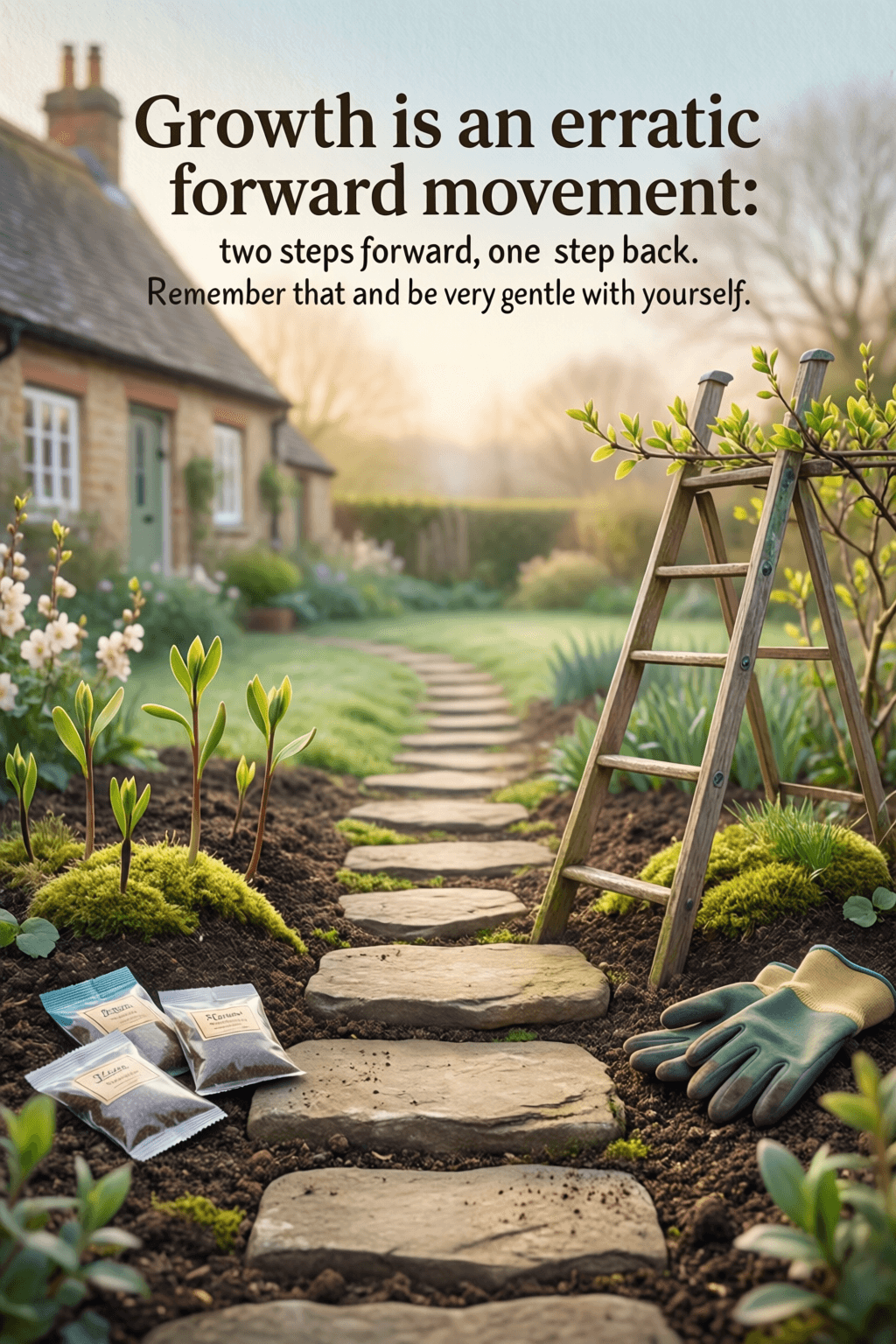
Growth is an erratic forward movement: two steps forward, one step back. Remember that and be very gentle with yourself. — Julia Cameron
—What lingers after this line?
Progress Is Not a Straight Line
Julia Cameron’s quote begins by dismantling a common illusion: that growth should look smooth, steady, and predictable. Instead, she describes it as ‘erratic forward movement,’ a phrase that captures the stop-and-start rhythm of real change. In other words, setbacks do not cancel progress; they are often woven into it. This perspective matters because many people abandon difficult work the moment they slip. Yet Cameron reframes retreat as part of advancement itself. Much like learning a language or recovering from burnout, improvement often includes hesitation, repetition, and temporary regression before a deeper level of mastery appears.
The Meaning of Two Steps Forward, One Back
The image of ‘two steps forward, one step back’ offers a practical arithmetic of hope. Although there is backward motion, the larger direction still points ahead. Therefore, the quote encourages patience with the uneven pace of healing, creativity, discipline, or self-discovery. Seen this way, what feels like failure may actually be recalibration. Thomas Edison’s often-cited reflections on experimentation during the development of the light bulb suggest a similar principle: unsuccessful attempts were not meaningless detours but part of discovering what worked. Cameron applies that same logic to the inner life.
Why Self-Gentleness Matters
From there, the quote turns from observation to instruction: ‘be very gentle with yourself.’ This is crucial, because once people recognize that growth is messy, they still must decide how to respond to the mess. Cameron’s answer is compassion rather than punishment. In practice, harsh self-criticism often slows development by creating shame and paralysis. By contrast, research on self-compassion by psychologist Kristin Neff (2003) shows that treating oneself with kindness during difficulty can support resilience and motivation. Thus, gentleness is not indulgence; it is a wiser emotional strategy for continuing the journey.
Creative Life and Emotional Recovery
This insight fits especially well with Cameron’s broader work in The Artist’s Way (1992), where creativity is portrayed not as a constant flow of inspiration but as a vulnerable, cyclical process. Artists, writers, and even professionals in ordinary careers often experience bursts of confidence followed by doubt, avoidance, or exhaustion. However, those reversals need not signal the end of growth. A novelist may abandon a draft for weeks, only to return with clearer vision. Similarly, someone rebuilding after grief or disappointment may feel stronger one month and fragile the next. Cameron’s wisdom lies in normalizing that rhythm rather than pathologizing it.
A More Humane Standard for Change
Ultimately, the quote offers a gentler standard by which to measure a life. Instead of asking whether progress has been flawless, it asks whether the overall movement remains forward. That shift can transform how people interpret bad days, relapses, mistakes, and delays. Consequently, Cameron invites us to replace perfectionism with endurance. Growth may wobble, but it still counts. And when we remember that unevenness is built into becoming, we are far less likely to mistake temporary backward steps for permanent defeat.
Recommended Reading
As an Amazon Associate, we earn from qualifying purchases.
One-minute reflection
Where does this idea show up in your life right now?
Related Quotes
6 selectedBeing kind enough to give yourself a break is the wisest thing you can do for your future. — Julia Cameron
Julia Cameron
At first glance, Julia Cameron’s line sounds gentle, but its core claim is surprisingly strong: giving yourself a break is not indulgence, it is wisdom. She reframes rest as a strategic act, suggesting that the future is...
Read full interpretation →Growth is not a race; it is a slow, quiet return to your own true rhythm. — Bianca Sparacino
Bianca Sparacino
Bianca Sparacino’s line begins by gently rejecting a familiar story: that growth is something you win by arriving first. By saying it is “not a race,” she challenges the pressure to measure progress against someone else’...
Read full interpretation →What progress have I made? I have begun to be a friend to myself. — Seneca
Seneca
At first glance, Seneca’s line shifts the idea of progress away from status, wealth, or public praise and toward an inner achievement. To say, “I have begun to be a friend to myself,” suggests that real development start...
Read full interpretation →Quietly, I am becoming the woman I was always meant to be. — Mitsuye Yamada
Mitsuye Yamada
Mitsuye Yamada’s line begins not with spectacle, but with stillness. The word “quietly” suggests that the deepest changes in a life often happen away from applause, in private acts of courage, reflection, and endurance.
Read full interpretation →Learning is not a sprint toward an end goal; it is a life-long rhythm of shedding what no longer serves you to make room for what does. — Pema Chödrön
Pema Chödrön
At first glance, Pema Chödrön’s reflection challenges one of the most common assumptions about education: that learning is a race with a clear endpoint. Degrees, promotions, and certifications often tempt us to think of...
Read full interpretation →It is not a sign that you are doing something wrong to need a break; it is a sign that you are human. — Nedra Glover Tawwab
Nedra Glover Tawwab
At its core, Nedra Glover Tawwab’s quote rejects the harsh belief that constant productivity is the measure of worth. Instead, it reframes the need for a break as evidence of our basic humanity: bodies tire, minds overlo...
Read full interpretation →More From Author
More from Julia Cameron →You get to decide what you make room for. Start there. — Julia Cameron
Julia Cameron’s line begins with a quiet but powerful reminder: our lives are shaped not only by what happens to us, but by what we choose to accommodate. To “make room” for something is to give it time, attention, and v...
Read full interpretation →Being kind enough to give yourself a break is the wisest thing you can do for your future. — Julia Cameron
At first glance, Julia Cameron’s line sounds gentle, but its core claim is surprisingly strong: giving yourself a break is not indulgence, it is wisdom. She reframes rest as a strategic act, suggesting that the future is...
Read full interpretation →Serenity is not freedom from the storm, but peace amid the storm. — Julia Cameron
Julia Cameron’s line begins by overturning a common fantasy: that peace arrives only when difficulty disappears. Instead, she proposes a deeper form of serenity, one that does not depend on controlling the weather of lif...
Read full interpretation →Serious art is born from serious play. — Julia Cameron
At first glance, Julia Cameron’s line seems contradictory: how can play be serious, and how can seriousness produce art without becoming rigid? Yet that tension is precisely her point.
Read full interpretation →