
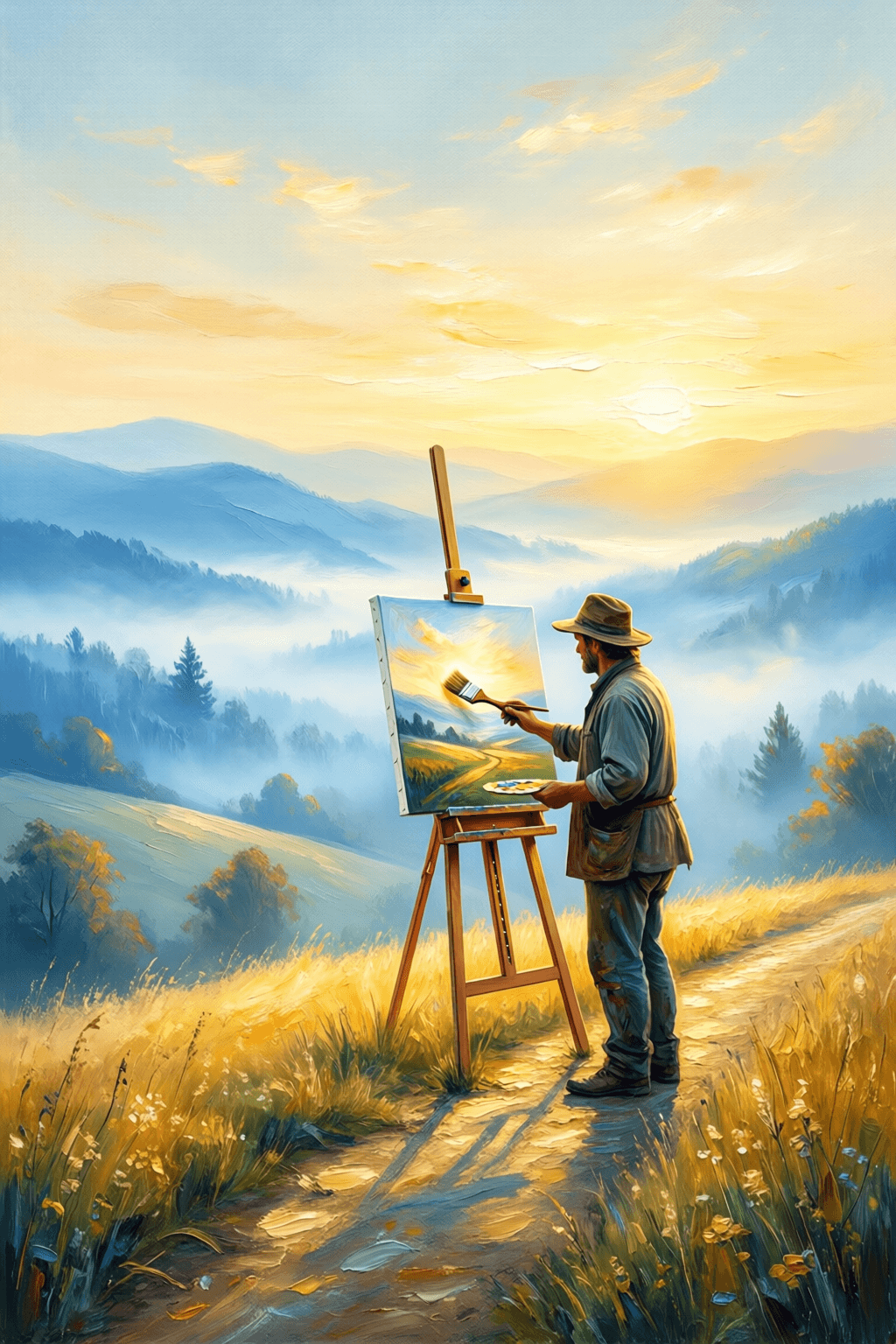
Don't be an art critic, but paint, there lies salvation. — Paul Cézanne
—What lingers after this line?
A Command Rather Than a Complaint
Cézanne’s line reads less like a theory of aesthetics than a stern piece of life advice. Instead of standing back and judging art, he urges us to make it—to enter the difficult, absorbing labor of painting itself. In that shift from criticism to creation, the quote locates salvation not in having perfect opinions, but in doing the work that transforms perception. This idea fits Cézanne’s own life. Working tirelessly in Aix-en-Provence in the late nineteenth century, he returned again and again to Mont Sainte-Victoire, apples, bathers, and tabletops, as if repetition itself could bring him closer to truth. Thus, the statement suggests that redemption lies in practice, patience, and attention.
Why Making Matters More Than Judging
From there, the quote opens into a broader human contrast between observing and participating. To be a critic is, in one sense, to remain outside the act; to paint is to risk failure, uncertainty, and exposure. Cézanne seems to prefer that vulnerable engagement, implying that spiritual or emotional rescue comes when we stop measuring life from a distance and begin shaping it with our own hands. In this way, painting becomes a model for all meaningful labor. Much as Aristotle’s *Nicomachean Ethics* (4th century BC) ties fulfillment to activity rather than mere contemplation, Cézanne points toward a life in which action clarifies the self. Salvation, then, is found in committed practice.
Painting as a Discipline of Seeing
At the same time, Cézanne’s advice is not only about self-expression; it is about learning how to see. Painting forces the eye to slow down, to notice shifts of color, weight, angle, and relation that ordinary looking often misses. By urging us to paint, he calls us into a stricter, humbler encounter with reality. This was central to his art. Art historian Meyer Schapiro noted in essays on Cézanne that his paintings remake vision through structure and color rather than simply copying appearances. Consequently, salvation here may mean release from superficial habits of perception. Through painting, the world regains depth, and the self becomes more awake within it.
Work as Consolation and Rescue
Furthermore, the word “salvation” gives the sentence unusual gravity. Cézanne is not saying painting is pleasant or decorative; he is saying it saves. For many artists, sustained work has indeed functioned as a defense against despair, confusion, or fragmentation. The studio becomes a place where attention gathers a scattered mind and where form is wrested from inner chaos. Vincent van Gogh’s letters, especially those to Theo in the 1880s, often describe labor in art as a way to endure suffering and remain spiritually alive. Although Cézanne’s temperament differed, the underlying belief is similar: disciplined creation can keep a person from dissolving into passivity or bitterness.
A Modern Lesson Beyond the Canvas
Finally, Cézanne’s remark reaches far beyond painters. Even for those who never touch a brush, it argues for the saving power of making over merely commenting. In an age saturated with reaction, review, and instant opinion, his words feel strikingly contemporary: do not just appraise beauty, participate in bringing something into being. Therefore, the quote endures because it joins artistic advice to a philosophy of life. Salvation lies in focused creation, in patient attention, and in the courage to work rather than judge. Painting names the act, but the deeper lesson is larger: we are steadied, and perhaps redeemed, by what we earnestly make.
Recommended Reading
As an Amazon Associate, we earn from qualifying purchases.
One-minute reflection
What's one small action this suggests?
Related Quotes
6 selectedArt is a form of standing up for yourself, a way to declare that your internal world has a right to exist. — Rebecca Solnit
Rebecca Solnit
Rebecca Solnit frames art not as decoration but as an act of self-defense and self-definition. In this view, to make something—a poem, painting, song, or story—is to insist that one’s private perceptions deserve space in...
Read full interpretation →Creativity takes courage. — Henri Matisse
Henri Matisse
This quote highlights that being creative often involves exposing one's inner thoughts and feelings, which requires a significant amount of courage as it makes one vulnerable to criticism and judgment.
Read full interpretation →Creativity is not the finding of a thing, but the making something out of it after it is found. — James Russell Lowell
James Lowell
James Russell Lowell’s line shifts attention away from the romantic myth of the sudden genius who invents from nothing. Instead, he argues that creativity truly begins after the initial encounter—after an idea, object, p...
Read full interpretation →Sometimes you have to stop and be bored, because boredom is the dream-killer's worst enemy. — Elizabeth Gilbert
Elizabeth Gilbert
At first glance, Elizabeth Gilbert’s remark sounds counterintuitive, because boredom is usually treated as something to escape. Yet her point turns that assumption upside down: when we stop filling every empty moment, we...
Read full interpretation →The painter tries to master color; the color is the artist's language. — Paul Cézanne
Paul Cézanne
At first glance, Cézanne’s remark seems simple: painters work to control color. Yet the second half deepens the thought by suggesting that color is not merely a tool but the very medium through which the artist thinks an...
Read full interpretation →Rest is not laziness; it is the essential fuel that allows your creativity to ignite once more. — Arianna Huffington
Arianna Huffington
At first glance, Arianna Huffington’s statement challenges a deep cultural bias: the tendency to equate nonstop activity with virtue and rest with weakness. By insisting that rest is not laziness, she reframes it as a ne...
Read full interpretation →More From Author
More from Paul Cézanne →The painter tries to master color; the color is the artist's language. — Paul Cézanne
At first glance, Cézanne’s remark seems simple: painters work to control color. Yet the second half deepens the thought by suggesting that color is not merely a tool but the very medium through which the artist thinks an...
Read full interpretation →Do not wait to be struck by lightning; learn to build your own fire. — Paul Cezanne
This quote encourages individuals to take proactive steps in their lives rather than waiting for external circumstances to bring about change or inspiration.
Read full interpretation →We live in a rainbow of chaos. — Paul Cézanne
Paul Cézanne’s vivid expression, 'We live in a rainbow of chaos,' encapsulates the vibrant turbulence of human experience. By juxtaposing 'rainbow'—a symbol of beauty and diversity—with 'chaos,' Cézanne acknowledges the...
Read full interpretation →We live in a rainbow of chaos. — Paul Cézanne
Paul Cézanne’s declaration—'We live in a rainbow of chaos'—captures the essence of his revolutionary approach to art. Renowned for his bold brushwork and vibrant palettes, Cézanne saw the world not as a static, orderly a...
Read full interpretation →