
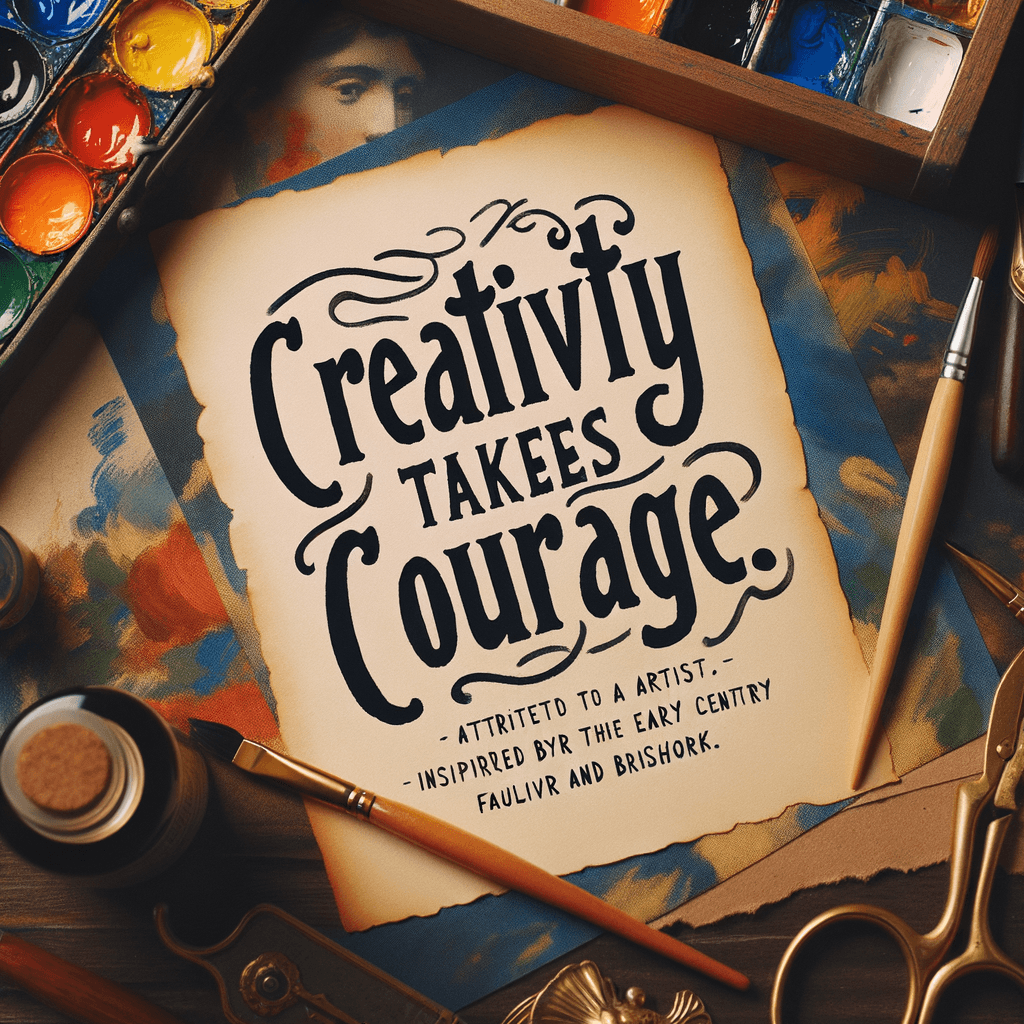
Creativity takes courage. — Henri Matisse
—What lingers after this line?
Embracing Vulnerability
This quote highlights that being creative often involves exposing one's inner thoughts and feelings, which requires a significant amount of courage as it makes one vulnerable to criticism and judgment.
Overcoming Fear of Failure
Creativity involves trying new things and pushing boundaries, which inherently comes with the risk of failure. It takes bravery to step into the unknown and create something original despite the possibility of not succeeding.
Challenging the Status Quo
Being creative often means challenging existing norms and conventional thinking. It requires courage to present new ideas and perspectives that may not be immediately accepted by others.
Personal Growth
Through the process of being creative, individuals often encounter personal growth. It takes courage to face this transformative process, which can be both rewarding and challenging.
Artistic Context
Henri Matisse, a renowned French artist, was known for his innovative use of color and form. His career exemplifies the courage required to pursue unique artistic visions and leave a lasting impact on the art world.
One-minute reflection
What does this quote ask you to notice today?
Related Quotes
6 selectedThe moment a man begins to talk about technique, that's proof that he is fresh out of ideas. — Dylan Thomas
Dylan Thomas
Dylan Thomas’s remark begins with a sharp suspicion: when an artist talks too much about technique, the living impulse behind the work may already be gone. Technique, in this sense, becomes a substitute language, a way o...
Read full interpretation →To be courageous is to act with the heart. — Molière
Molière
Molière’s line suggests that courage is not merely the absence of fear, but the decision to move despite it. By connecting courage with the heart, he frames bravery as an emotional and moral act rather than a simple disp...
Read full interpretation →Imperfection inspires invention, imagination, and creativity. — Mary Sharratt
Mary Sharratt
Mary Sharratt’s insight begins with a reversal of ordinary expectations: imperfection is not merely something to fix, but something that awakens possibility. When a plan fails, a surface cracks, or an idea refuses to fit...
Read full interpretation →The best people possess a feeling for beauty, the courage to take risks, the discipline to tell the truth, the capacity for sacrifice. — Ernest Hemingway
Ernest Hemingway
Hemingway’s line presents goodness not as politeness or success, but as a demanding inner code. The “best people” are those who combine sensitivity, bravery, honesty, and self-denial—qualities that do not always coexist...
Read full interpretation →Don't think. Thinking is the enemy of creativity. It's self-conscious, and anything self-conscious is lousy. — Ray Bradbury
Ray Bradbury
At first glance, Ray Bradbury’s line sounds almost rebellious: “Don’t think. Thinking is the enemy of creativity.” Yet his target is not intelligence itself, but the paralyzing kind of self-awareness that makes an artist...
Read full interpretation →You can be cautious or you can be creative, but there's no such thing as a cautious creative. — George Lois
George Lois
George Lois draws a sharp line between two mindsets: caution protects what already exists, while creativity risks making something new. At first glance, the statement sounds absolute, yet that severity is exactly its poi...
Read full interpretation →More From Author
More from Henri Matisse →The spring that keeps running is more valuable than the jug which bottoms out each day. We unlock that spring by patiently working at our task and giving our best effort every time. — Henri Matisse
Matisse’s image contrasts two kinds of value: the jug that must be refilled each day and the spring that continues to flow from within. At first glance, the jug seems useful, but its usefulness is limited by its emptines...
Read full interpretation →Consistency is the sum that equals what we become. — Henri Matisse
At its core, Matisse’s remark suggests that identity is not formed in a single dramatic moment but accumulated through repeated actions. What we do regularly—how we think, practice, respond, and persist—gradually adds up...
Read full interpretation →The secret to a life of significance is not in the grand gesture, but in the quiet, unrelenting consistency of your daily practice. — Henri Matisse
At first glance, Matisse overturns the common belief that meaningful lives are built through dramatic turning points. Instead, he locates significance in repetition: the small actions done faithfully when no audience is...
Read full interpretation →The artist must be a craftsman; he must know his materials, his tools, and his methods. — Henri Matisse
Henri Matisse’s statement immediately shifts attention from inspiration to discipline. Rather than treating art as a purely mysterious gift, he insists that the artist is first a craftsman—someone who understands how thi...
Read full interpretation →