
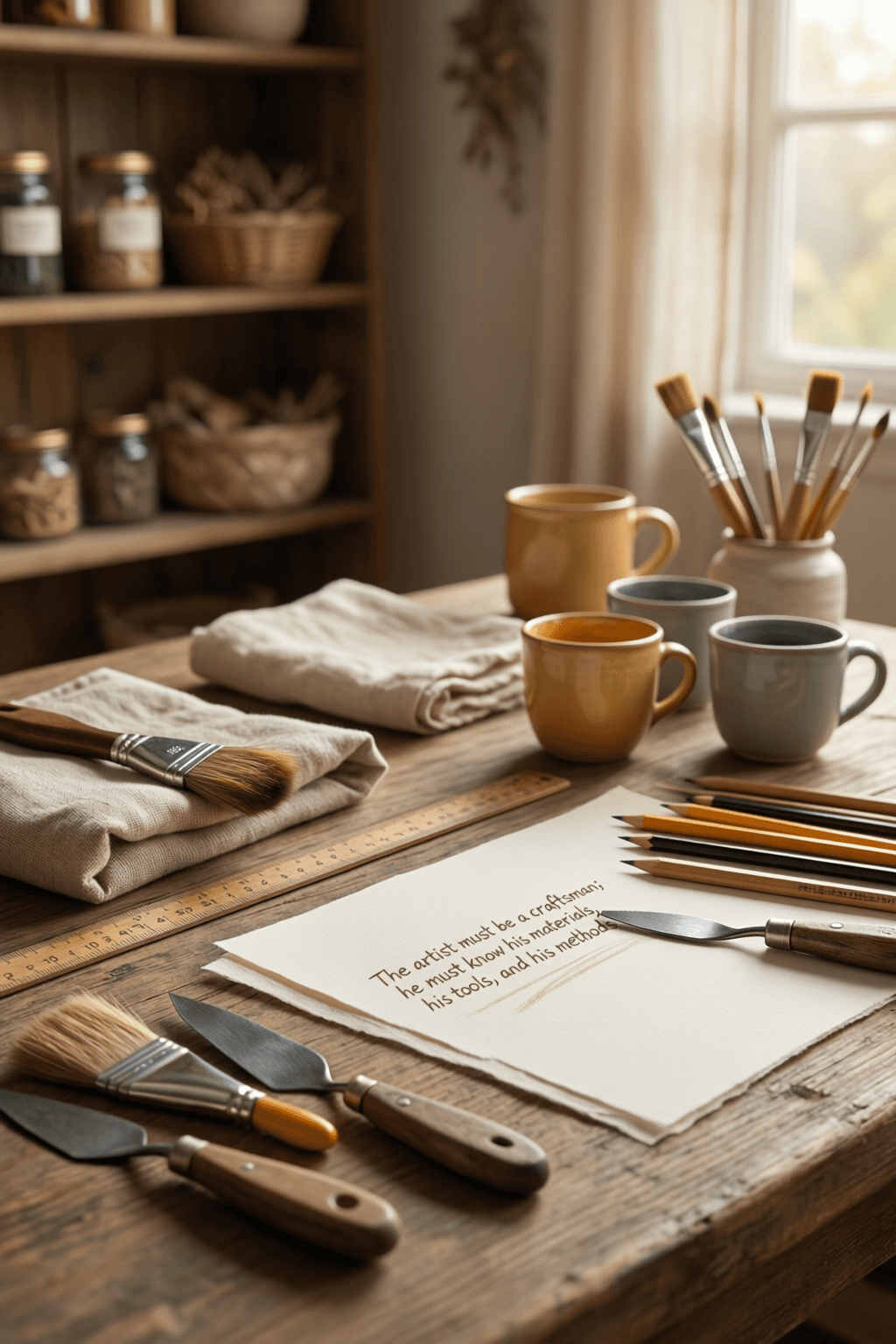
The artist must be a craftsman; he must know his materials, his tools, and his methods. — Henri Matisse
—What lingers after this line?
Art Begins with Mastery
Henri Matisse’s statement immediately shifts attention from inspiration to discipline. Rather than treating art as a purely mysterious gift, he insists that the artist is first a craftsman—someone who understands how things are made. In this view, imagination matters deeply, yet it can only take durable form when guided by practiced hands and informed decisions. From this starting point, Matisse challenges the romantic myth of effortless genius. A painter who does not understand pigment, surface, and brushwork, or a sculptor unfamiliar with weight and texture, cannot fully realize vision. Thus, artistic freedom does not arise in opposition to craft; it grows out of it.
Knowing the Nature of Materials
Building on that idea, Matisse emphasizes the artist’s relationship with materials themselves. Paint behaves differently on canvas than ink on paper, just as marble resists the hand in ways clay does not. To know one’s materials is to anticipate their possibilities and limits, allowing the work to emerge through collaboration rather than struggle. Art history repeatedly affirms this principle. For example, Leonardo da Vinci’s notebooks reveal sustained technical curiosity about pigment, light, and anatomy, showing that observation and material knowledge were inseparable from invention. In the same way, Matisse suggests that artistic power comes not from ignoring matter, but from understanding it intimately.
Tools as Extensions of Thought
Equally important, the quote draws attention to tools, which are never neutral instruments. A chisel, a brush, a stylus, or a printing press shapes the very kind of mark an artist can make. Once an artist truly knows these tools, they begin to act almost like extensions of the mind, translating intention into form with increasing precision. This is why workshops and apprenticeships mattered so much in earlier periods. Renaissance studios, including those described by Giorgio Vasari in Lives of the Artists (1550), trained painters through repeated handling of tools before encouraging individual style. Accordingly, Matisse’s remark implies that originality often rests on technical familiarity, not on spontaneity alone.
Method Gives Form to Vision
However, knowledge of materials and tools is still incomplete without method. By adding “methods,” Matisse points to process: the sequence of choices, revisions, and habits through which art is actually made. Method turns scattered talent into reliable practice, enabling the artist to approach problems deliberately instead of waiting passively for inspiration. Seen this way, method is not mechanical routine but structured intelligence. Printmakers know the order of inking and pressing; fresco painters must work within the drying time of plaster; even modern digital artists rely on layered workflows. Therefore, Matisse presents artistic creation as a union of sensibility and procedure, where vision becomes tangible through repeatable discipline.
Craft and Creativity Are Not Opposites
As the quotation unfolds, its deeper argument becomes clear: craftsmanship does not limit creativity but protects and enlarges it. Many people imagine technique as something rigid, yet Matisse suggests the reverse. The more fully an artist knows the means of making, the more boldly that artist can experiment without collapsing into accident or confusion. Matisse’s own career illustrates this balance. His seemingly effortless color harmonies and simplified forms were the result of long study and deliberate control, not casual impulse. In that sense, the quote becomes quietly liberating: it tells artists that technical labor is not secondary to expression, but the very ground from which expressive freedom emerges.
A Lesson Beyond the Studio
Finally, Matisse’s insight extends beyond painting or sculpture into any serious creative field. Writers must know language, rhythm, and structure; musicians must know tone, timing, and technique; architects must know materials and construction. In every case, artistry depends on respect for the medium and the disciplined study of how it works. For that reason, the quote remains enduringly practical. It reminds us that beauty is rarely accidental and that genuine expression is strengthened—not diminished—by technical knowledge. By calling the artist a craftsman, Matisse restores dignity to labor and shows that mastery is not the enemy of art, but its most dependable foundation.
One-minute reflection
What's one small action this suggests?
Related Quotes
6 selectedProficiency in a craft is essential to every artist. Therein lies the prime source of creative imagination. — Walter Gropius
Walter Gropius
At first glance, Walter Gropius’s statement may seem to place discipline above inspiration, yet his deeper point is that imagination needs a workable form. An artist who understands materials, structure, and technique ca...
Read full interpretation →Craftsmanship is the quality of design, shown in something by the skill, time, and attention to detail put in by the artist. — Canvs Editorial
Canvs Editorial
At its core, this statement presents craftsmanship as visible care. Design is not treated as mere decoration, but as the outward result of discipline, patience, and practiced skill.
Read full interpretation →There are two men inside the artist, the poet and the craftsman. One is born a poet. One becomes a craftsman. — Emile Zola
Émile Zola
At first glance, Zola’s remark divides the artist into two figures: the poet and the craftsman. Yet the contrast is not meant to split art into separate worlds, but to show that creation depends on both impulse and disci...
Read full interpretation →He who works with his hands and his head is a craftsman. He who works with his hands and his head and his heart is an artist. — Francis of Assisi
Francis of Assisi
Francis of Assisi draws a graceful line between skill and art by adding one decisive element: the heart. In his view, working with the hands and the head produces competence, discipline, and useful creation—the marks of...
Read full interpretation →Quality, manual labor, and a lot of time: that is the essence of craftsmanship. — Katarzyna Maniak
Katarzyna Maniak
At its core, Katarzyna Maniak’s statement reduces craftsmanship to three inseparable elements: quality, manual labor, and time. Rather than treating a finished object as merely a product, the quote frames it as the visib...
Read full interpretation →I would almost prefer the word 'craftsman'. He is like one of those old-fashioned ship builders who conceived the build of the boat in their mind and after that touched every single piece. — William Golding
William Golding
At first glance, Golding’s preference for the word “craftsman” shifts attention away from the romantic image of effortless genius and toward disciplined making. The term suggests someone who does not merely imagine a wor...
Read full interpretation →More From Author
More from Henri Matisse →Consistency is the sum that equals what we become. — Henri Matisse
At its core, Matisse’s remark suggests that identity is not formed in a single dramatic moment but accumulated through repeated actions. What we do regularly—how we think, practice, respond, and persist—gradually adds up...
Read full interpretation →The secret to a life of significance is not in the grand gesture, but in the quiet, unrelenting consistency of your daily practice. — Henri Matisse
At first glance, Matisse overturns the common belief that meaningful lives are built through dramatic turning points. Instead, he locates significance in repetition: the small actions done faithfully when no audience is...
Read full interpretation →I think that when you create something, you leave a part of yourself in it. — Henri Matisse
At its core, Matisse’s reflection suggests that making anything—a painting, a poem, a song, even a room—inevitably transfers something inward into outward form. Creation is not merely the arrangement of materials; rather...
Read full interpretation →The beauty of handmade is in the imperfections. — Henri Matisse
Matisse’s remark begins with a quiet reversal of modern expectations: what is irregular, uneven, or visibly human is not a flaw to hide but the very place where beauty appears. A handmade object carries the trace of touc...
Read full interpretation →