
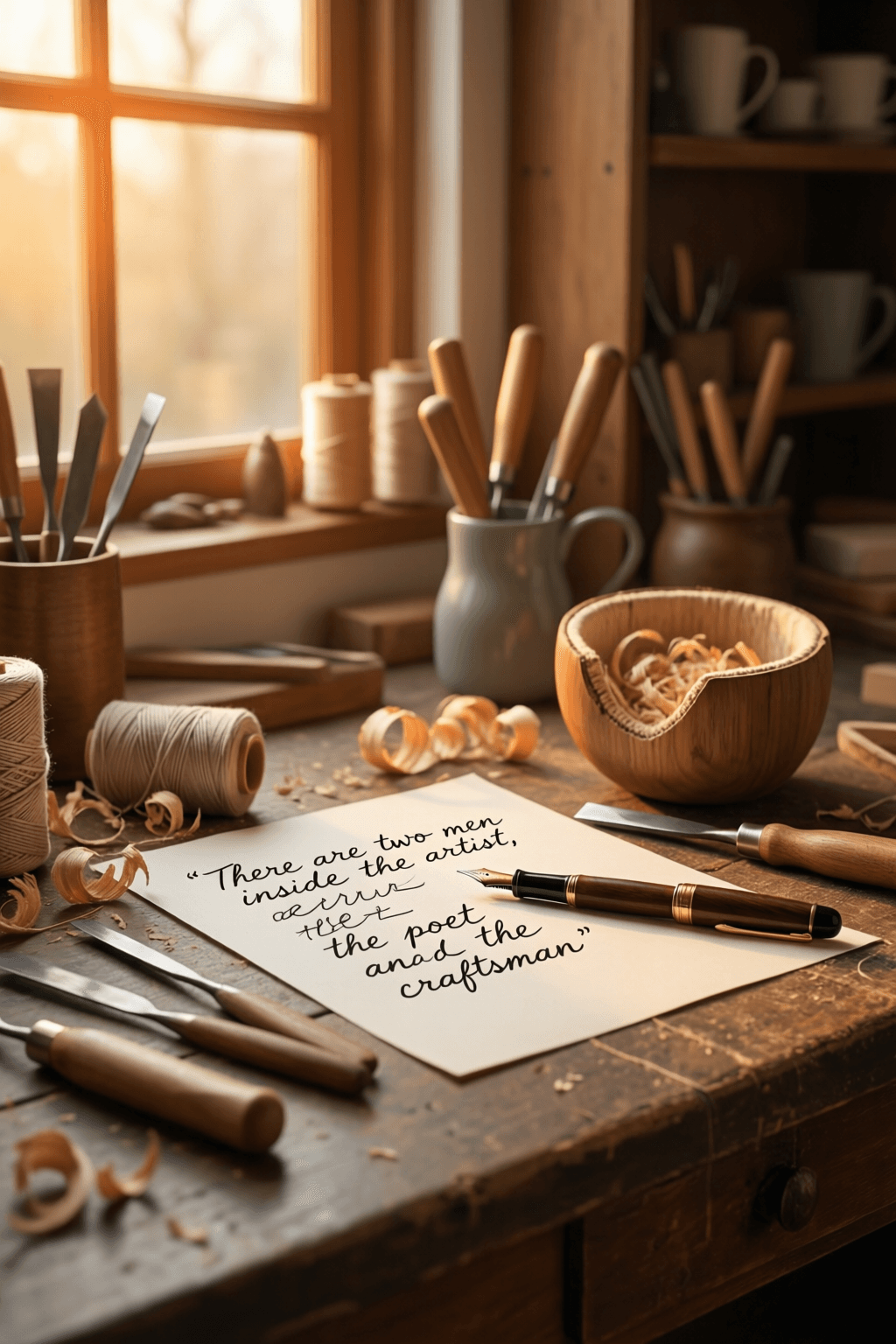
There are two men inside the artist, the poet and the craftsman. One is born a poet. One becomes a craftsman. — Emile Zola
—What lingers after this line?
A Divided but Unified Self
At first glance, Zola’s remark divides the artist into two figures: the poet and the craftsman. Yet the contrast is not meant to split art into separate worlds, but to show that creation depends on both impulse and discipline. The “poet” names the inward spark—temperament, sensitivity, vision—while the “craftsman” represents the learned ability to shape that spark into lasting form. In this way, Zola suggests that talent alone is incomplete. An artist may feel deeply, imagine vividly, or perceive beauty with unusual force, but without technique those gifts remain private and unfinished. Thus the quote introduces a lifelong tension, not between enemies, but between two necessary powers within the same creative self.
The Mystery of Being Born a Poet
Zola’s claim that one is “born a poet” points to qualities that seem to arrive before instruction: emotional intensity, intuition, and a natural responsiveness to the world. Some people appear to possess, from an early age, a special sensitivity to rhythm, image, or human suffering. William Wordsworth’s The Prelude (1850), for example, presents poetic consciousness as something rooted in childhood perception rather than later training. Even so, Zola is not romanticizing raw feeling as sufficient. Instead, he grants that originality often begins in temperament. The artist’s first resource is not method but vision. From that starting point, the quote moves naturally to a harder truth: what is given by nature must still be made useful by labor.
Becoming Through Practice
From innate gift, Zola turns to acquired skill. If the poet is born, the craftsman is made through repetition, failure, correction, and patience. Here art resembles any demanding discipline: the musician practices scales, the painter studies anatomy, and the novelist revises sentences until they carry exact weight. Gustave Flaubert, whom Zola admired, was famous for searching tirelessly for le mot juste—the precise word—a habit that exemplifies artistic craftsmanship. Consequently, the quote rejects the myth that inspiration alone produces greatness. A gifted artist without craft may remain obscure even to himself, unable to give form to what he feels. Training does not extinguish genius; rather, it gives genius structure, clarity, and endurance.
Why Art Needs Both Forces
Once these two aspects are seen together, Zola’s deeper insight becomes clear: art fails when either side dominates completely. Pure poetry without craftsmanship can become vague, excessive, or chaotic. On the other hand, pure craftsmanship without the inner poet may produce work that is polished but lifeless, technically competent yet emotionally empty. This balance appears across artistic history. Leonardo da Vinci’s notebooks reveal both wonder and method, while Johann Sebastian Bach’s compositions show how profound feeling can inhabit strict formal design. Therefore, Zola is not praising instinct over skill or skill over instinct. He is describing the union through which art becomes both moving and memorable.
A Democratic View of Mastery
Importantly, the second half of the quotation carries an encouraging message. Not everyone may be “born a poet” in the same degree, but anyone serious about art can become more of a craftsman. That means improvement is not reserved for the naturally gifted; it is available through apprenticeship, study, and sustained work. In this sense, Zola leaves room for effort, humility, and gradual mastery. Moreover, this idea broadens the meaning of artistic success. The artist is not only a vessel of inspiration but also a worker. Such a view honors the studio, the desk, and the rehearsal room as much as the moment of sudden vision. Art, then, becomes not merely a miracle of birth, but also an achievement of character.
The Enduring Lesson for Creators
Ultimately, Zola’s statement remains relevant because it speaks to every creative field, from poetry and painting to filmmaking and design. Modern creators are often urged to “express themselves,” yet expression without form rarely reaches others. Conversely, technical fluency without inner necessity can feel mechanical. The challenge, as Zola frames it, is to preserve the original flame while learning how to tend it. For that reason, the quote offers both realism and hope. It acknowledges that some artistic qualities seem native and mysterious, but it also insists that excellence is built. The true artist, in Zola’s sense, is neither only born nor only trained, but formed where inspiration meets disciplined making.
Recommended Reading
As an Amazon Associate, we earn from qualifying purchases.
One-minute reflection
What feeling does this quote bring up for you?
Related Quotes
6 selectedThe artist must be a craftsman; he must know his materials, his tools, and his methods. — Henri Matisse
Henri Matisse
Henri Matisse’s statement immediately shifts attention from inspiration to discipline. Rather than treating art as a purely mysterious gift, he insists that the artist is first a craftsman—someone who understands how thi...
Read full interpretation →He who works with his hands and his head is a craftsman. He who works with his hands and his head and his heart is an artist. — Francis of Assisi
Francis of Assisi
Francis of Assisi draws a graceful line between skill and art by adding one decisive element: the heart. In his view, working with the hands and the head produces competence, discipline, and useful creation—the marks of...
Read full interpretation →The artist is not a solid, static being. The artist is fluid, like water, moving with the tides and changing form. — James McCrae
James McCrae
James McCrae’s image of the artist as fluid immediately challenges the common idea that creative people possess a single, fixed essence. Instead, he suggests that artistry is a process of becoming, not a stable condition...
Read full interpretation →The artist works by locating the world in himself. — Gertrude Stein
Gertrude Stein
At first glance, Gertrude Stein’s line suggests that art does not begin with the outer world alone, but with the artist’s inner ability to absorb and reinterpret it. To ‘locate the world in himself’ means that experience...
Read full interpretation →The artist is nothing without the gift, but the gift is nothing without work. — Émile Zola
Émile Zola
Émile Zola’s claim sets a dual imperative: talent is the spark, but only sustained labor turns that spark into a durable flame. His own career exemplifies the point.
Read full interpretation →I would almost prefer the word 'craftsman'. He is like one of those old-fashioned ship builders who conceived the build of the boat in their mind and after that touched every single piece. — William Golding
William Golding
At first glance, Golding’s preference for the word “craftsman” shifts attention away from the romantic image of effortless genius and toward disciplined making. The term suggests someone who does not merely imagine a wor...
Read full interpretation →More From Author
More from Émile Zola →The artist is nothing without the gift, but the gift is nothing without work. — Émile Zola
Émile Zola’s claim sets a dual imperative: talent is the spark, but only sustained labor turns that spark into a durable flame. His own career exemplifies the point.
Read full interpretation →Take as a rule of life what you have learned from grapes: the juice is worth the squeeze. — Émile Zola
This quote conveys that the worthwhile outcomes in life often require effort, just as extracting juice from grapes requires squeezing.
Read full interpretation →If you ask me what I came into this life to do, I will tell you: I came to live out loud. — Émile Zola
Zola’s declaration rejects the safety of half-lived days. To live out loud is not mere volume; it is moral clarity expressed in public, where risk and responsibility meet.
Read full interpretation →