
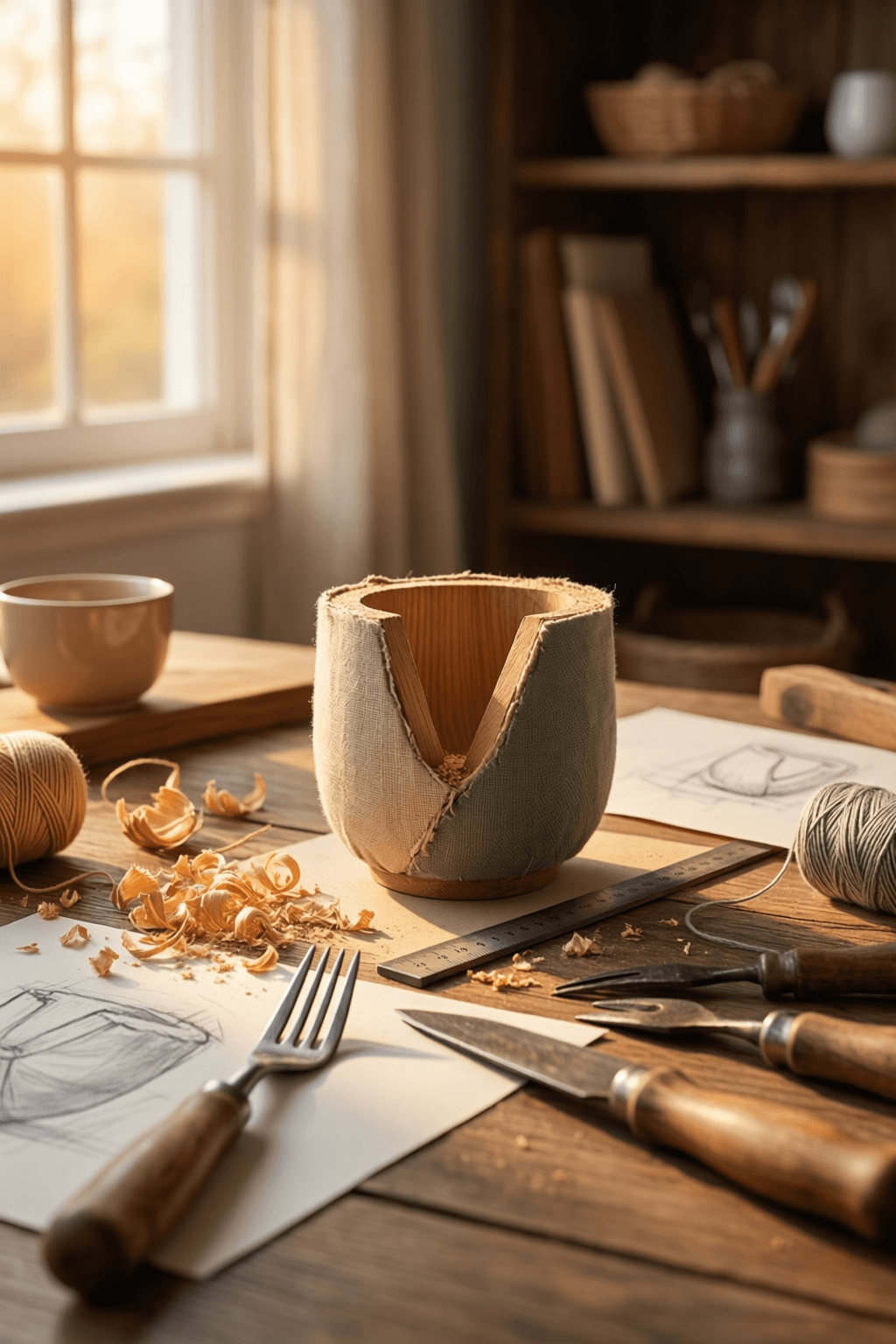
The beauty of a thing is not just in its final form, but in the slow, deliberate history of how it was made. — William Morris
—What lingers after this line?
Beauty Beyond the Surface
At first glance, William Morris shifts attention away from the polished object and toward the human story embedded within it. His point is not that the final form does not matter, but that its beauty deepens when we understand the patience, judgment, and care that brought it into being. In other words, appearance alone is incomplete without process. This idea reflects Morris’s broader Arts and Crafts philosophy, developed in works such as “The Lesser Arts” (1877), where he argued that meaningful design joins utility, labor, and dignity. Seen this way, a chair, a tapestry, or a building becomes beautiful not only because it pleases the eye, but because it preserves the trace of thoughtful making.
The Moral Value of Craft
From there, Morris’s insight becomes almost ethical. A slowly made object suggests attention, discipline, and respect for materials, and these qualities shape our response to it. We sense when something has been rushed into existence and when it has been formed through care; the difference is emotional as much as visual. Consequently, beauty here is tied to integrity. Morris, influenced by medieval craftsmanship and reacting against industrial mass production in Victorian Britain, believed that labor should not be alienated from artistry. His own Morris & Co. workshops embodied this principle, treating design not as mere output but as a humane practice in which maker and object remain meaningfully connected.
Time as an Ingredient
Just as pigment or wood grain contributes to an object’s character, time itself becomes one of its materials. Morris invites us to see slowness not as inefficiency but as enrichment: revisions, setbacks, and accumulated skill all leave subtle marks on the finished work. What we admire, then, is often condensed time made visible. A useful parallel appears in Japanese pottery traditions, where irregularities created through firing are prized rather than concealed. Likewise, in Bernard Leach’s A Potter’s Book (1940), craft is presented as a dialogue among hand, material, and duration. The object’s beauty emerges because it records a lived process, not because it escaped one.
Against the Logic of Instant Production
This perspective also serves as a quiet critique of cultures obsessed with speed. If beauty resides partly in a thing’s making, then disposable goods designed for quick consumption lose something essential, even when they are sleek or efficient. Morris saw this clearly in the industrial age, when mechanized production often severed workmanship from meaning. Accordingly, his quote remains strikingly modern. In an era of fast fashion, algorithmic design, and overnight delivery, many people still seek handmade ceramics, stitched garments, or restored furniture precisely because such objects resist anonymity. Their appeal lies in visible effort, in the sense that someone’s time and consciousness are still present within them.
What the Maker Leaves Behind
As the thought develops, Morris’s sentence becomes almost archival: every made thing carries a record of decisions. Tool marks, joins, textures, and even imperfections testify to the maker’s hand. Rather than flaws to erase, these features can become the very signs that an object has lived through a process of becoming. This is why hand-bound books, woven textiles, or carved tables often feel more intimate than factory-perfect counterparts. John Ruskin, whom Morris admired, made a similar case in The Stones of Venice (1851–1853), praising the vitality found in irregular workmanship. The maker leaves behind not just a product, but evidence of presence.
A Lesson for Living Creatively
Finally, Morris’s insight extends beyond craft into life itself. If beauty includes the long history of making, then creative work, personal growth, and even relationships may be valued not only for outcomes but for the shaping journey behind them. The finished form matters, yet it is enriched by the patience that produced it. For that reason, the quote offers more than an aesthetic principle; it proposes a way of seeing. We are asked to honor process, to recognize that meaning often gathers slowly, and to resist judging worth solely by immediate results. In Morris’s view, the most beautiful things are not merely completed—they are deeply made.
Recommended Reading
As an Amazon Associate, we earn from qualifying purchases.
One-minute reflection
What's one small action this suggests?
Related Quotes
6 selectedThe craft of life is not in the final product, but in the slow, intentional turning of the hands and the quiet cultivation of the soul. — William Morris
William Morris
At its heart, this reflection shifts attention away from finished achievements and toward the manner in which a life is shaped. William Morris suggests that meaning does not reside chiefly in what we produce, display, or...
Read full interpretation →Craftsmanship is the refusal to accept the mediocre, the patient pursuit of a standard that exists only in your own mind. — William Morris
William Morris
William Morris defines craftsmanship not as mere skill, but as an act of resistance against the acceptable average. From the beginning, his words suggest that mediocrity often arrives disguised as practicality: good enou...
Read full interpretation →To do common things perfectly is far better than to pretend to do wonderful things badly. — William Morris
William Morris
William Morris’s remark begins with a sharp moral distinction: it is better to perform ordinary work with real skill than to chase grandeur without competence. In that sense, he challenges the temptation to value appeara...
Read full interpretation →We don't value craftsmanship anymore! All we value is ruthless efficiency, and I say we deny our own humanity that way! — William Morris
William Morris
William Morris’s complaint opens as more than nostalgia for handmade beauty; rather, it is a moral protest against a society that measures worth only by speed, output, and utility. When he says that ruthless efficiency d...
Read full interpretation →The beauty of craftsmanship is that it is a dialogue with time, a slow resistance against the rush of the world. — Richard Sennett
Richard Sennett
At its core, Richard Sennett’s line presents craftsmanship as more than skilled labor; it becomes a moral and temporal stance. To make something carefully is to refuse the culture of haste, where speed is often mistaken...
Read full interpretation →Craftsmanship is the quality of design, shown in something by the skill, time, and attention to detail put in by the artist. — Canvs Editorial
Canvs Editorial
At its core, this statement presents craftsmanship as visible care. Design is not treated as mere decoration, but as the outward result of discipline, patience, and practiced skill.
Read full interpretation →More From Author
More from William Morris →A man at work, making something which he feels will exist because he is working at it and wills it, is exercising the energies of his mind and soul as well as of his body. — William Morris
At its core, William Morris presents work not as drudgery but as an act of creation. A person who makes something with the conviction that it will endure is doing more than completing a task; he is shaping reality throug...
Read full interpretation →Craftsmanship is the refusal to accept the mediocre, the patient pursuit of a standard that exists only in your own mind. — William Morris
William Morris defines craftsmanship not as mere skill, but as an act of resistance against the acceptable average. From the beginning, his words suggest that mediocrity often arrives disguised as practicality: good enou...
Read full interpretation →One's home should be a place where one can be oneself, a sanctuary from the noise of the world. — William Morris
William Morris presents home not merely as a physical shelter, but as a moral and emotional refuge. At the heart of the quote lies a simple human need: the desire for one place where performance ends and authenticity beg...
Read full interpretation →The craft of life is not in the final product, but in the slow, intentional turning of the hands and the quiet cultivation of the soul. — William Morris
At its heart, this reflection shifts attention away from finished achievements and toward the manner in which a life is shaped. William Morris suggests that meaning does not reside chiefly in what we produce, display, or...
Read full interpretation →