
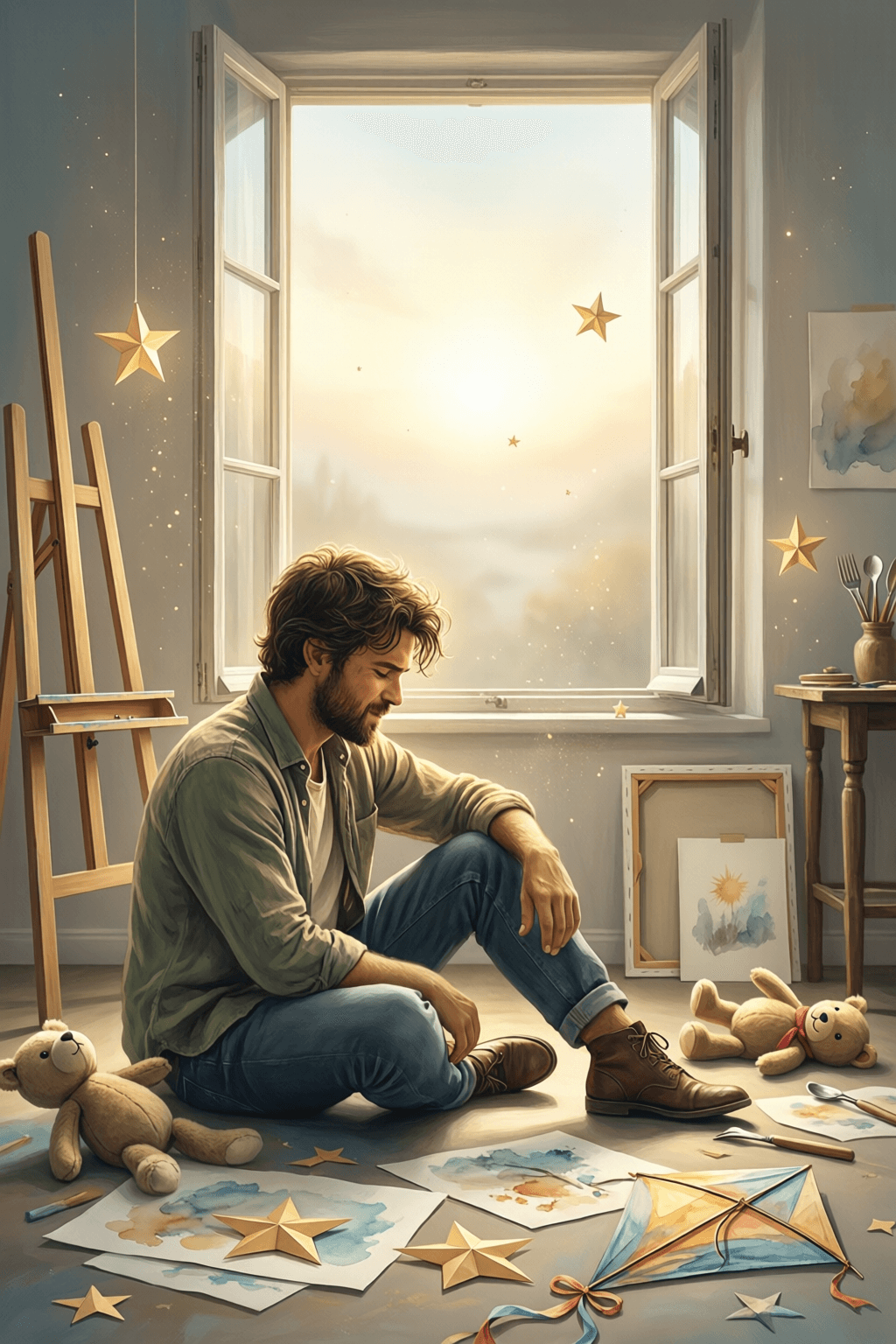
The creative adult is the child who survived. — Ursula Le Guin
—What lingers after this line?
A Quiet Definition of Creativity
At first glance, Ursula Le Guin’s sentence seems simple, yet it offers a profound definition of what it means to remain creative. By saying that the creative adult is ‘the child who survived,’ she suggests that imagination is not something acquired late in life but something preserved against pressure, disappointment, and conformity. Creativity, in this view, is less a new talent than an old inheritance kept alive. In other words, the artist, thinker, or innovator does not abandon childhood entirely; instead, that person carries forward its curiosity, playfulness, and capacity for wonder. Le Guin, whose essays in *The Language of the Night* (1979) often defend imagination as a serious human power, reminds us that maturity need not mean emotional or imaginative surrender.
What Childhood Represents
From there, the quotation invites us to consider what ‘the child’ symbolizes. It is not mere innocence or naivety, but a mode of being marked by openness, experimentation, and the freedom to ask improbable questions. Children build worlds from scraps, invent rules as they go, and treat possibility as something ordinary. That instinct lies at the heart of all creative work. Accordingly, Le Guin’s idea aligns with thinkers like Jean Piaget, whose studies of childhood development showed how children actively construct meaning rather than passively absorb it. The creative adult retains some part of that constructive energy. Rather than seeing the world as fixed and fully explained, such a person continues to test it, reshape it, and imagine alternatives.
Survival Against Social Pressure
However, the most striking word in the quotation is ‘survived.’ It implies danger, loss, and resistance. Childhood imagination often meets forces that try to domesticate it: rigid schooling, social embarrassment, economic anxiety, or the demand to be practical at all times. As a result, many people do not lose creativity naturally; they are trained out of trusting it. This insight echoes Pablo Picasso’s famous remark, ‘Every child is an artist. The problem is how to remain an artist once we grow up.’ Le Guin’s phrasing is sharper because it frames creativity as endurance. The adult who still imagines freely has not merely matured well; that person has protected something fragile and essential through a culture that often rewards obedience more than invention.
Imagination as Emotional Resilience
Seen this way, creativity is not only aesthetic but psychological. The surviving child within the adult is the part that can still play, adapt, and transform pain into meaning. Many writers and artists have described this process directly. Maya Angelou’s autobiographical work, especially *I Know Why the Caged Bird Sings* (1969), shows how language and imagination can become tools for surviving trauma without surrendering one’s inner life. Therefore, Le Guin’s line also honors resilience. To stay creative is to resist numbness. It means keeping alive the capacity for surprise even after disillusionment, and preserving sensitivity in a world that often mistakes hardness for strength. The imagination survives not by denying suffering, but by metabolizing it into story, image, and possibility.
The Ethical Power of Wonder
Beyond personal survival, Le Guin’s idea points toward an ethical dimension of creativity. Children often question rules adults take for granted, and that questioning can become morally important. A creative adult is able to imagine that society could be otherwise, which is why imagination matters not just in art but in politics, education, and community life. Le Guin’s own fiction, including *The Dispossessed* (1974), demonstrates this principle by building alternative social worlds that challenge accepted norms. In that sense, the surviving child is not escapist; it is visionary. The ability to wonder, ‘Why must things be this way?’ becomes the first step toward empathy and reform. Creativity thus preserves the freedom to imagine better arrangements for human life.
A Lifelong Task of Preservation
Finally, the quotation suggests that creativity requires care across a lifetime. If the child survives, it is because the adult makes room for play, attention, and unguarded perception. This may happen through art, reading, conversation, solitude, or any practice that loosens the grip of habit. The point is not to become childish, but to remain permeable to discovery. Le Guin’s insight is therefore both descriptive and instructive. It tells us that the most alive adults are often those who have not betrayed their earliest sense of wonder. In a culture eager to equate adulthood with efficiency alone, her words gently argue for another model of maturity: one in which wisdom grows not by burying the child, but by letting that child continue to speak.
Recommended Reading
As an Amazon Associate, we earn from qualifying purchases.
One-minute reflection
What does this quote ask you to notice today?
Related Quotes
6 selectedYou can be cautious or you can be creative, but there's no such thing as a cautious creative. — George Lois
George Lois
George Lois draws a sharp line between two mindsets: caution protects what already exists, while creativity risks making something new. At first glance, the statement sounds absolute, yet that severity is exactly its poi...
Read full interpretation →Dreams are made of sturdy stuff. — William Carlos Williams
William Carlos Williams
At first glance, William Carlos Williams’s line reverses a familiar assumption: dreams are often treated as airy, fleeting, and insubstantial, yet he insists they are made of “sturdy stuff.” In that compact phrase, he gi...
Read full interpretation →Almost always, the creative dedicated minority has made the world better. — Martin Luther King, Jr.
Martin Luther King Jr.
Martin Luther King, Jr. distills a sweeping historical truth into a single sentence: progress is often driven not by the passive majority but by a small, committed group willing to imagine a better order.
Read full interpretation →Confidence is not absence of fear; it is the quiet recognition that you have survived every hard day so far. — Michelle Obama
Michelle Obama
At first glance, confidence is often mistaken for boldness without hesitation, yet Michelle Obama’s words gently overturn that myth. She frames confidence not as the absence of fear, but as a steadier inner knowledge: yo...
Read full interpretation →The art of life is more like the wrestler's art than the dancer's; stand ready and firm to meet sudden and unexpected onsets. — Marcus Aurelius
Marcus Aurelius
Marcus Aurelius contrasts two arts to clarify what living well demands. A dancer suggests elegance, rhythm, and practiced beauty; a wrestler, by contrast, suggests balance under pressure, resistance, and constant readine...
Read full interpretation →Everything is a season, and this is just a chapter, not your whole story. — Glennon Doyle
Glennon Doyle
At its core, Glennon Doyle’s quote reframes hardship and change by comparing life to the natural cycle of seasons. Just as winter does not cancel spring, a painful or uncertain period does not define a person forever.
Read full interpretation →More From Author
More from Ursula Le Guin →